Thanks for visiting SNEWPapers!
Sign up free today to connect your AI tools to the Library of Congress' newspaper collection.
The Guardian Editorial November 26, 1955
Boston, Suffolk, Massachusetts
Cautionary note: era-typical racial language and description of a racially motivated murder
What is this article about?
Editorial condemning Mississippi for the murder of 14-year-old Emmett Till and the acquittal of his killers, arguing the injustice echoes around the world and exposes the state's degradation.
Quality green show the numbers
Measured from the scan
— how cleanly the OCR engine read the characters
- Mean ink quality
- 99.0% The length-weighted average confidence across the OCR lines — the mean of exactly the per-line scores whose tails the two figures below report. Typical is 99%.
- Illegible ink
- 0.0% Text sitting in OCR-detected lines that scored below 80% confidence — very shaky reads. Weighted by line length, so one long bad line counts for more than a short one.
- Uncertain ink
- 0.0% Text in lines that scored 80–90% — somewhat shaky reads.
- Matches source
- 99.68% How closely the served text matches the raw OCR of the same boxes, letter by letter, after collapsing spacing and case. This measures agreement, not correctness: the OCR is often wrong and the extractor corrects it, so 100% does not mean perfect, and a low figure usually means poor scan text was rewritten rather than that text was lost (length vs source shows loss).
- Length vs source
- 99.36% Below 100% means text was dropped from the OCR; above means text was added to make it read.
Assembled by the extraction model
— whether the stitched-together text holds up; catches layout and segmentation errors, which the scores above cannot see
- Transcription confidence
- 95.0% (typical 96%) How cleanly the extractor could assemble what it was given. Low here with clean ink scores points at layout analysis — the characters were read correctly but grouped or ordered wrongly.
- Comprehension
- 92.0% Whether the piece reads coherently start to finish. Can stay high while transcription confidence drops, when only part of the component is affected.
Clipping
Full Text
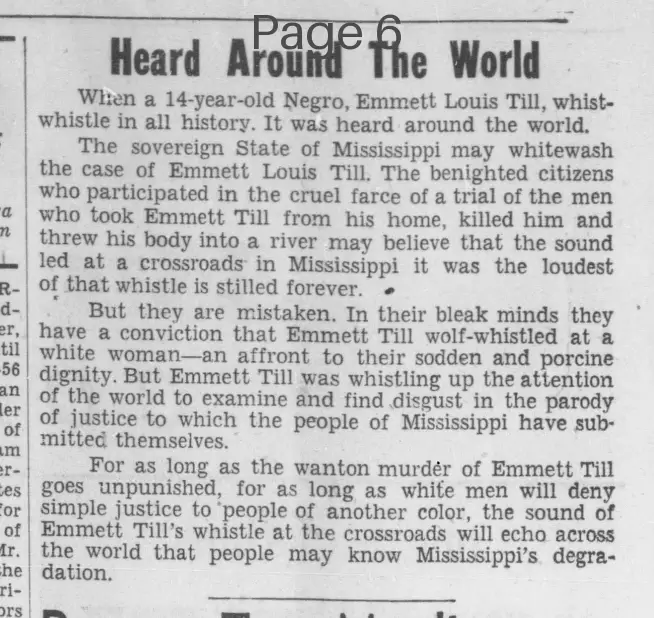
Heard Around The World
When a 14-year-old Negro, Emmett Louis Till, whistled at a crossroads in Mississippi it was the loudest whistle in all history. It was heard around the world.
The sovereign State of Mississippi may whitewash the case of Emmett Louis Till. The benighted citizens who participated in the cruel farce of a trial of the men who took Emmett Till from his home, killed him and threw his body into a river may believe that the sound of that whistle is stilled forever.
But they are mistaken. In their bleak minds they have a conviction that Emmett Till wolf-whistled at a white woman—an affront to their sodden and porcine dignity. But Emmett Till was whistling up the attention of the world to examine and find disgust in the parody of justice to which the people of Mississippi have submitted themselves.
For as long as the wanton murder of Emmett Till goes unpunished, for as long as white men will deny simple justice to people of another color, the sound of Emmett Till's whistle at the crossroads will echo across the world that people may know Mississippi's degradation.
What sub-type of article is it?
Slavery Abolition
Crime Or Punishment
What keywords are associated?
Emmett Till
Racial Injustice
Mississippi
Murder Trial
Civil Rights
Equal Justice
What entities or persons were involved?
Emmett Louis Till
Mississippi
Editorial Details
Primary Topic
Racial Injustice And The Murder Of Emmett Till
Stance / Tone
Moral Outrage; Condemnation Of Mississippi
Key Figures
Emmett Louis Till
Mississippi
Key Arguments
- Till's whistle was heard around the world
- Mississippi may whitewash the case but cannot still its echo
- the trial of his killers was a cruel farce
- unpunished murder exposes Mississippi's degradation before the world