Thank you for visiting SNEWPapers!
Sign up free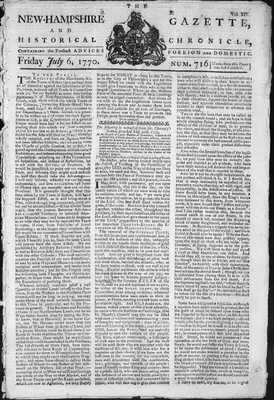
The New Hampshire Gazette And Historical Chronicle Editorial July 6, 1770
Portsmouth, Rockingham, New Hampshire
Possibly incomplete: this story may be missing part of its text, or continue from or into another issue.
What is this article about?
An editorial urging Rhode Island to respond prudently to the other colonies' trade embargo for refusing non-importation agreements, and to seek economic independence by cultivating western lands and opening roads to carry wheat to market.
Quality yellow The extractor was unsure its transcription reads as real language, even though the scan measures clean. show the numbers
Measured from the scan
— how cleanly the OCR engine read the characters
- Mean ink quality
- 98.0% The length-weighted average confidence across the OCR lines — the mean of exactly the per-line scores whose tails the two figures below report. Typical is 99%.
- Illegible ink
- 0.8% Text sitting in OCR-detected lines that scored below 80% confidence — very shaky reads. Weighted by line length, so one long bad line counts for more than a short one.
- Uncertain ink
- 0.0% Text in lines that scored 80–90% — somewhat shaky reads.
- Matches source
- 96.01% How closely the served text matches the raw OCR of the same boxes, letter by letter, after collapsing spacing and case. This measures agreement, not correctness: the OCR is often wrong and the extractor corrects it, so 100% does not mean perfect, and a low figure usually means poor scan text was rewritten rather than that text was lost (length vs source shows loss).
- Length vs source
- 99.22% Below 100% means text was dropped from the OCR; above means text was added to make it read.
Assembled by the extraction model
— whether the stitched-together text holds up; catches layout and segmentation errors, which the scores above cannot see
- Transcription confidence
- 90.0% (typical 96%) How cleanly the extractor could assemble what it was given. Low here with clean ink scores points at layout analysis — the characters were read correctly but grouped or ordered wrongly.
- Comprehension
- 92.0% Whether the piece reads coherently start to finish. Can stay high while transcription confidence drops, when only part of the component is affected.
Clipping
Full Text
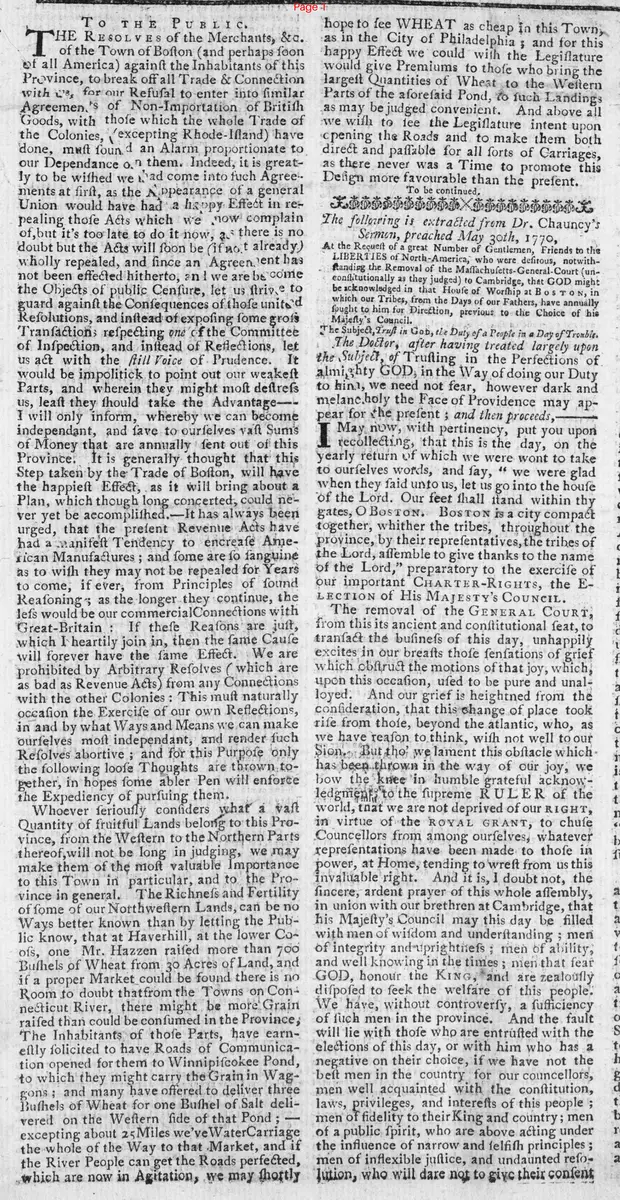
TO THE PUBLIC.
The resolve of the merchants &c. (of all America) against the inhabitants of this Province, to break off all trade & connection with us, for our refusal to enter into similar agreements of non-importation of British goods, with those which the whole trade of the Colonies, excepting Rhode-Island, have done, must sound an alarm proportionate to our dependence on them. Indeed, it is greatly to be wished we had come into such agreements at first, as the appearance of a general union would have had a happy effect in repealing those acts which we now complain of; but it's too late to do it now, as there is no doubt but the acts will soon be (if not already) wholly repealed, and since an agreement has not been effected hitherto, and we are become the objects of public censure, let us strive to guard against the consequences of those united resolutions, and instead of exposing some gross transactions respecting one of the committee of inspection, and instead of reflections, let us act with the still voice of prudence. It would be impolitic to point out our weakest parts, and wherein they might most distress us, lest they should take the advantage—I will only inform, whereby we can become independant, and save to ourselves vast sums of money that are annually sent out of this Province. It is generally thought that this step taken by the trade of Boston, will have the happiest effect, as it will bring about a plan, which though long concerted, could never yet be accomplished.—It has always been urged, that the present revenue acts have had a manifest tendency to encrease American manufactures; and some are so sanguine as to wish they may not be repealed for years to come, if ever, from principles of found reasoning; as the longer they continue, the less would be our commercial connections with Great-Britain: If these reasons are just, which I heartily join in, then the same cause will forever have the same effect. We are prohibited by arbitrary resolves (which are as bad as revenue acts) from any connections with the other Colonies: This must naturally occasion the exercise of our own reflections, in and by what ways and means we can make ourselves most independant, and render such resolves abortive; and for this purpose only the following loose thoughts are thrown together, in hopes some abler pen will enforce the expediency of pursuing them.
Whoever seriously considers what a vast quantity of fruitful lands belong to this Province, from the western to the northern parts thereof, will not be long in judging, we may make them of the most valuable importance to this town in particular, and to the Province in general. The richness and fertility of some of our northwestern lands, can be no ways better known than by letting the public know, that at Haverhill, at the lower Coos, one Mr. Hazzen raised more than 700 bushels of wheat from 30 acres of land, and if a proper market could be found there is no room to doubt that from the towns on Connecticut River, there might be more grain raised than could be consumed in the Province.
The inhabitants of those parts, have earnestly solicited to have roads of communication opened for them to Winnipiscogee Pond, to which they might carry the grain in wagons; and many have offered to deliver three bushels of wheat for one bushel of salt delivered on the western side of that Pond; — excepting about 25 miles we've water carriage the whole of the way to that market, and if the river people can get the roads perfected, which are now in agitation, we may shortly hope to see WHEAT as cheap in this town, as in the city of Philadelphia; and for this happy effect we could wish the Legislature would give premiums to those who bring the largest quantities of wheat to the western parts of the aforesaid Pond, to such landings as may be judged convenient. And above all we wish to see the Legislature intent upon opening the roads and to make them both direct and passable for all sorts of carriages, as there never was a time to promote this design more favourable than the present.
To be continued.
What sub-type of article is it?
Economic Policy
Trade Or Commerce
Infrastructure
What keywords are associated?
Non Importation Agreements
Colonial Trade Embargo
Economic Independence
Revenue Acts
Wheat Production
Internal Improvements
Road Building
Rhode Island
What entities or persons were involved?
Merchants Of The American Colonies
Committee Of Inspection
Mr. Hazzen
Boston Traders
The Province Legislature
Great Britain
Editorial Details
Primary Topic
Economic Independence For Rhode Island Through Internal Improvements And Agriculture Amid Colonial Non Importation Disputes
Stance / Tone
Pragmatic, Self Reliant, And Mildly Conciliatory; Urges Prudence Rather Than Recrimination
Key Figures
Merchants Of The American Colonies
Committee Of Inspection
Mr. Hazzen
Boston Traders
The Province Legislature
Great Britain
Key Arguments
- Joining the non-importation agreements earlier would have aided repeal of the revenue acts, but it is now too late
- The Province should act with prudence and not expose its weaknesses to other colonies
- Revenue acts, though oppressive, tend to increase American manufactures and reduce commercial ties with Great Britain
- Rhode Island can become independent by cultivating its fertile western and northern lands
- Opening roads to Winnipiscogee Pond would enable cheap transport of wheat (e.g., Mr. Hazzen's 700 bushels from 30 acres)
- The Legislature should grant premiums for wheat and perfect the roads