Thanks for visiting SNEWPapers!
Sign up free today to connect your AI tools to the Library of Congress' newspaper collection.
Fowle's New Hampshire Gazette And General Advertiser Letter to Editor December 2, 1785
Portsmouth, Rockingham, New Hampshire
What is this article about?
A reader's letter to the New-Hampshire Gazette arguing that the Legislature's Tender Act is a retrospective law repugnant to the state Constitution, injurious to creditors and private credit, signed 'A Friend of Government.'
Quality green show the numbers
Measured from the scan
— how cleanly the OCR engine read the characters
- Mean ink quality
- 99.0% The length-weighted average confidence across the OCR lines — the mean of exactly the per-line scores whose tails the two figures below report. Typical is 99%.
- Illegible ink
- 0.0% Text sitting in OCR-detected lines that scored below 80% confidence — very shaky reads. Weighted by line length, so one long bad line counts for more than a short one.
- Uncertain ink
- 0.4% Text in lines that scored 80–90% — somewhat shaky reads.
- Matches source
- 96.27% How closely the served text matches the raw OCR of the same boxes, letter by letter, after collapsing spacing and case. This measures agreement, not correctness: the OCR is often wrong and the extractor corrects it, so 100% does not mean perfect, and a low figure usually means poor scan text was rewritten rather than that text was lost (length vs source shows loss).
- Length vs source
- 99.63% Below 100% means text was dropped from the OCR; above means text was added to make it read.
Assembled by the extraction model
— whether the stitched-together text holds up; catches layout and segmentation errors, which the scores above cannot see
- Transcription confidence
- 95.0% (typical 96%) How cleanly the extractor could assemble what it was given. Low here with clean ink scores points at layout analysis — the characters were read correctly but grouped or ordered wrongly.
- Comprehension
- 95.0% Whether the piece reads coherently start to finish. Can stay high while transcription confidence drops, when only part of the component is affected.
Clipping
Full Text
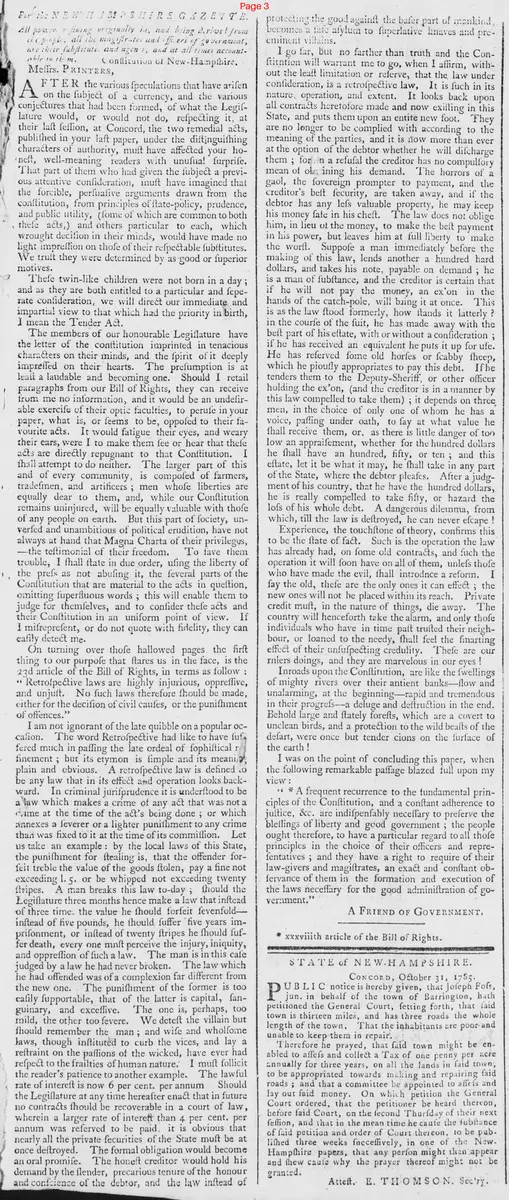
For the New-Hampshire Gazette.
All power residing originally in, and being derived from the people, all the magistrates and officers of government, are their substitutes and agents, and at all times accountable to them. Constitution of New-Hampshire.
Messrs. Printers,
AFTER the various speculations that have arisen on the subject of a currency, and the various conjectures that had been formed, of what the Legislature would, or would not do, respecting it, at their last session, at Concord, the two remedial acts, published in your last paper, under the distinguishing characters of authority, must have affected your honest, well-meaning readers with unusual surprise. That part of them who had given the subject a previous attentive consideration, must have imagined that the forcible, persuasive arguments drawn from the constitution, from principles of state-policy, prudence, and public utility, (some of which are common to both these acts,) and others particular to each, which wrought decision in their minds, would have made no light impression on those of their respectable substitutes. We trust they were determined by as good or superior motives.
These twin-like children were not born in a day; and as they are both entitled to a particular and separate consideration, we will direct our immediate and impartial view to that which had the priority in birth, I mean the Tender Act.
The members of our honourable Legislature have the letter of the constitution imprinted in tenacious characters on their minds, and the spirit of it deeply impressed on their hearts. The presumption is at least a laudable and becoming one. Should I retail paragraphs from our Bill of Rights, they can receive from me no information, and it would be an undesirable exercise of their optic faculties, to peruse in your paper, what is, or seems to be, opposed to their favourite acts. It would fatigue their eyes, and weary their ears, were I to make them see or hear that these acts are directly repugnant to that Constitution. I shall attempt to do neither. The larger part of this and of every community, is composed of farmers, tradesmen, and artificers; men whose liberties are equally dear to them, and, while our Constitution remains uninjured, will be equally valuable with those of any people on earth. But this part of society, unversed and unambitious of political erudition, have not always at hand that Magna Charta of their privileges, —the testimonial of their freedom. To save them trouble, I shall state in due order, using the liberty of the press as not abusing it, the several parts of the Constitution that are material to the acts in question, omitting superfluous words; this will enable them to judge for themselves, and to consider these acts and their Constitution in an uniform point of view. If I misrepresent, or do not quote with fidelity, they can easily detect me.
On turning over those hallowed pages, the first thing to our purpose that stares us in the face, is the 22d article of the Bill of Rights, in terms as follow: "Retrospective laws are highly injurious, oppressive, and unjust. No such laws therefore should be made, either for the decision of civil causes, or the punishment of offences."
I am not ignorant of the late quibble on a popular occasion. The word Retrospective had like to have suffered much in passing the late ordeal of sophistical refinement; but its etymon is simple and its meaning plain and obvious. A retrospective law is defined to be any law that in its effect and operation looks backward. In criminal jurisprudence it is understood to be a law which makes a crime of any act that was not a crime at the time of the act's being done; or which annexes a severer or a lighter punishment to any crime than was fixed to it at the time of its commission. Let us take an example: by the local laws of this State, the punishment for stealing is, that the offender forfeit treble the value of the goods stolen, pay a fine not exceeding l. 5. or be whipped not exceeding twenty stripes. A man breaks this law to-day; should the Legislature three months hence make a law that instead of three times the value he should forfeit sevenfold—instead of five pounds, he should suffer five years imprisonment, or instead of twenty stripes he should suffer death, every one must perceive the injury, iniquity, and oppression of such a law. The man is in this case judged by a law he had never broken. The law which he had offended was of a complexion far different from the new one. The punishment of the former is too easily supportable, that of the latter is capital, sanguinary, and excessive. The one is, perhaps, too mild, the other too severe. We detest the villain but should remember the man: and wise and wholesome laws, though instituted to curb the vices, and lay a restraint on the passions of the wicked, have ever had respect to the frailties of human nature. I must solicit the reader's patience to another example. The lawful rate of interest is now 6 per cent. per annum. Should the Legislature at any time hereafter enact that in future no contracts should be recoverable in a court of law, wherein a larger rate of interest than 4 per cent. per annum was reserved to be paid, it is obvious that nearly all the private securities of the State must be at once destroyed. The formal obligation would become an oral promise. The honest creditor would hold his demand by the slender, precarious tenure of the honour and conscience of the debtor, and the law instead of protecting the good against the baser part of mankind, becomes a safe asylum to superlative knaves and pre-eminent villains.
I go far, but no farther than truth and the Constitution will warrant me to go, when I affirm, without the least limitation or reserve, that the law under consideration, is a retrospective law. It is such in its nature, operation, and extent. It looks back upon all contracts heretofore made and now existing in this State, and puts them upon an entire new foot. They are no longer to be complied with according to the meaning of the parties, and it is now more than ever at the option of the debtor whether he will discharge them; for on a refusal the creditor has no compulsory means of obtaining his demand. The horrors of a gaol, the sovereign prompter to payment, and the creditor's best security, are taken away, and if the debtor has any less valuable property, he may keep his money safe in his chest. The law does not oblige him, in lieu of the money, to make the best payment in his power, but leaves him at full liberty to make the worst. Suppose a man immediately before the making of this law, lends another a hundred hard dollars, and takes his note, payable on demand; he is a man of substance, and the creditor is certain that if he will not pay the money, an execution in the hands of the catch-pole, will bring it at once. This is as the law stood formerly, how stands it latterly? in the course of the suit, he has made away with the best part of his estate, with or without a consideration; if he has received an equivalent he puts it up for use. He has reserved some old horses or scabby sheep, which he piously appropriates to pay this debt. If he tenders them to the Deputy-Sheriff, or other officer holding the execution, (and the creditor is in a manner by this law compelled to take them); it depends on three men, in the choice of only one of whom he has a voice, passing under oath, to say at what value he shall receive them, or, as there is little danger of too low an appraisement, whether for the hundred dollars he shall have an hundred, fifty, or ten; and this estate, let it be what it may, he shall take in any part of the State, where the debtor pleases. After a judgment of his country, that he have the hundred dollars, he is really compelled to take fifty, or hazard the loss of his whole debt. A dangerous dilemma, from which, till the law is destroyed, he can never escape!
Experience, the touchstone of theory, confirms this to be the state of fact. Such is the operation the law has already had, on some old contracts, and such the operation it will soon have on all of them, unless those who have made the evil, shall introduce a reform. I say the old, these are the only ones it can effect; the new ones will not be placed within its reach. Private credit must, in the nature of things, die away. The country will henceforth take the alarm, and only those individuals who have in time past trusted their neighbour, or loaned to the needy, shall feel the smarting effect of their unsuspecting credulity. These are our rulers' doings, and they are marvelous in our eyes!
Inroads upon the Constitution, are like the swellings of mighty rivers over their ancient banks—flow and unalarming, at the beginning—rapid and tremendous in their progress—a deluge and destruction in the end. Behold large and stately forests, which are a covert to unclean birds, and a protection to the wild beasts of the desert, were once but tender scions on the surface of the earth!
I was on the point of concluding this paper, when the following remarkable passage blazed full upon my view:
" *A frequent recurrence to the fundamental principles of the Constitution, and a constant adherence to justice, &c. are indispensably necessary to preserve the blessings of liberty and good government; the people ought therefore, to have a particular regard to all those principles in the choice of their officers and representatives; and they have a right to require of their law-givers and magistrates, an exact and constant observance of them in the formation and execution of the laws necessary for the good administration of government."
A FRIEND OF GOVERNMENT.
* xxxviiith article of the Bill of Rights.
What sub-type of article is it?
Persuasive
Political
Historical
What themes does it touch?
Constitutional Rights
Economic Policy
Politics
What keywords are associated?
Tender Act
Retrospective Law
New Hampshire Constitution
Bill Of Rights
Creditors
Debtors
Private Credit
Currency
What entities or persons were involved?
Messrs. Printers
A Friend Of Government
Letter to Editor Details
Author
A Friend Of Government
Recipient
Messrs. Printers
Main Argument
Argues that the Tender Act passed by the New Hampshire Legislature is a retrospective law that violates the state Constitution, injures creditors, and destroys private credit.
Notable Details
- Quotes Article 22 of the New Hampshire Bill of Rights against retrospective laws
- Defines a retrospective law and gives examples (theft punishment, interest-rate cap)
- Describes how the Tender Act lets debtors tender worthless property and forces creditors to accept low appraisals
- Quotes the 38th article of the Bill of Rights on recurring to fundamental principles
- Signed pseudonymously as 'A Friend of Government'