Thank you for visiting SNEWPapers!
Sign up free
Fowle's New Hampshire Gazette And General Advertiser Letter to Editor July 1, 1785
Portsmouth, Rockingham, New Hampshire
What is this article about?
A reader, 'A Friend to the Rights of Mankind,' responds to 'Mr. Observer,' arguing against making paper money a lawful tender, defending the adequate payment of state securities, and rejecting charges that the writer is an engrosser or speculator.
Quality green show the numbers
Measured from the scan
— how cleanly the OCR engine read the characters
- Mean ink quality
- 99.0% The length-weighted average confidence across the OCR lines — the mean of exactly the per-line scores whose tails the two figures below report. Typical is 99%.
- Illegible ink
- 0.2% Text sitting in OCR-detected lines that scored below 80% confidence — very shaky reads. Weighted by line length, so one long bad line counts for more than a short one.
- Uncertain ink
- 0.0% Text in lines that scored 80–90% — somewhat shaky reads.
- Matches source
- 95.75% How closely the served text matches the raw OCR of the same boxes, letter by letter, after collapsing spacing and case. This measures agreement, not correctness: the OCR is often wrong and the extractor corrects it, so 100% does not mean perfect, and a low figure usually means poor scan text was rewritten rather than that text was lost (length vs source shows loss).
- Length vs source
- 98.97% Below 100% means text was dropped from the OCR; above means text was added to make it read.
Assembled by the extraction model
— whether the stitched-together text holds up; catches layout and segmentation errors, which the scores above cannot see
- Transcription confidence
- 92.0% (typical 96%) How cleanly the extractor could assemble what it was given. Low here with clean ink scores points at layout analysis — the characters were read correctly but grouped or ordered wrongly.
- Comprehension
- 92.0% Whether the piece reads coherently start to finish. Can stay high while transcription confidence drops, when only part of the component is affected.
Clipping
Full Text
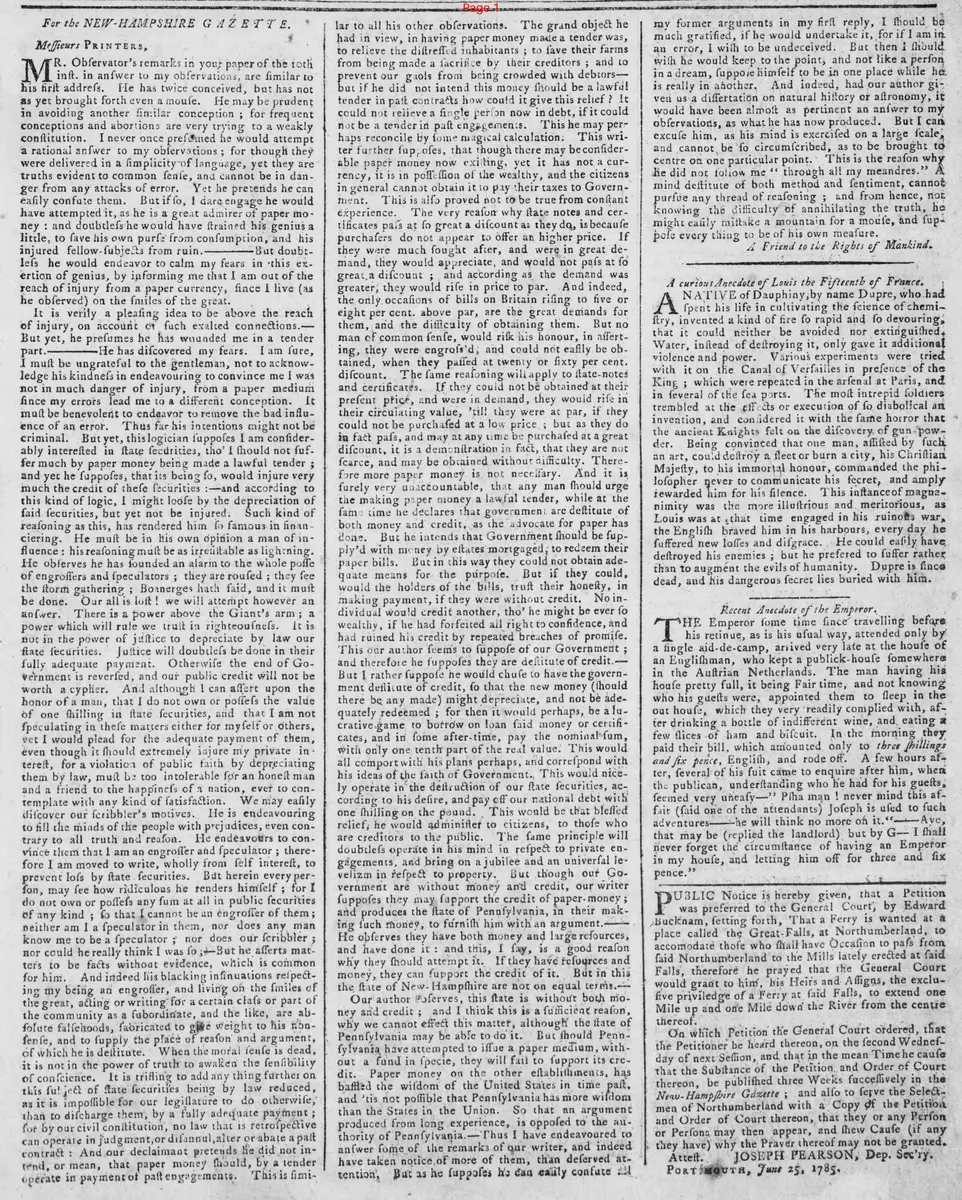
For the NEW-HAMPSHIRE GAZETTE.
Messieurs PRINTERS,
Mr. Observer's remarks are his first address. He has twice conceived, but has not as yet brought forth even a mouse. He may be prudent in avoiding another similar conception; for frequent conceptions and abortions are very trying to a weakly constitution. I never once presumed he would attempt a rational answer to my observations; for though they were delivered in a simplicity of language, yet they are truths evident to common sense, and cannot be in danger from any attacks of error. Yet he pretends he can easily confute them. But if so, I dare engage he would have attempted it, as he is a great admirer of paper money: and doubtless he would have strained his genius a little, to save his own purse from consumption, and his injured fellow-subjects from ruin.— But doubtless he would endeavor to calm my fears in this exertion of genius, by informing me that I am out of the reach of injury from a paper currency, since I live (as he observed) on the smiles of the great.
It is verily a pleasing idea to be above the reach of injury, on account of such exalted connections.— But yet, he presumes he has wounded me in a tender part.— He has discovered my fears. I am sure, I must be ungrateful to the gentleman, not to acknowledge his kindness in endeavouring to convince me I was not in much danger of injury, from a paper medium since my errors lead me to a different conception. It must be benevolent to endeavor to remove the bad influence of an error. Thus far his intentions might not be criminal. But yet, this logician supposes I am considerably interested in state securities, tho' I should not suffer much by paper money being made a lawful tender; and yet he supposes, that its being so, would injure very much the credit of these securities:—and according to this kind of logic, I might lose by the depreciation of said securities, but yet not be injured: Such kind of reasoning as this, has rendered him so famous in financiering. He must be in his own opinion a man of influence: his reasoning must be as irresistible as lightning.
He observes he has founded an alarm to the whole posse of engrossers and speculators; they are roused; they see the storm gathering; Boanerges hath said, and it must be done. Our all is lost! we will attempt however an answer. There is a power above the Giant's arm; a power which will rule, we trust, in righteousness. It is not in the power of justice to depreciate by law our state securities. Justice will doubtless be done in their fully adequate payment. Otherwise the end of Government is reversed, and our public credit will not be worth a cipher. And although I can assert upon the honor of a man, that I do not own or possess the value of one shilling in state securities, and that I am not speculating in these matters either for myself or others, yet I would plead for the adequate payment of them, even though it should extremely injure my private interest, for a violation of public faith by depreciating them by law, must be too intolerable for an honest man and a friend to the happiness of a nation, ever to contemplate with any kind of satisfaction.
We may easily discover our scribbler's motives. He is endeavouring to fill the minds of the people with prejudices, even contrary to all truth and reason. He endeavours to convince them that I am an engrosser and speculator; therefore I am moved to write, wholly from self interest, to prevent loss by state securities. But herein every person, may see how ridiculous he renders himself; for I do not own or possess any sum at all in public securities of any kind; so that I cannot be an engrosser of them; neither am I a speculator in them, nor does any man know me to be a speculator; nor does our scribbler; nor could he really think I was so;—But he asserts matters to be facts without evidence, which is common for him. And indeed his blackening insinuations respecting my being an engrosser, and living on the smiles of the great, acting or writing for a certain class or part of the community as a subordinate, and the like, are absolute falsehoods, fabricated to give weight to his nonsense, and to supply the place of reason and argument, of which he is destitute.
When the moral sense is dead, it is not in the power of truth to awaken the sensibility of conscience. It is trifling to add any thing further on this subject of state securities being by law reduced, as it is impossible for our legislature to do otherwise, than to discharge them, by a fully adequate payment; for by our civil constitution, no law that is retrospective can operate in judgment, or disannul, alter or abate a past contract: And our declaimant pretends he did not intend, or mean, that paper money should, by a tender operate in payment of past engagements. This is similar to all his other observations. The grand object he had in view, in having paper money made a tender was, to relieve the distressed inhabitants; to save their farms from being made a sacrifice by their creditors; and to prevent our gaols from being crowded with debtors—but if he did not intend this money should be a lawful tender in past contracts how could it give this relief? It could not relieve a single person now in debt, if it could not be a tender in past engagements. This he may perhaps reconcile by some magical calculation: This writer further supposes, that though there may be considerable paper money now existing, yet it has not a currency, it is in possession of the wealthy, and the citizens in general cannot obtain it to pay their taxes to Government. This is also proved not to be true from constant experience. The very reason why state notes and certificates pass at so great a discount as they do, is because purchasers do not appear to offer an higher price. If they were much sought after, and were in great demand, they would appreciate, and would not pass at so great a discount; and according as the demand was greater, they would rise in price to par. And indeed, the only occasions of bills on Britain rising to five or eight per cent. above par, are the great demands for them, and the difficulty of obtaining them. But no man of common sense, would risk his honour, in asserting, they were engross'd; and could not easily be obtained, when they passed at twenty or sixty per cent. discount. The same reasoning will apply to state-notes and certificates. If they could not be obtained at their present price, and were in demand, they would rise in their circulating value, 'till they were at par, if they could not be purchased at a low price; but as they do in fact pass, and may at any time be purchased at a great discount, it is a demonstration in fact, that they are not scarce, and may be obtained without difficulty. Therefore more paper money is not necessary. And it is surely very unaccountable, that any man should urge the making paper money a lawful tender, while at the same time he declares that government are destitute of both money and credit, as the advocate for paper has done. But he intends that Government should be supply'd with money by estates mortgaged, to redeem their paper bills. But in this way they could not obtain adequate means for the purpose. But if they could, would the holders of the bills, trust their honesty, in making payment, if they were without credit. No individual would credit another, tho' he might be ever so wealthy, if he had forfeited all right to confidence, and had ruined his credit by repeated breaches of promise. This our author seems to suppose of our Government; and therefore he supposes they are destitute of credit. But I rather suppose he would chuse to have the government destitute of credit, so that the new money (should there be any made) might depreciate, and not be adequately redeemed; for then it would perhaps, be a lucrative game to borrow on loan said money or certificates, and in some after-time, pay the nominal sum, with only one tenth part of the real value. This would all comport with his plans perhaps, and correspond with his ideas of the faith of Government. This would nicely operate in the destruction of our state securities, according to his desire, and pay off our national debt with one shilling on the pound. This would be that blessed relief, he would administer to citizens, to those who are creditors to the public. The same principle will doubtless operate in his mind in respect to private engagements, and bring on a jubilee and an universal levellism in respect to property. But though our Government are without money and credit, our writer supposes they may support the credit of paper-money; and produces the state of Pennsylvania, in their making such money, to furnish him with an argument. He observes they have both money and large resources, and have done it: and this, I say, is a good reason why they should attempt it. If they have resources and money, they can support the credit of it. But in this the state of New-Hampshire are not on equal terms.
Our author observes, this state is without both money and credit; and I think this is a sufficient reason, why we cannot effect this matter, although the state of Pennsylvania may be able to do it. But should Pennsylvania have attempted to issue a paper medium, without a fund in specie, they will fail to support its credit. Paper money on the other establishments, has baffled the wisdom of the United States in time past, and 'tis not possible that Pennsylvania has more wisdom than the States in the Union. So that an argument produced from long experience, is opposed to the authority of Pennsylvania.—Thus I have endeavoured to answer some of the remarks of our writer, and indeed have taken notice of more of them, than deserved attention. But as he supposes he can easily confute all my former arguments in my first reply, I should be much gratified, if he would undertake it, for if I am in an error, I wish to be undeceived. But then I should wish he would keep to the point, and not like a person in a dream, suppose himself to be in one place while he is really in another. And indeed, had our author given us a dissertation on natural history or astronomy, it would have been almost as pertinent an answer to my observations, as what he has now produced. But I can excuse him, as his mind is exercised on a large scale, and cannot be so circumscribed, as to be brought to centre on one particular point. This is the reason why he did not follow me "through all my meanders." A mind destitute of both method and sentiment, cannot pursue any thread of reasoning; and from hence, not knowing the difficulty of annihilating the truth, he might easily mistake a mountain for a mouse, and suppose every thing to be of his own measure.
A Friend to the Rights of Mankind.
What sub-type of article is it?
Persuasive
Political
What themes does it touch?
Economic Policy
Constitutional Rights
What keywords are associated?
Paper Money
Legal Tender
State Securities
Public Credit
New Hampshire
Contract Rights
What entities or persons were involved?
Messieurs Printers
A Friend To The Rights Of Mankind
Letter to Editor Details
Author
A Friend To The Rights Of Mankind
Recipient
Messieurs Printers
Main Argument
Opposes making paper money a lawful tender, insisting that past contracts must be discharged by fully adequate payment and that state securities must not be depreciated by law; refutes Mr. Observer's personal insinuations.
Notable Details
- Refers to the adversary as 'Mr. Observer' and 'Boanerges'
- Denies owning any state securities or speculating
- Cites the example of Pennsylvania to argue that New Hampshire lacks the resources to support paper money
- Argues retrospective laws cannot disannul past contracts under the civil constitution
- Accuses the paper-money advocate of aiming at a 'jubilee and universal levellism' in property