Thank you for visiting SNEWPapers!
Sign up free
The Massachusetts Spy, Or, Thomas's Boston Journal Foreign News March 11, 1773
Boston, Suffolk, Massachusetts
What is this article about?
A letter from St. Vincent's (Jan. 14) reports British operations against the Caribs: a regiment from Antigua disembarked, army about 2000 men, Caribs using bush fighting, several officers killed; latest advices (Jan. 28) say Col. Walsh and six men were killed, and Caribs sent a messenger to Col. Dalrymple asking terms.
Quality green show the numbers
Measured from the scan
— how cleanly the OCR engine read the characters
- Mean ink quality
- 98.0% The length-weighted average confidence across the OCR lines — the mean of exactly the per-line scores whose tails the two figures below report. Typical is 99%.
- Illegible ink
- 0.0% Text sitting in OCR-detected lines that scored below 80% confidence — very shaky reads. Weighted by line length, so one long bad line counts for more than a short one.
- Uncertain ink
- 0.0% Text in lines that scored 80–90% — somewhat shaky reads.
- Matches source
- 95.34% How closely the served text matches the raw OCR of the same boxes, letter by letter, after collapsing spacing and case. This measures agreement, not correctness: the OCR is often wrong and the extractor corrects it, so 100% does not mean perfect, and a low figure usually means poor scan text was rewritten rather than that text was lost (length vs source shows loss).
- Length vs source
- 99.16% Below 100% means text was dropped from the OCR; above means text was added to make it read.
Assembled by the extraction model
— whether the stitched-together text holds up; catches layout and segmentation errors, which the scores above cannot see
- Transcription confidence
- 95.0% (typical 96%) How cleanly the extractor could assemble what it was given. Low here with clean ink scores points at layout analysis — the characters were read correctly but grouped or ordered wrongly.
- Comprehension
- 92.0% Whether the piece reads coherently start to finish. Can stay high while transcription confidence drops, when only part of the component is affected.
Clipping
Full Text
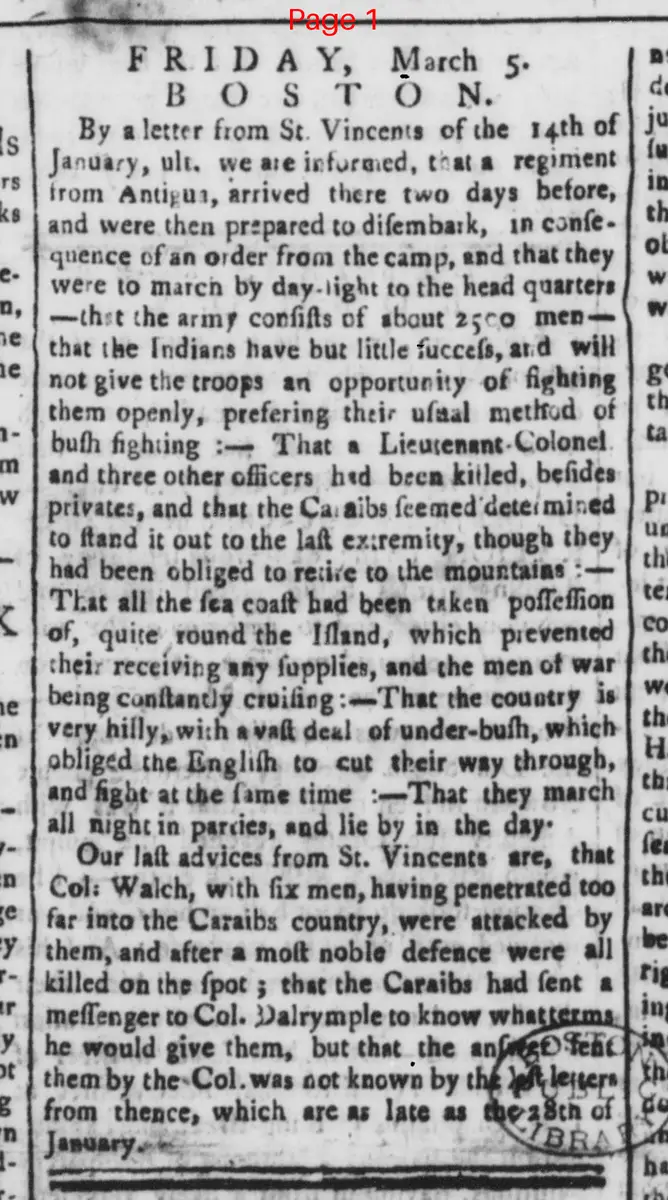
FRIDAY, March 5.
BOSTON.
By a letter from St. Vincents of the 14th of January, ult. we are informed, that a regiment from Antigua, arrived there two days before, and were then prepared to disembark, in consequence of an order from the camp, and that they were to march by day-light to the head quarters—that the army consists of about 2000 men—that the Indians have but little success, and will not give the troops an opportunity of fighting them openly, preferring their usual method of bush fighting:— That a Lieutenant-Colonel and three other officers had been killed, besides privates, and that the Caribs seemed determined to stand it out to the last extremity, though they had been obliged to retire to the mountains:— That all the sea coast had been taken possession of, quite round the Island, which prevented their receiving any supplies, and the men of war being constantly cruising:—That the country is very hilly, with a vast deal of under-bush, which obliged the English to cut their way through, and fight at the same time:—That they march all night in parties, and lie by in the day.
Our last advices from St. Vincents are, that Col. Walsh, with six men, having penetrated too far into the Caribs country, were attacked by them, and after a most noble defence were all killed on the spot; that the Caribs had sent a messenger to Col. Dalrymple to know what terms he would give them, but that the answer sent them by the Col. was not known by the last letters from thence, which are as late as the 28th of January.
What sub-type of article is it?
Military Campaign
Colonial Affairs
War Report
What keywords are associated?
Carib War
St Vincent Campaign
British Troops
Bush Fighting
What entities or persons were involved?
Col. Walsh
Col. Dalrymple
Where did it happen?
St. Vincent's
Foreign News Details
Primary Location
St. Vincent's
Event Date
14th And 28th Of January (Ult.)
Key Persons
Col. Walsh
Col. Dalrymple
Outcome
a lieutenant-colonel and three other officers killed besides privates; col. walsh and six men killed; caribs retired to mountains; sea coast taken by british; caribs sent messenger asking terms.