Thank you for visiting SNEWPapers!
Sign up free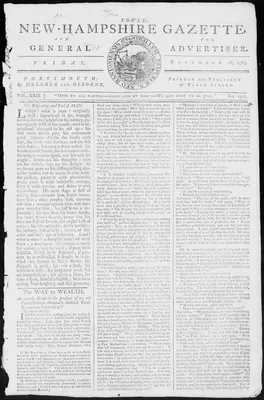
Fowle's New Hampshire Gazette And General Advertiser Literary November 18, 1785
Portsmouth, Rockingham, New Hampshire
What is this article about?
A rhetorical meditation on the human condition, tracing man from helpless infancy through wild youth and mad manhood to decrepit old age, cataloguing his miseries, frailties, and vanities.
Quality green show the numbers
Measured from the scan
— how cleanly the OCR engine read the characters
- Mean ink quality
- 98.0% The length-weighted average confidence across the OCR lines — the mean of exactly the per-line scores whose tails the two figures below report. Typical is 99%.
- Illegible ink
- 1.9% Text sitting in OCR-detected lines that scored below 80% confidence — very shaky reads. Weighted by line length, so one long bad line counts for more than a short one.
- Uncertain ink
- 0.0% Text in lines that scored 80–90% — somewhat shaky reads.
- Matches source
- 95.91% How closely the served text matches the raw OCR of the same boxes, letter by letter, after collapsing spacing and case. This measures agreement, not correctness: the OCR is often wrong and the extractor corrects it, so 100% does not mean perfect, and a low figure usually means poor scan text was rewritten rather than that text was lost (length vs source shows loss).
- Length vs source
- 97.55% Below 100% means text was dropped from the OCR; above means text was added to make it read.
Assembled by the extraction model
— whether the stitched-together text holds up; catches layout and segmentation errors, which the scores above cannot see
- Transcription confidence
- 95.0% (typical 96%) How cleanly the extractor could assemble what it was given. Low here with clean ink scores points at layout analysis — the characters were read correctly but grouped or ordered wrongly.
- Comprehension
- 95.0% Whether the piece reads coherently start to finish. Can stay high while transcription confidence drops, when only part of the component is affected.
Clipping
Full Text
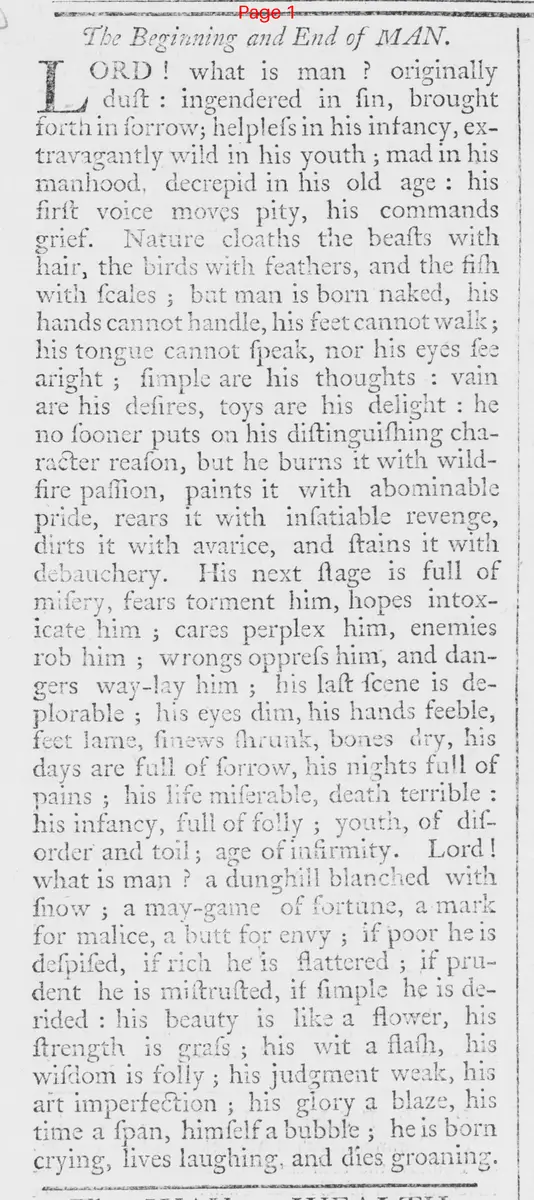
The Beginning and End of MAN.
LORD what is man originally? Forth in sorrow; helpless in his infancy, extravagantly wild in his youth; mad in his manhood, decrepid in his old age: his first voice moves pity, his commands grief. Nature clothes the beasts with hair, the birds with feathers, and the fish with scales; but man is born naked, his hands cannot handle, his feet cannot walk; his tongue cannot speak, nor his eyes see aright; simple are his thoughts: vain are his desires, toys are his delight: he no sooner puts on his distinguishing character reason, but he burns it with wildfire passion, paints it with abominable pride, rears it with insatiable revenge, dirts it with avarice, and stains it with debauchery. His next stage is full of misery, fears torment him, hopes intoxicate him; cares perplex him, enemies rob him; wrongs oppress him, and dangers waylay him; his last scene is deplorable; his eyes dim, his hands feeble, feet lame, sinews shrunk, bones dry, his days are full of sorrow, his nights full of pains; his life miserable, death terrible: his infancy, full of folly; youth, of disorder and toil; age of infirmity. Lord! what is man? a dunghill blanched with snow; a may-game of fortune, a mark for malice, a butt for envy; if poor he is despised, if rich he is flattered; if prudent he is mistrusted, if simple he is derided: his beauty is like a flower, his strength is grass; his wit a flash, his wisdom is folly; his judgment weak, his art imperfection; his glory a blaze, his time a span, himself a bubble; he is born crying, lives laughing, and dies groaning.
What sub-type of article is it?
Essay
What themes does it touch?
Death Mortality
Moral Virtue
What keywords are associated?
Human Condition
Mortality
Vanity
Meditation
Frailty
Literary Details
Title
The Beginning And End Of Man.
Subject
A Meditation On The Frailty And Misery Of Human Life From Birth To Death
Form / Style
Rhetorical Prose Meditation With Anaphora And Apostrophe
Key Lines
Lord! What Is Man? A Dunghill Blanched With Snow; A May Game Of Fortune, A Mark For Malice, A Butt For Envy
He Is Born Crying, Lives Laughing, And Dies Groaning