Thank you for visiting SNEWPapers!
Sign up free
The Wilmingtonian, And Delaware Advertiser Poem July 6, 1826
Wilmington, New Castle, Delaware
What is this article about?
A poem on the frailty of beauty, contrasting fading charms with the enduring blessings of virtue and religion.
Quality green show the numbers
Measured from the scan
— how cleanly the OCR engine read the characters
- Mean ink quality
- 99.0% The length-weighted average confidence across the OCR lines — the mean of exactly the per-line scores whose tails the two figures below report. Typical is 99%.
- Illegible ink
- 0.0% Text sitting in OCR-detected lines that scored below 80% confidence — very shaky reads. Weighted by line length, so one long bad line counts for more than a short one.
- Uncertain ink
- 0.0% Text in lines that scored 80–90% — somewhat shaky reads.
- Matches source
- 98.61% How closely the served text matches the raw OCR of the same boxes, letter by letter, after collapsing spacing and case. This measures agreement, not correctness: the OCR is often wrong and the extractor corrects it, so 100% does not mean perfect, and a low figure usually means poor scan text was rewritten rather than that text was lost (length vs source shows loss).
- Length vs source
- 100.75% Below 100% means text was dropped from the OCR; above means text was added to make it read.
Assembled by the extraction model
— whether the stitched-together text holds up; catches layout and segmentation errors, which the scores above cannot see
- Transcription confidence
- 96.0% (typical 96%) How cleanly the extractor could assemble what it was given. Low here with clean ink scores points at layout analysis — the characters were read correctly but grouped or ordered wrongly.
- Comprehension
- 90.0% Whether the piece reads coherently start to finish. Can stay high while transcription confidence drops, when only part of the component is affected.
Clipping
Full Text
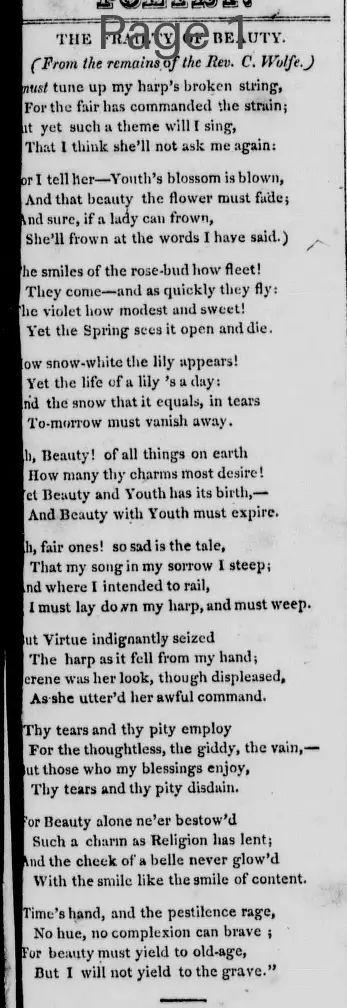
THE FRAILTY OF BEAUTY.
(From the remains of the Rev. C. Wolfe.)
I must tune up my harp's broken string,
For the fair has commanded the strain;
If yet such a theme will I sing,
That I think she'll not ask me again:
For I tell her—Youth's blossom is blown,
And that beauty the flower must fade;
And sure, if a lady can frown,
She'll frown at the words I have said.)
The smiles of the rose-bud how fleet!
They come—and as quickly they fly:
The violet how modest and sweet!
Yet the Spring sees it open and die.
How snow-white the lily appears!
Yet the life of a lily 's a day:
And the snow that it equals, in tears
To-morrow must vanish away.
O, Beauty! of all things on earth
How many thy charms most desire!
Yet Beauty and Youth has its birth,—
And Beauty with Youth must expire.
Oh, fair ones! so sad is the tale,
That my song in my sorrow I steep;
And where I intended to rail,
I must lay down my harp, and must weep.
But Virtue indignantly seized
The harp as it fell from my hand;
Serene was her look, though displeased,
As she uttered her awful command.
Thy tears and thy pity employ
For the thoughtless, the giddy, the vain,—
But those who my blessings enjoy,
Thy tears and thy pity disdain.
For Beauty alone ne'er bestowed
Such a charm as Religion has lent;
And the cheek of a belle never glowed
With the smile like the smile of content.
Time's hand, and the pestilence rage,
No hue, no complexion can brave;
For beauty must yield to old-age,
But I will not yield to the grave.
What sub-type of article is it?
Lyric
Didactic
What themes does it touch?
Moral Virtue
Death Mourning
What keywords are associated?
Frailty Of Beauty
Virtue
Transience
What entities or persons were involved?
Rev. C. Wolfe
Poem Details
Title
The Frailty Of Beauty
Author
Rev. C. Wolfe
Subject
On The Frailty Of Beauty And The Permanence Of Virtue
Form / Style
Rhymed Quatrains
Key Lines
I Must Tune Up My Harp's Broken String,
For The Fair Has Commanded The Strain;