Thank you for visiting SNEWPapers!
Sign up free
The Virginia Gazette Letter to Editor June 14, 1770
Williamsburg, Virginia
What is this article about?
A letter to the tutor of the Prince of Wales, advising him on the moral and ethical education of the prince, emphasizing equality, virtue, clemency, and the duty of a sovereign to serve the public.
Quality green show the numbers
Measured from the scan
— how cleanly the OCR engine read the characters
- Mean ink quality
- 98.0% The length-weighted average confidence across the OCR lines — the mean of exactly the per-line scores whose tails the two figures below report. Typical is 99%.
- Illegible ink
- 0.0% Text sitting in OCR-detected lines that scored below 80% confidence — very shaky reads. Weighted by line length, so one long bad line counts for more than a short one.
- Uncertain ink
- 1.1% Text in lines that scored 80–90% — somewhat shaky reads.
- Matches source
- 95.02% How closely the served text matches the raw OCR of the same boxes, letter by letter, after collapsing spacing and case. This measures agreement, not correctness: the OCR is often wrong and the extractor corrects it, so 100% does not mean perfect, and a low figure usually means poor scan text was rewritten rather than that text was lost (length vs source shows loss).
- Length vs source
- 99.95% Below 100% means text was dropped from the OCR; above means text was added to make it read.
Assembled by the extraction model
— whether the stitched-together text holds up; catches layout and segmentation errors, which the scores above cannot see
- Transcription confidence
- 98.0% (typical 96%) How cleanly the extractor could assemble what it was given. Low here with clean ink scores points at layout analysis — the characters were read correctly but grouped or ordered wrongly.
- Comprehension
- 95.0% Whether the piece reads coherently start to finish. Can stay high while transcription confidence drops, when only part of the component is affected.
Clipping
Full Text
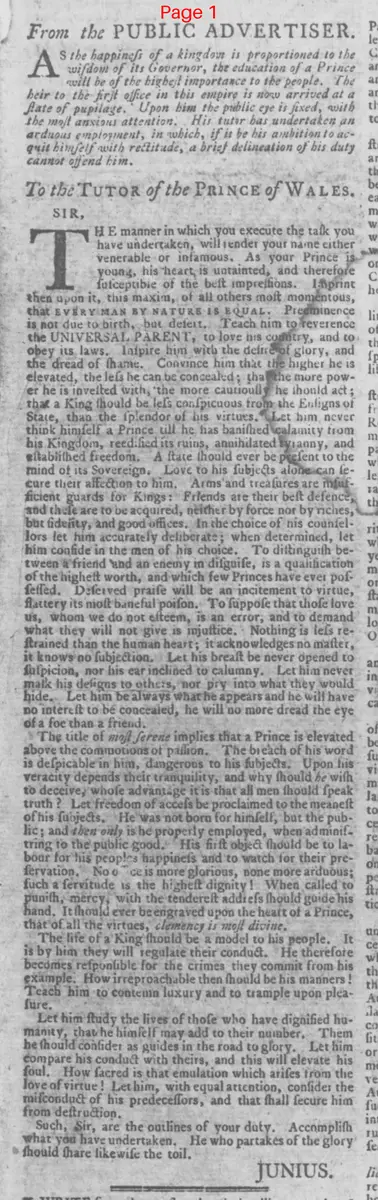
From the PUBLIC ADVERTISER.
To the TUTOR of the PRINCE of WALES.
SIR,
As the happiness of a kingdom is proportioned to the wisdom of its Governor, the education of a Prince will be of the highest importance to the people. The heir to the first office in this empire is now arrived at a state of pupilage. Upon him the public eye is fixed, with the most anxious attention: His tutor has undertaken an arduous employment, in which, if it be his ambition to acquit himself with rectitude, a brief delineation of his duty cannot offend him.
The manner in which you execute the task you have undertaken, will render your name either venerable or infamous. As your Prince is young, his heart is untainted, and therefore susceptible of the best impressions. Imprint then upon it, this maxim, of all others most momentous, that EVERY MAN BY NATURE IS EQUAL. Preeminence is not due to birth, but desert. Teach him to reverence the UNIVERSAL PARENT, to love his country, and to obey its laws. Inspire him with the desire of glory, and the dread of shame. Convince him that the higher he is elevated, the less he can be concealed; that the more power he is invested with, the more cautiously he should act; that a King should be less conspicuous from the Ensigns of State, than the splendor of his virtues. Let him never think himself a Prince till he has banished calamity from his Kingdom, re-edified its ruins, annihilated tyranny, and established freedom. A state should ever be present to the mind of its Sovereign. Love to his subjects alone can secure their affection to him. Arms and treasures are insufficient guards for Kings: Friends are their best defence, and these are to be acquired, neither by force nor by riches, but fidelity, and good offices. In the choice of his counsellors let him accurately deliberate; when determined, let him confide in the men of his choice. To distinguish between a friend and an enemy in disguise, is a qualification of the highest worth, and which few Princes have ever possessed. Deserved praise will be an incitement to virtue, flattery its most baneful poison. To suppose that those love us, whom we do not esteem, is an error, and to demand what they will not give is injustice. Nothing is less restrained than the human heart; it acknowledges no master, it knows no subjection. Let his breast be never opened to suspicion, nor his ear inclined to calumny. Let him never mask his designs to others, nor pry into what they would hide. Let him be always what he appears and he will have no interest to be concealed, he will no more dread the eye of a foe than a friend.
The title of most serene implies that a Prince is elevated above the commotions of passion. The breach of his word is despicable in him, dangerous to his subjects. Upon his veracity depends their tranquility, and why should he wish to deceive, whose advantage it is that all men should speak truth? Let freedom of access be proclaimed to the meanest of his subjects. He was not born for himself, but the public; and then only is he properly employed, when administering to the public good. His first object should be to labour for his people's happiness and to watch for their preservation. No office is more glorious, none more arduous; such a servitude is the highest dignity! When called to punish, mercy, with the tenderest address should guide his hand. It should ever be engraved upon the heart of a Prince, that of all the virtues, clemency is most divine.
The life of a King should be a model to his people. It is by him they will regulate their conduct. He therefore becomes responsible for the crimes they commit from his example. How irreproachable then should be his manners! Teach him to contemn luxury and to trample upon pleasure.
Let him study the lives of those who have dignified humanity, that he himself may add to their number. Them he should consider as guides in the road to glory. Let him compare his conduct with theirs, and this will elevate his soul. How sacred is that emulation which arises from the love of virtue! Let him, with equal attention, consider the misconduct of his predecessors, and that shall secure him from destruction.
Such, Sir, are the outlines of your duty. Accomplish what you have undertaken. He who partakes of the glory should share likewise the toil.
JUNIUS.
What sub-type of article is it?
Ethical Moral
Persuasive
Reflective
What themes does it touch?
Morality
Education
What keywords are associated?
Prince Education
Royal Virtues
Equality
Clemency
Kingly Duty
What entities or persons were involved?
The Tutor Of The Prince Of Wales
Junius
Letter to Editor Details
Author
Junius
Recipient
The Tutor Of The Prince Of Wales
Main Argument
The tutor must instill in the prince the principles of equality, virtue, clemency, and service to the people, so that he becomes a just and wise king.
Notable Details
- EVERY MAN BY NATURE IS EQUAL
- clemency is most divine
- The life of a King should be a model to his people