Thank you for visiting SNEWPapers!
Sign up free
The Virginia Gazette Foreign News October 27, 1752
Richmond, Richmond, Virginia
What is this article about?
A letter from Paris reports that experiments by Dalibard and de Lor confirmed Franklin's theory that pointed iron bars can draw electricity from thunder-clouds and preserve buildings and ships from lightning.
Quality green show the numbers
Measured from the scan
— how cleanly the OCR engine read the characters
- Mean ink quality
- 98.0% The length-weighted average confidence across the OCR lines — the mean of exactly the per-line scores whose tails the two figures below report. Typical is 99%.
- Illegible ink
- 0.0% Text sitting in OCR-detected lines that scored below 80% confidence — very shaky reads. Weighted by line length, so one long bad line counts for more than a short one.
- Uncertain ink
- 0.0% Text in lines that scored 80–90% — somewhat shaky reads.
- Matches source
- 96.17% How closely the served text matches the raw OCR of the same boxes, letter by letter, after collapsing spacing and case. This measures agreement, not correctness: the OCR is often wrong and the extractor corrects it, so 100% does not mean perfect, and a low figure usually means poor scan text was rewritten rather than that text was lost (length vs source shows loss).
- Length vs source
- 99.44% Below 100% means text was dropped from the OCR; above means text was added to make it read.
Assembled by the extraction model
— whether the stitched-together text holds up; catches layout and segmentation errors, which the scores above cannot see
- Transcription confidence
- 97.0% (typical 96%) How cleanly the extractor could assemble what it was given. Low here with clean ink scores points at layout analysis — the characters were read correctly but grouped or ordered wrongly.
- Comprehension
- 92.0% Whether the piece reads coherently start to finish. Can stay high while transcription confidence drops, when only part of the component is affected.
Clipping
Full Text
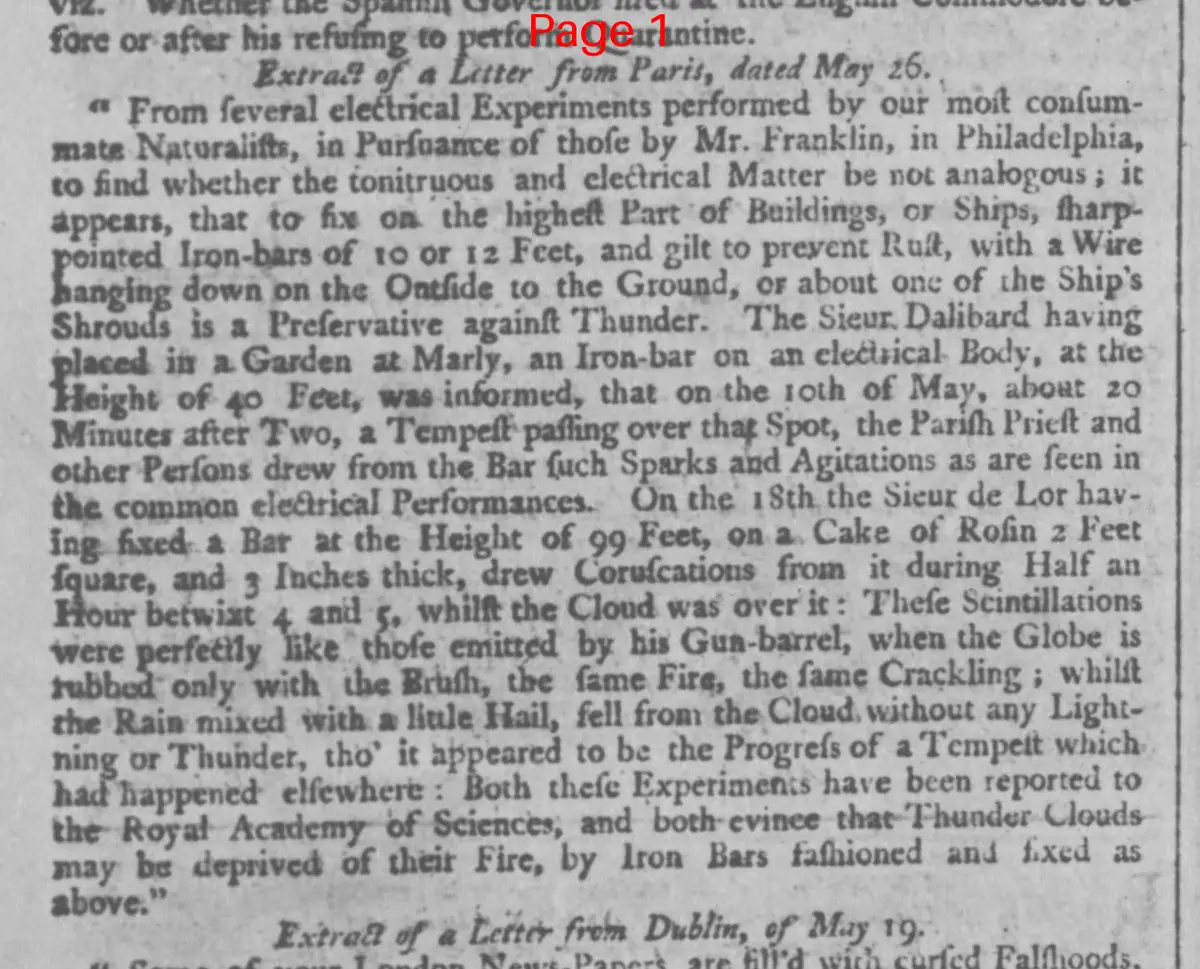
Extract of a Letter from Paris, dated May 26.
From several electrical Experiments performed by our most consummate Naturalists, in Pursuance of those by Mr. Franklin, in Philadelphia, to find whether the tonitruous and electrical Matter be not analogous; it appears, that to fix on the highest Part of Buildings, or Ships, sharp-pointed Iron-bars of 10 or 12 Feet, and gilt to prevent Rust, with a Wire hanging down on the Outside to the Ground, or about one of the Ship's Shrouds is a Preservative against Thunder. The Sieur Dalibard having placed in a Garden at Marly, an Iron-bar on an electrical Body, at the Height of 40 Feet, was informed, that on the 10th of May, about 20 Minutes after Two, a Tempest passing over that Spot, the Parish Priest and other Persons drew from the Bar such Sparks and Agitations as are seen in the common electrical Performances. On the 18th the Sieur de Lor having fixed a Bar at the Height of 99 Feet, on a Cake of Rosin 2 Feet square, and 3 Inches thick, drew Coruscations from it during Half an Hour betwixt 4 and 5, whilst the Cloud was over it: These Scintillations were perfectly like those emitted by his Gun-barrel, when the Globe is rubbed only with the Brush, the same Fire, the same Crackling; whilst the Rain mixed with a little Hail, fell from the Cloud, without any Lightning or Thunder, tho' it appeared to be the Progress of a Tempest which had happened elsewhere: Both these Experiments have been reported to the Royal Academy of Sciences; and both evince that Thunder-Clouds may be deprived of their Fire, by Iron Bars fashioned and fixed as above.
From several electrical Experiments performed by our most consummate Naturalists, in Pursuance of those by Mr. Franklin, in Philadelphia, to find whether the tonitruous and electrical Matter be not analogous; it appears, that to fix on the highest Part of Buildings, or Ships, sharp-pointed Iron-bars of 10 or 12 Feet, and gilt to prevent Rust, with a Wire hanging down on the Outside to the Ground, or about one of the Ship's Shrouds is a Preservative against Thunder. The Sieur Dalibard having placed in a Garden at Marly, an Iron-bar on an electrical Body, at the Height of 40 Feet, was informed, that on the 10th of May, about 20 Minutes after Two, a Tempest passing over that Spot, the Parish Priest and other Persons drew from the Bar such Sparks and Agitations as are seen in the common electrical Performances. On the 18th the Sieur de Lor having fixed a Bar at the Height of 99 Feet, on a Cake of Rosin 2 Feet square, and 3 Inches thick, drew Coruscations from it during Half an Hour betwixt 4 and 5, whilst the Cloud was over it: These Scintillations were perfectly like those emitted by his Gun-barrel, when the Globe is rubbed only with the Brush, the same Fire, the same Crackling; whilst the Rain mixed with a little Hail, fell from the Cloud, without any Lightning or Thunder, tho' it appeared to be the Progress of a Tempest which had happened elsewhere: Both these Experiments have been reported to the Royal Academy of Sciences; and both evince that Thunder-Clouds may be deprived of their Fire, by Iron Bars fashioned and fixed as above.
What sub-type of article is it?
Scientific Discovery
Invention Technology
What keywords are associated?
Lightning Rods
Electrical Experiments
Franklin
Paris
Thunder
What entities or persons were involved?
Sieur Dalibard
Sieur De Lor
Mr. Franklin
Where did it happen?
Paris
Foreign News Details
Primary Location
Paris
Event Date
May 26
Key Persons
Sieur Dalibard
Sieur De Lor
Mr. Franklin
Outcome
experiments showed pointed iron bars can draw fire from thunder-clouds, serving as a preservative against lightning; results reported to the royal academy of sciences.