Thanks for visiting SNEWPapers!
Sign up free today to connect your AI tools to the Library of Congress' newspaper collection.
Fowle's New Hampshire Gazette And General Advertiser Poem July 15, 1785
Portsmouth, Rockingham, New Hampshire
What is this article about?
A poem to a young woman who revived a fainting soldier on his march to New York, praising her pity and asking why she will not heal the wounds her eyes have given.
Quality green show the numbers
Measured from the scan
— how cleanly the OCR engine read the characters
- Mean ink quality
- 99.0% The length-weighted average confidence across the OCR lines — the mean of exactly the per-line scores whose tails the two figures below report. Typical is 99%.
- Illegible ink
- 0.0% Text sitting in OCR-detected lines that scored below 80% confidence — very shaky reads. Weighted by line length, so one long bad line counts for more than a short one.
- Uncertain ink
- 0.0% Text in lines that scored 80–90% — somewhat shaky reads.
- Matches source
- 96.54% How closely the served text matches the raw OCR of the same boxes, letter by letter, after collapsing spacing and case. This measures agreement, not correctness: the OCR is often wrong and the extractor corrects it, so 100% does not mean perfect, and a low figure usually means poor scan text was rewritten rather than that text was lost (length vs source shows loss).
- Length vs source
- 99.73% Below 100% means text was dropped from the OCR; above means text was added to make it read.
Assembled by the extraction model
— whether the stitched-together text holds up; catches layout and segmentation errors, which the scores above cannot see
- Transcription confidence
- 97.0% (typical 96%) How cleanly the extractor could assemble what it was given. Low here with clean ink scores points at layout analysis — the characters were read correctly but grouped or ordered wrongly.
- Comprehension
- 90.0% Whether the piece reads coherently start to finish. Can stay high while transcription confidence drops, when only part of the component is affected.
Clipping
Full Text
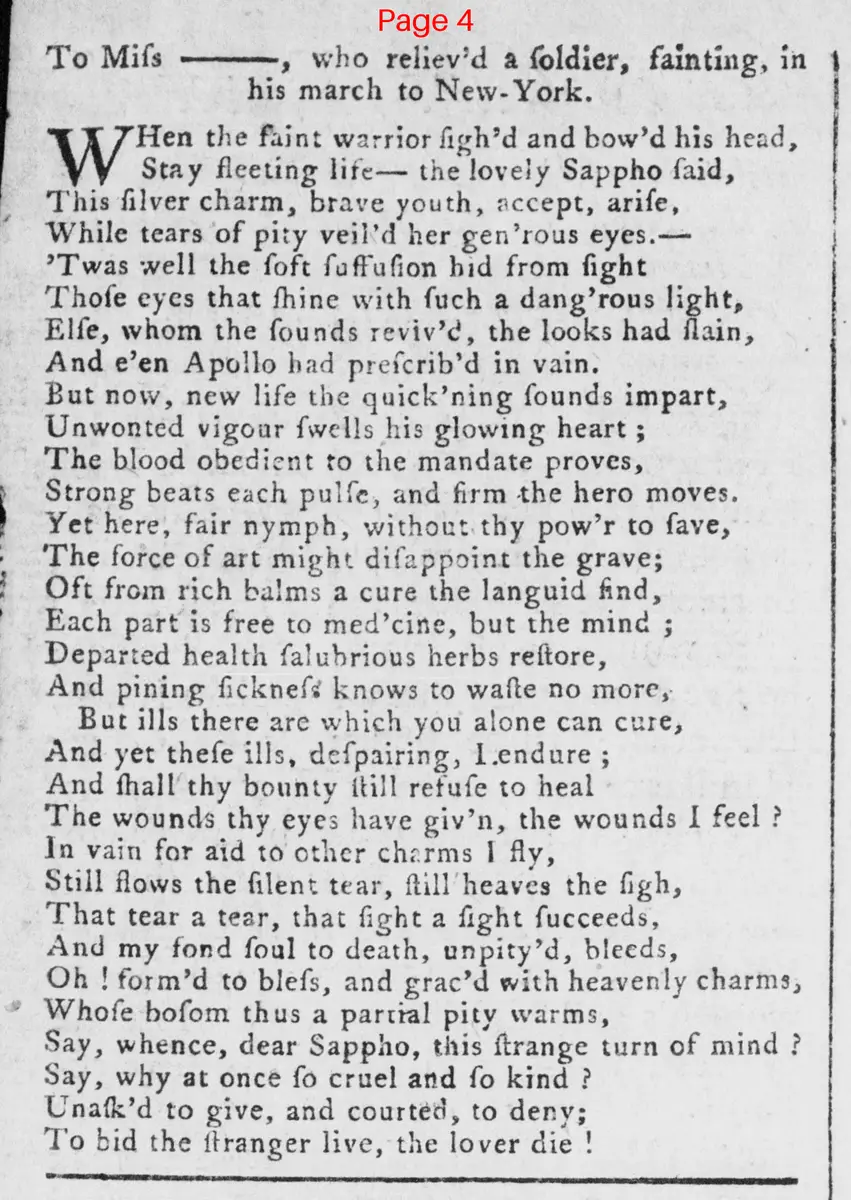
To Miss —, who reliev'd a soldier, fainting, in
his march to New-York.
Stay fleeting life— the lovely Sappho said,
This silver charm, brave youth, accept, arise,
While tears of pity veil'd her gen'rous eyes.
'Twas well the soft suffusion hid from sight
Those eyes that shine with such a dang'rous light,
Else, whom the sounds reviv'd, the looks had slain,
And e'en Apollo had prescrib'd in vain.
But now, new life the quick'ning sounds impart,
Unwonted vigour swells his glowing heart;
The blood obedient to the mandate proves,
Strong beats each pulse, and firm the hero moves.
Yet here, fair nymph, without thy pow'r to save,
The force of art might disappoint the grave;
Oft from rich balms a cure the languid find,
Each part is free to med'cine, but the mind;
Departed health salubrious herbs restore,
And pining sickness knows to waste no more,
But ills there are which you alone can cure,
And yet these ills, despairing, I endure;
And shall thy bounty still refuse to heal
The wounds thy eyes have giv'n, the wounds I feel?
In vain for aid to other charms I fly,
Still flows the silent tear, still heaves the sigh,
That tear a tear, that sigh a sigh succeeds,
And my fond soul to death, unpity'd, bleeds,
Oh! form'd to bless, and grac'd with heavenly charms,
Whose bosom thus a partial pity warms,
Say, whence, dear Sappho, this strange turn of mind?
Say, why at once so cruel and so kind?
Unask'd to give, and courted, to deny;
To bid the stranger live, the lover die!
What sub-type of article is it?
Lyric
What themes does it touch?
Love Courtship
War Military
What keywords are associated?
Soldier
Sappho
Love
Pity
New York March
Poem Details
Title
To Miss —, Who Reliev'd A Soldier, Fainting, In His March To New York
Subject
On A Young Woman's Kindness To A Soldier
Form / Style
Heroic Couplets
Key Lines
Stay Fleeting Life— The Lovely Sappho Said,
This Silver Charm, Brave Youth, Accept, Arise,
Say, Why At Once So Cruel And So Kind?