Thanks for visiting SNEWPapers!
Sign up free today to connect your AI tools to the Library of Congress' newspaper collection.
The Virginia Gazette Literary October 15, 1736
Richmond, Richmond, Virginia
What is this article about?
An essay from 'The Monitor' series (No. 10) criticizing those who argue peremptorily outside their competence, and arguing that the pleasure of music lies in the mind's perception of harmony, not mere sound.
Quality green show the numbers
Measured from the scan
— how cleanly the OCR engine read the characters
- Mean ink quality
- 99.0% The length-weighted average confidence across the OCR lines — the mean of exactly the per-line scores whose tails the two figures below report. Typical is 99%.
- Illegible ink
- 0.0% Text sitting in OCR-detected lines that scored below 80% confidence — very shaky reads. Weighted by line length, so one long bad line counts for more than a short one.
- Uncertain ink
- 0.0% Text in lines that scored 80–90% — somewhat shaky reads.
- Matches source
- 96.93% How closely the served text matches the raw OCR of the same boxes, letter by letter, after collapsing spacing and case. This measures agreement, not correctness: the OCR is often wrong and the extractor corrects it, so 100% does not mean perfect, and a low figure usually means poor scan text was rewritten rather than that text was lost (length vs source shows loss).
- Length vs source
- 99.42% Below 100% means text was dropped from the OCR; above means text was added to make it read.
Assembled by the extraction model
— whether the stitched-together text holds up; catches layout and segmentation errors, which the scores above cannot see
- Transcription confidence
- 97.0% (typical 96%) How cleanly the extractor could assemble what it was given. Low here with clean ink scores points at layout analysis — the characters were read correctly but grouped or ordered wrongly.
- Comprehension
- 100.0% Whether the piece reads coherently start to finish. Can stay high while transcription confidence drops, when only part of the component is affected.
Clipping
Full Text
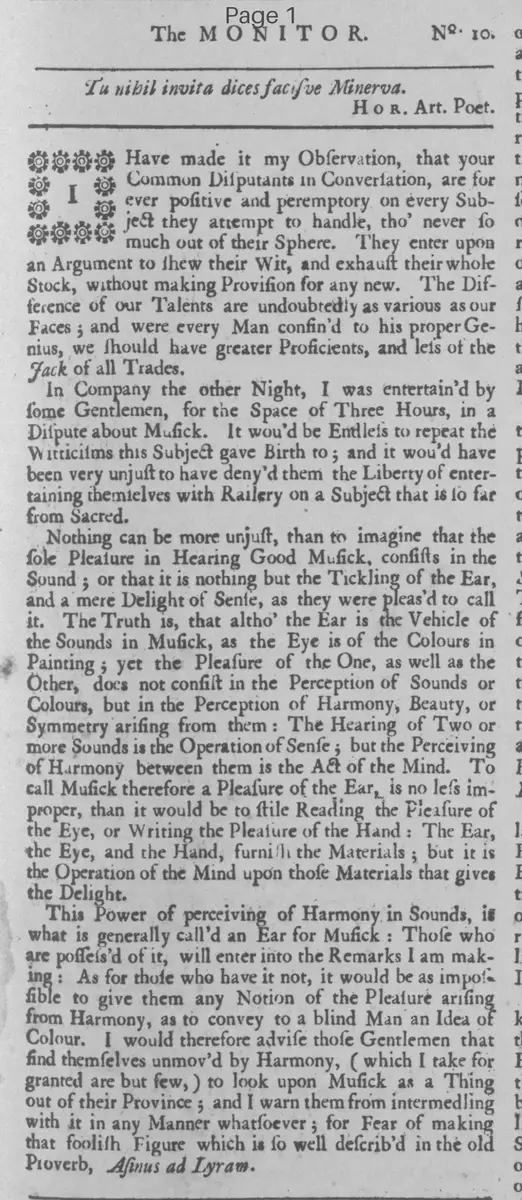
The MONITOR. No. 10.
Tu nihil invita dices faciesve Minerva.
Hor. Art. Poet.
Have made it my Observation, that your Common Disputants in Conversation, are for ever positive and peremptory on every Subject they attempt to handle, tho' never so much out of their Sphere. They enter upon an Argument to shew their Wit, and exhaust their whole Stock, without making Provision for any new. The Difference of our Talents are undoubtedly as various as our Faces; and were every Man confin'd to his proper Genius, we should have greater Proficients, and less of the Jack of all Trades.
In Company the other Night, I was entertain'd by some Gentlemen, for the Space of Three Hours, in a Dispute about Musick. It wou'd be Endless to repeat the Witticisms this Subject gave Birth to; and it wou'd have been very unjust to have deny'd them the Liberty of entertaining themselves with Railery on a Subject that is so far from Sacred.
Nothing can be more unjust, than to imagine that the sole Pleasure in Hearing good Musick, consists in the Sound; or that it is nothing but the Tickling of the Ear, and a mere Delight of Sense, as they were pleas'd to call it. The Truth is, that altho' the Ear is the Vehicle of the Sounds in Musick, as the Eye is of the Colours in Painting; yet the Pleasure of the One, as well as the Other, does not consist in the Perception of Sounds or Colours, but in the Perception of Harmony, Beauty, or Symmetry arising from them: The Hearing of Two or more Sounds is the Operation of Sense; but the Perceiving of Harmony between them is the Act of the Mind. To call Musick therefore a Pleasure of the Ear, is no less improper, than it would be to stile Reading the Pleasure of the Eye, or Writing the Pleasure of the Hand: The Ear, the Eye, and the Hand, furnish the Materials; but it is the Operation of the Mind upon those Materials that gives the Delight.
This Power of perceiving of Harmony in Sounds, is what is generally call'd an Ear for Musick: Those who are possess'd of it, will enter into the Remarks I am making: As for those who have it not, it would be as impossible to give them any Notion of the Pleasure arising from Harmony, as to convey to a blind Man an Idea of Colour. I would therefore advise those Gentlemen that find themselves unmov'd by Harmony, (which I take for granted are but few,) to look upon Musick as a Thing out of their Province; and I warn them from intermedling with it in any Manner whatsoever; for Fear of making that foolish Figure which is so well describ'd in the old Proverb, Asinus ad Lyram.
What sub-type of article is it?
Essay
What themes does it touch?
Moral Virtue
Social Manners
What keywords are associated?
Music
Harmony
Disputation
Self Knowledge
Periodical Essay
Literary Details
Title
The Monitor. No. 10.
Subject
On The Folly Of Disputing Outside One's Sphere, With Reflections On Music And Harmony
Form / Style
Periodical Essay In The Spectator Tradition
Key Lines
The Ear, The Eye, And The Hand, Furnish The Materials; But It Is The Operation Of The Mind Upon Those Materials That Gives The Delight.
Asinus Ad Lyram.