Thank you for visiting SNEWPapers!
Sign up free
The Patowmac Guardian, And Berkeley Advertiser Domestic News September 30, 1793
Martinsburg, Berkeley, West Virginia
What is this article about?
A letter from Philadelphia describes the origin of the malignant fever (thought imported from Cape Francois), the panic, deaths (about 1000), and mass departure.
Quality green show the numbers
Measured from the scan
— how cleanly the OCR engine read the characters
- Mean ink quality
- 98.0% The length-weighted average confidence across the OCR lines — the mean of exactly the per-line scores whose tails the two figures below report. Typical is 99%.
- Illegible ink
- 0.0% Text sitting in OCR-detected lines that scored below 80% confidence — very shaky reads. Weighted by line length, so one long bad line counts for more than a short one.
- Uncertain ink
- 2.8% Text in lines that scored 80–90% — somewhat shaky reads.
- Matches source
- 95.01% How closely the served text matches the raw OCR of the same boxes, letter by letter, after collapsing spacing and case. This measures agreement, not correctness: the OCR is often wrong and the extractor corrects it, so 100% does not mean perfect, and a low figure usually means poor scan text was rewritten rather than that text was lost (length vs source shows loss).
- Length vs source
- 99.06% Below 100% means text was dropped from the OCR; above means text was added to make it read.
Assembled by the extraction model
— whether the stitched-together text holds up; catches layout and segmentation errors, which the scores above cannot see
- Transcription confidence
- 96.0% (typical 96%) How cleanly the extractor could assemble what it was given. Low here with clean ink scores points at layout analysis — the characters were read correctly but grouped or ordered wrongly.
- Comprehension
- 95.0% Whether the piece reads coherently start to finish. Can stay high while transcription confidence drops, when only part of the component is affected.
Clipping
Full Text
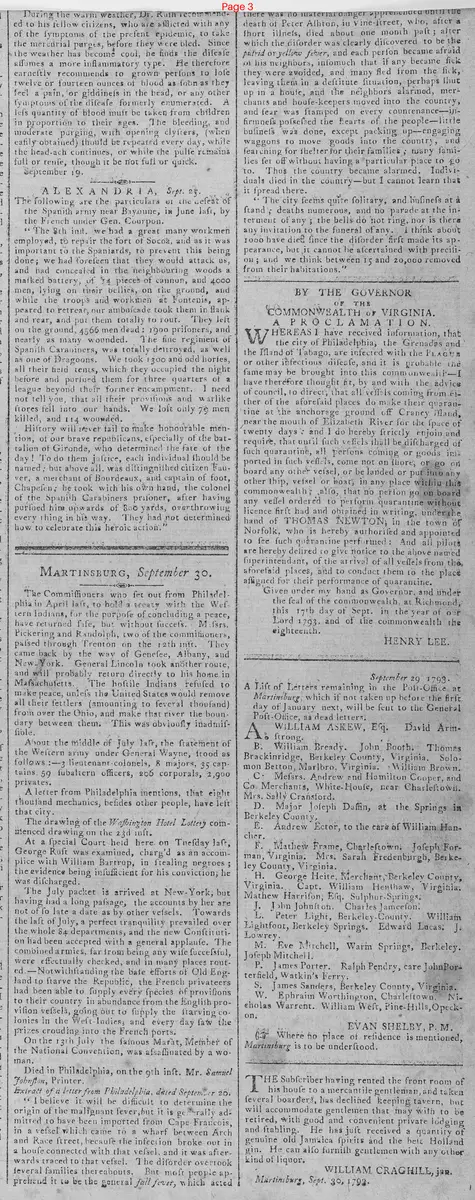
Extract of a letter from Philadelphia, dated September 20.
"I believe it will be difficult to determine the origin of the malignant fever, but it is generally admitted to have been imported from Cape Francois, in a vessel which came to a wharf between Arch and Race street, because the infection broke out in a house connected with that vessel, and it was afterwards traced to that vessel. The disorder overtook several families thereabouts. But most people apprehend it to be the general fall fever, which acted—there was no material danger apprehended until the death of Peter Ashton, in Vine-street, who, after a short illness, died about one month past; after which the disorder was clearly discovered to be the putrid or yellow fever, and each person became afraid of his neighbors, insomuch that if any became sick they were avoided, and many fled from the sick, leaving them in a destitute situation, perhaps shut up in a house, and the neighbors alarmed, merchants and house-keepers moved into the country, and fear was stamped on every countenance—infirmness possessed the hearts of the people—little business was done, except packing up—engaging waggons to move goods into the country, and searching for shelter for their families; many families set off without having a particular place to go to. Thus the country became alarmed. Individuals died in the country—but I cannot learn that it spread here.
The city seems quite solitary, and business at a stand; deaths numerous, and no parade at the interment of any; the bells do not ring, nor is there any invitation to the funeral of any. I think about 1000 have died since the disorder first made its appearance, but it cannot be ascertained with precision; and we think between 15 and 20,000 removed from their habitations."
What sub-type of article is it?
Disease Or Epidemic
Death Or Funeral
What keywords are associated?
Fever
Origin
Deaths
Philadelphia
Where did it happen?
Philadelphia
Domestic News Details
Primary Location
Philadelphia
Event Date
September 20
Outcome
about 1000 deaths