Thanks for visiting SNEWPapers!
Sign up free today to connect your AI tools to the Library of Congress' newspaper collection.
The New Hampshire Gazette Letter to Editor February 25, 1763
Portsmouth, Rockingham, New Hampshire
What is this article about?
A reader forwards an extract on manuring coastal lands with sea shells as practiced in counties Londonderry and Donegal, Ireland, describing the method, its benefits, and its long-lasting effect on boggy and clay soils.
Quality green show the numbers
Measured from the scan
— how cleanly the OCR engine read the characters
- Mean ink quality
- 99.0% The length-weighted average confidence across the OCR lines — the mean of exactly the per-line scores whose tails the two figures below report. Typical is 99%.
- Illegible ink
- 0.0% Text sitting in OCR-detected lines that scored below 80% confidence — very shaky reads. Weighted by line length, so one long bad line counts for more than a short one.
- Uncertain ink
- 0.0% Text in lines that scored 80–90% — somewhat shaky reads.
- Matches source
- 95.89% How closely the served text matches the raw OCR of the same boxes, letter by letter, after collapsing spacing and case. This measures agreement, not correctness: the OCR is often wrong and the extractor corrects it, so 100% does not mean perfect, and a low figure usually means poor scan text was rewritten rather than that text was lost (length vs source shows loss).
- Length vs source
- 99.38% Below 100% means text was dropped from the OCR; above means text was added to make it read.
Assembled by the extraction model
— whether the stitched-together text holds up; catches layout and segmentation errors, which the scores above cannot see
- Transcription confidence
- 94.0% (typical 96%) How cleanly the extractor could assemble what it was given. Low here with clean ink scores points at layout analysis — the characters were read correctly but grouped or ordered wrongly.
- Comprehension
- 90.0% Whether the piece reads coherently start to finish. Can stay high while transcription confidence drops, when only part of the component is affected.
Clipping
Full Text
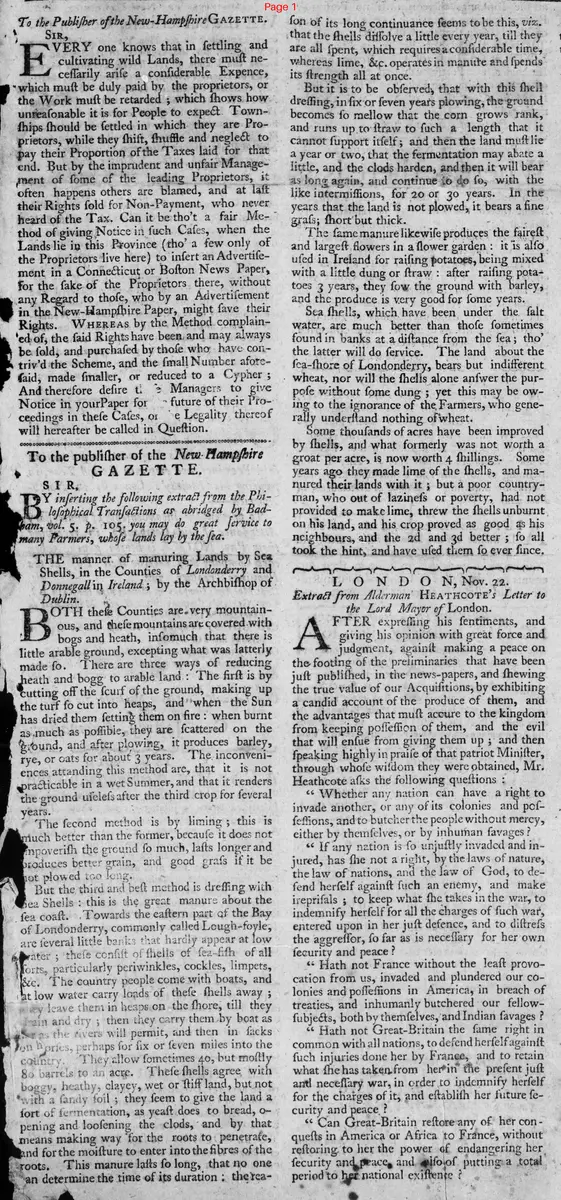
To the Publisher of the New-Hampshire GAZETTE.
SIR,
Pam., vol. 5. p. 105, you may do great service to many Farmers, whose lands lay by the sea.
THE manner of manuring Lands by Sea Shells, in the Counties of Londonderry and Donnegall in Ireland; by the Archbishop of Dublin.
BOTH these Counties are very mountainous, and these mountains are covered with bogs and heath, insomuch that there is little arable ground, excepting what was latterly made so. There are three ways of reducing heath and bogg to arable land: The first is by cutting off the scurf of the ground, making up the turf so cut into heaps, and when the Sun has dried them setting them on fire: when burnt as much as possible, they are scattered on the ground, and after plowing, it produces barley, rye, or oats for about 3 years. The inconveniences attending this method are, that it is not practicable in a wet Summer, and that it renders the ground useless after the third crop for several years.
The second method is by liming; this is much better than the former, because it does not impoverish the ground so much, lasts longer and produces better grain, and good grass if it be not plowed too long.
But the third and best method is dressing with Sea Shells: this is the great manure about the sea coast. Towards the eastern part of the Bay of Londonderry, commonly called Lough-foyle, are several little banks that hardly appear at low water; these consist of shells of sea-fish of all sorts, particularly periwinkles, cockles, limpets, &c. The country people come with boats, and at low water carry loads of these shells away; they leave them in heaps on the shore, till they are dry; then they carry them by boat as far as the rivers will permit, and then in sacks on horses, perhaps for six or seven miles into the country. They allow sometimes 40, but mostly 80 barrels to an acre. These shells agree with boggy, heathy, clayey, wet or stiff land, but not with a sandy soil; they seem to give the land a sort of fermentation, as yeast does to bread, opening and loosening the clods, and by that means making way for the roots to penetrate, and for the moisture to enter into the fibres of the roots. This manure lasts so long, that no one can determine the time of its duration: the reason of its long continuance seems to be this, viz. that the shells dissolve a little every year, till they are all spent, which requires a considerable time, whereas lime, &c. operates in manure and spends its strength all at once.
But it is to be observed, that with this shell dressing, in six or seven years plowing, the ground becomes so mellow that the corn grows rank, and runs up to straw to such a length that it cannot support itself; and then the land must lie a year or two, that the fermentation may abate a little, and the clods harden, and then it will bear as long again, and continue to do so, with the like intermissions, for 20 or 30 years. In the years that the land is not plowed, it bears a fine grass; short but thick.
The same manure likewise produces the fairest and largest flowers in a flower garden: it is also used in Ireland for raising potatoes, being mixed with a little dung or straw: after raising potatoes 3 years, they sow the ground with barley, and the produce is very good for some years.
Sea shells, which have been under the salt water, are much better than those sometimes found in banks at a distance from the sea; tho' the latter will do service. The land about the sea-shore of Londonderry, bears but indifferent wheat, nor will the shells alone answer the purpose without some dung; yet this may be owing to the ignorance of the Farmers, who generally understand nothing of wheat.
Some thousands of acres have been improved by shells, and what formerly was not worth a groat per acre, is now worth 4 shillings. Some years ago they made lime of the shells, and manured their lands with it; but a poor countryman, who out of laziness or poverty, had not provided to make lime, threw the shells unburnt on his land, and his crop proved as good as his neighbours, and the 2d and 3d better; so all took the hint, and have used them so ever since.
What sub-type of article is it?
Informative
What themes does it touch?
Agriculture
What keywords are associated?
Sea Shell Manure
Manuring Land
Ireland Farming
Londonderry
Donegal
What entities or persons were involved?
Publisher Of The New Hampshire Gazette
Letter to Editor Details
Recipient
Publisher Of The New Hampshire Gazette
Main Argument
Sea shells are the best manure for boggy, heathy, clayey, wet or stiff land, providing a long-lasting fermentation that improves the soil for 20 to 30 years.
Notable Details
- three methods of reducing heath and bog to arable land: burning turf, liming, and sea shells
- shells gathered from Lough-foyle
- 80 barrels per acre typical
- land improved from a groat to 4 shillings per acre