Thank you for visiting SNEWPapers!
Sign up free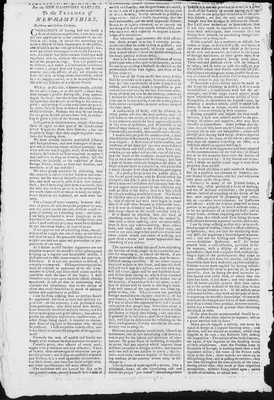
Fowle's New Hampshire Gazette And General Advertiser Letter to Editor February 18, 1785
Portsmouth, Rockingham, New Hampshire
What is this article about?
Major General John Sullivan addresses the freemen of New Hampshire urging formation of a well-regulated militia: appoint capable officers, train in small parties, adopt a cheap uniform of domestic manufacture, and avoid a standing army; he ties the plan to preserving liberty and improving the balance of trade.
Quality green show the numbers
Measured from the scan
— how cleanly the OCR engine read the characters
- Mean ink quality
- 99.0% The length-weighted average confidence across the OCR lines — the mean of exactly the per-line scores whose tails the two figures below report. Typical is 99%.
- Illegible ink
- 0.0% Text sitting in OCR-detected lines that scored below 80% confidence — very shaky reads. Weighted by line length, so one long bad line counts for more than a short one.
- Uncertain ink
- 0.19% Text in lines that scored 80–90% — somewhat shaky reads.
- Matches source
- 96.03% How closely the served text matches the raw OCR of the same boxes, letter by letter, after collapsing spacing and case. This measures agreement, not correctness: the OCR is often wrong and the extractor corrects it, so 100% does not mean perfect, and a low figure usually means poor scan text was rewritten rather than that text was lost (length vs source shows loss). Across pages, this is the worst fragment.
- Length vs source
- 99.22% Below 100% means text was dropped from the OCR; above means text was added to make it read.
Assembled by the extraction model
— whether the stitched-together text holds up; catches layout and segmentation errors, which the scores above cannot see
- Transcription confidence
- 95.0% (typical 96%) How cleanly the extractor could assemble what it was given. Low here with clean ink scores points at layout analysis — the characters were read correctly but grouped or ordered wrongly.
- Comprehension
- 95.0% Whether the piece reads coherently start to finish. Can stay high while transcription confidence drops, when only part of the component is affected.
Clippings
1 of 2
Full Text
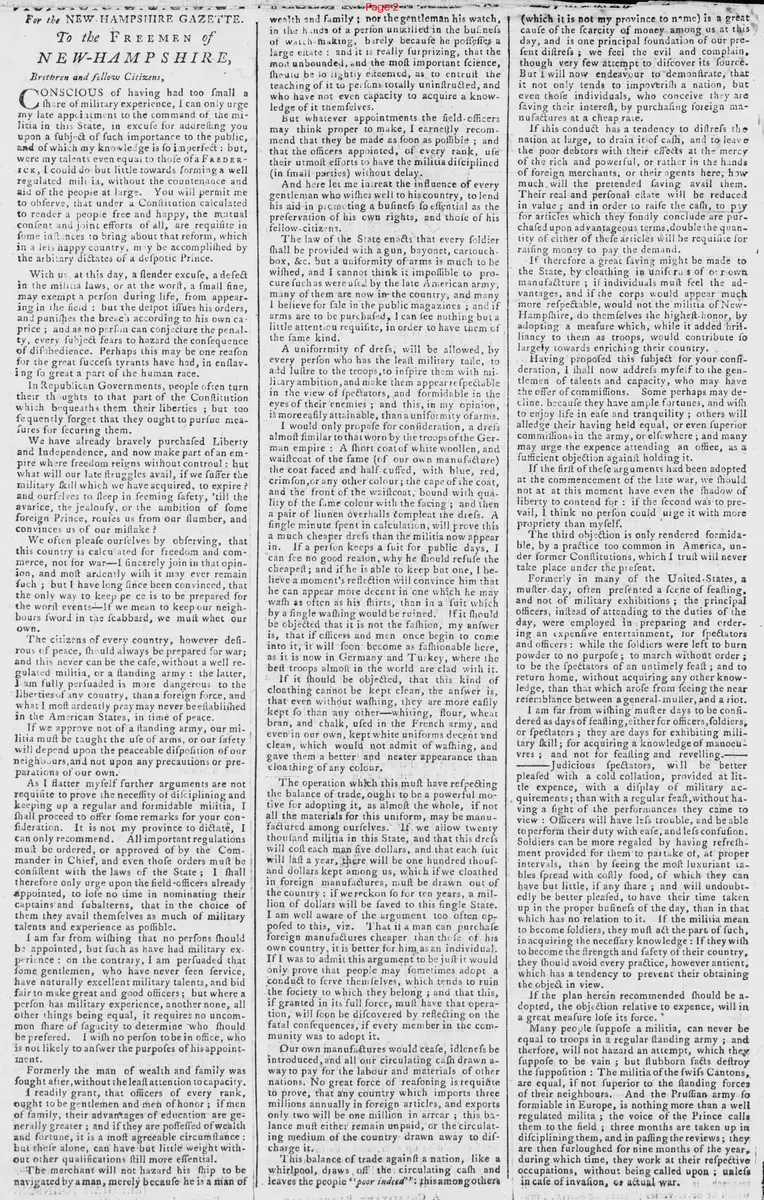
For the NEW-HAMPSHIRE GAZETTE.
To the FREEMEN of NEW-HAMPSHIRE
Brethren and fellow Citizens,
Conscious of having had too fallacious my late appointment to the command of the militia in this State, in excuse for addressing you upon a subject of such importance to the public, and of which my knowledge is so imperfect: but, were my talents even equal to those of a Frederick, I could do but little towards forming a well regulated militia, without the countenance and aid of the people at large. You will permit me to observe, that under a Constitution calculated to render a people free and happy, the mutual consent and joint efforts of all, are requisite in some instances to bring about that reform, which in a less happy country, may be accomplished by the arbitrary dictates of a despotic Prince.
With us, at this day, a slender excuse, a defect in the militia laws, or at the worst, a small fine, may exempt a person during life, from appearing in the field: but the despot issues his orders, and punishes the breach according to his own caprice; and as no person can conjecture the penalty, every subject fears to hazard the consequence of disobedience. Perhaps this may be one reason for the great success tyrants have had, in enslaving so great a part of the human race.
In Republican Governments, people often turn their thoughts to that part of the Constitution which bequeaths them their liberties; but too frequently forget that they ought to pursue measures for securing them.
We have already bravely purchased Liberty and Independence, and now make part of an empire where freedom reigns without control: but what will our late struggles avail, if we suffer the military skill which we have acquired, to expire? and ourselves to sleep in seeming safety, till the avarice, the jealousy, or the ambition of some foreign Prince, rouses us from our slumber, and convinces us of our mistake?
We often please ourselves by observing, that this country is calculated for freedom and commerce, not for war—I sincerely join in that opinion, and most ardently wish it may ever remain such; but I have long since been convinced, that the only way to keep peace is to be prepared for the worst events—if we mean to keep our neighbours' sword in the scabbard, we must whet our own.
The citizens of every country, however desirous of peace, should always be prepared for war; and this never can be the case, without a well regulated militia, or a standing army: the latter, I am fully persuaded is more dangerous to the liberties of any country, than a foreign force, and what I most ardently pray may never be established in the American States, in time of peace.
If we approve not of a standing army, our militia must be taught the use of arms, or our safety will depend upon the peaceable disposition of our neighbours, and not upon any precautions or preparations of our own.
As I flatter myself farther arguments are not requisite to prove the necessity of disciplining and keeping up a regular and formidable militia, I shall proceed to offer some remarks for your consideration. It is not my province to dictate, I can only recommend. All important regulations must be ordered, or approved of by the Commander in Chief, and even those orders must be consistent with the laws of the State; I shall therefore only urge upon the field-officers already appointed, to lose no time in nominating their captains and subalterns, that in the choice of them they avail themselves as much of military talents and experience as possible.
I am far from wishing that no persons should be appointed, but such as have had military experience: on the contrary, I am persuaded that some gentlemen, who have never seen service, have naturally excellent military talents, and bid fair to make great and good officers; but where a person has military experience, another none, all other things being equal, it requires no uncommon share of sagacity to determine who should be preferred. I wish no person to be in office, who is not likely to answer the purposes of his appointment.
Formerly the man of wealth and family was sought after, without the least attention to capacity.
I readily grant, that officers of every rank, ought to be gentlemen and men of honor; if men of family, their advantages of education are generally greater; and if they are possessed of wealth and fortune, it is a most agreeable circumstance: but these alone, can have but little weight without other qualifications still more essential.
The merchant will not hazard his ship to be navigated by a man, merely because he is a man of wealth and family; nor the gentleman his watch, in the hands of a person unskilled in the business of watch-making, barely because he possesses a large estate: and it is really surprising, that the most unbounded, and the most important science, should be so lightly esteemed, as to entrust the teaching of it to persons totally uninstructed, and who have not even capacity to acquire a knowledge of it themselves.
But whatever appointments the field-officers may think proper to make, I earnestly recommend that they be made as soon as possible; and that the officers appointed, of every rank, use their utmost efforts to have the militia disciplined (in small parties) without delay.
And here let me entreat the influence of every gentleman who wishes well to his country, to lend his aid in promoting a business so essential as the preservation of his own rights, and those of his fellow-citizens.
The law of the State enacts that every soldier shall be provided with a gun, bayonet, cartouch box, &c. but a uniformity of arms is much to be wished, and I cannot think it impossible to procure such as were used by the late American army, many of them are now in the country, and many I believe for sale in the public magazines; and if arms are to be purchased, I can see nothing but a little attention requisite, in order to have them of the same kind.
A uniformity of dress, will be allowed, by every person who has the least military taste, to add lustre to the troops, to inspire them with military ambition, and make them appear respectable in the view of spectators, and formidable in the eyes of their enemies; and this, in my opinion, is more easily attainable, than a uniformity of arms.
I would only propose for consideration, a dress almost similar to that worn by the troops of the German empire: A short coat of white woollen, and waistcoat of the same (of our own manufacture) the coat faced and half cuffed, with blue, red, crimson, or any other colour; the cape of the coat, and the front of the waistcoat, bound with quality of the same colour with the facing; and then a pair of linen overalls to complete the dress. A single minute spent in calculation, will prove this a much cheaper dress than the militia now appear in. If a person keeps a suit for public days, I can see no good reason, why he should refuse the cheapest; and if he is able to keep but one, I believe a moment's reflection will convince him that he can appear more decent in one which he may wash as often as his shirts, than in a suit which by a single washing would be ruined. If it should be objected that it is not the fashion, my answer is, that if officers and men once begin to come into it, it will soon become as fashionable here, as it is now in Germany and Turkey, where the best troops almost in the world are clad with it. If it should be objected, that this kind of clothing cannot be kept clean, the answer is, that even without washing, they are more easily kept so than any other—whiting, flour, wheat bran, and chalk, used in the French army, and even in our own, kept white uniforms decent and clean, which would not admit of washing, and gave them a better and neater appearance than clothing of any colour.
The operation which this must have respecting the balance of trade, ought to be a powerful motive for adopting it, as almost the whole, if not all the materials for this uniform, may be manufactured among ourselves. If we allow twenty thousand militia in this State, and that this dress will cost each man five dollars, and that each suit will last a year, there will be one hundred thousand dollars kept among us, which if we clothed in foreign manufactures, must be drawn out of the country: if we reckon so for ten years, a million of dollars will be saved to this single State. I am well aware of the argument too often opposed to this, viz. That if a man can purchase foreign manufactures cheaper than those of his own country, it is better for him as an individual. If I was to admit this argument to be just it would only prove that people may sometimes adopt a conduct to serve themselves, which tends to ruin the society to which they belong; and that this, if granted in its full force, must have that operation, will soon be discovered by reflecting on the fatal consequences, if every member in the community was to adopt it.
Our own manufactures would cease, idleness be introduced, and all our circulating cash drawn away to pay for the labour and materials of other nations. No great force of reasoning is requisite to prove, that any country which imports three millions annually in foreign articles, and exports only two will be one million in arrear; this balance must either remain unpaid, or the circulating medium of the country drawn away to discharge it.
This balance of trade against a nation, like a whirlpool, draws off the circulating cash and leaves the people "poor indeed": this among others (which it is not my province to name) is a great cause of the scarcity of money among us at this day, and is one principal foundation of our present distress; we feel the evil and complain, though very few attempt to discover its source. But I will now endeavour to demonstrate, that it not only tends to impoverish a nation, but even those individuals, who conceive they are saving their interest, by purchasing foreign manufactures at a cheap rate.
If this conduct has a tendency to distress the nation at large, to drain it of cash, and to leave the poor debtors with their effects at the mercy of the rich and powerful, or rather in the hands of foreign merchants, or their agents here, how much will the pretended saving avail them. Their real and personal estate will be reduced in value; and in order to raise the cash, to pay for articles which they fondly conclude are purchased upon advantageous terms, double the quantity of either of these articles will be requisite for raising money to pay the demand.
If therefore a great saving might be made to the State, by clothing in uniforms of our own manufacture; if individuals must feel the advantages, and if the corps would appear much more respectable, would not the militia of New Hampshire, do themselves the highest honor, by adopting a measure which, while it added brilliancy to them as troops, would contribute so largely towards enriching their country.
Having proposed this subject for your consideration, I shall now address myself to the gentlemen of talents and capacity, who may have the offer of commissions. Some perhaps may decline, because they have ample fortunes, and wish to enjoy life in ease and tranquility; others will allege their having held equal, or even superior commissions in the army, or elsewhere; and many may urge the expence attending an office, as a sufficient objection against holding it.
If the first of these arguments had been adopted at the commencement of the late war, we should not at this moment have even the shadow of liberty to contend for: if the second was to prevail, I think no person could urge it with more propriety than myself.
The third objection is only rendered formidable, by a practice too common in America, under former Constitutions, which I trust will never take place under the present.
Formerly in many of the United-States, a muster-day, often presented a scene of feasting, and not of military exhibitions; the principal officers, instead of attending to the duties of the day, were employed in preparing and ordering an expensive entertainment, for spectators and officers: while the soldiers were left to burn powder to no purpose; to march without order; to be the spectators of an untimely feast; and to return home, without acquiring any other knowledge, than that which arose from seeing the near resemblance between a general muster, and a riot.
I am far from wishing muster days to be considered as days of feasting, either for officers, soldiers or spectators; they are days for exhibiting military skill; for acquiring a knowledge of manoeuvres; and not for feasting and revelling.—— Judicious spectators, will be better pleased with a cold collation, provided at little expence, with a display of military acquirements; than with a regular feast, without having a sight of the performances they came to view: Officers will have less trouble, and be able to perform their duty with ease, and less confusion. Soldiers can be more regaled by having refreshment provided for them to partake of, at proper intervals, than by seeing the most luxuriant tables spread with costly food, of which they can have but little, if any share; and will undoubtedly be better pleased, to have their time taken up in the proper business of the day, than in that which has no relation to it. If the militia mean to become soldiers, they must act the part of such, in acquiring the necessary knowledge: If they wish to become the strength and safety of their country, they should avoid every practice, however ancient, which has a tendency to prevent their obtaining the object in view.
If the plan herein recommended should be adopted, the objection relative to expence, will in a great measure lose its force.
Many people suppose a militia, can never be equal to troops in a regular standing army; and therefore, will not hazard an attempt, which they suppose to be vain; but stubborn facts destroy the supposition: The militia of the Swiss Cantons, are equal, if not superior to the standing forces of their neighbours. And the Prussian army so formidable in Europe, is nothing more than a well regulated militia; the voice of the Prince calls them to the field; three months are taken up in disciplining them, and in passing the reviews; they are then furloughed for nine months of the year, during which time, they work at their respective occupations, without being called upon: unless in case of invasion, or actual war.
I know so much time of the yeomanry in this country, cannot be spared; but much more than has ever yet been spent, might be devoted to a business so important, without being sensibly felt; and I cannot avoid urging this in the most pressing terms, at a time, when, however desirous we may be of a lasting peace; war does not in my view, appear at a great distance; If any gentleman should differ from me in sentiment, and can assign a satisfactory reason, for the British refusing to give up the important posts on our frontiers, ceded to us by treaty; I shall then with pleasure change my opinion, and my fears on that head will be at an end.
In order to prepare for every event, if in each neighbourhood the officers and soldiers were to assemble one or two hours in a week- to practice the use of arms, and regularly attend on the proper muster-days, they would soon become expert in the art of war; be a terror to every ambitious power; and render themselves able and skilful guardians of those liberties, purchased by the blood of their brethren, and the treasures of their country.
JOHN SULLIVAN,
Major-General.
DURHAM, January 27, 1785.
What sub-type of article is it?
Persuasive
Political
Open Letter
What themes does it touch?
Military War
Economic Policy
Politics
What keywords are associated?
Militia Discipline
Standing Army Opposition
Domestic Manufactures
Uniforms
Balance Of Trade
New Hampshire Freemen
What entities or persons were involved?
The Freemen Of New Hampshire
John Sullivan
Letter to Editor Details
Author
John Sullivan
Recipient
The Freemen Of New Hampshire
Main Argument
New Hampshire must build a well-regulated militia—selecting capable officers, training regularly, and adopting a uniform made from domestic materials—both to safeguard liberty without a standing army and to improve the balance of trade by keeping money in the country.
Notable Details
- compares Prussian army to a well-regulated militia
- cites Swiss cantons as militia equals to standing forces
- proposes a German-style white woollen uniform of domestic manufacture
- argues importing foreign manufactures drains cash and impoverishes the nation
- criticizes muster-day feasting as a riot rather than military training
- references British refusal to give up frontier posts as a sign of war risk