Thank you for visiting SNEWPapers!
Sign up free
Fowle's New Hampshire Gazette And General Advertiser Editorial October 28, 1785
Portsmouth, Rockingham, New Hampshire
What is this article about?
An editorial noting the scarcity of interesting European news and the difficult task of printers in finding content, listing recent news items as trivial.
Quality green show the numbers
Measured from the scan
— how cleanly the OCR engine read the characters
- Mean ink quality
- 98.0% The length-weighted average confidence across the OCR lines — the mean of exactly the per-line scores whose tails the two figures below report. Typical is 99%.
- Illegible ink
- 0.0% Text sitting in OCR-detected lines that scored below 80% confidence — very shaky reads. Weighted by line length, so one long bad line counts for more than a short one.
- Uncertain ink
- 1.3% Text in lines that scored 80–90% — somewhat shaky reads.
- Matches source
- 95.12% How closely the served text matches the raw OCR of the same boxes, letter by letter, after collapsing spacing and case. This measures agreement, not correctness: the OCR is often wrong and the extractor corrects it, so 100% does not mean perfect, and a low figure usually means poor scan text was rewritten rather than that text was lost (length vs source shows loss).
- Length vs source
- 98.54% Below 100% means text was dropped from the OCR; above means text was added to make it read.
Assembled by the extraction model
— whether the stitched-together text holds up; catches layout and segmentation errors, which the scores above cannot see
- Transcription confidence
- 93.0% (typical 96%) How cleanly the extractor could assemble what it was given. Low here with clean ink scores points at layout analysis — the characters were read correctly but grouped or ordered wrongly.
- Comprehension
- 90.0% Whether the piece reads coherently start to finish. Can stay high while transcription confidence drops, when only part of the component is affected.
Clipping
Full Text
BOSTON, October 20.
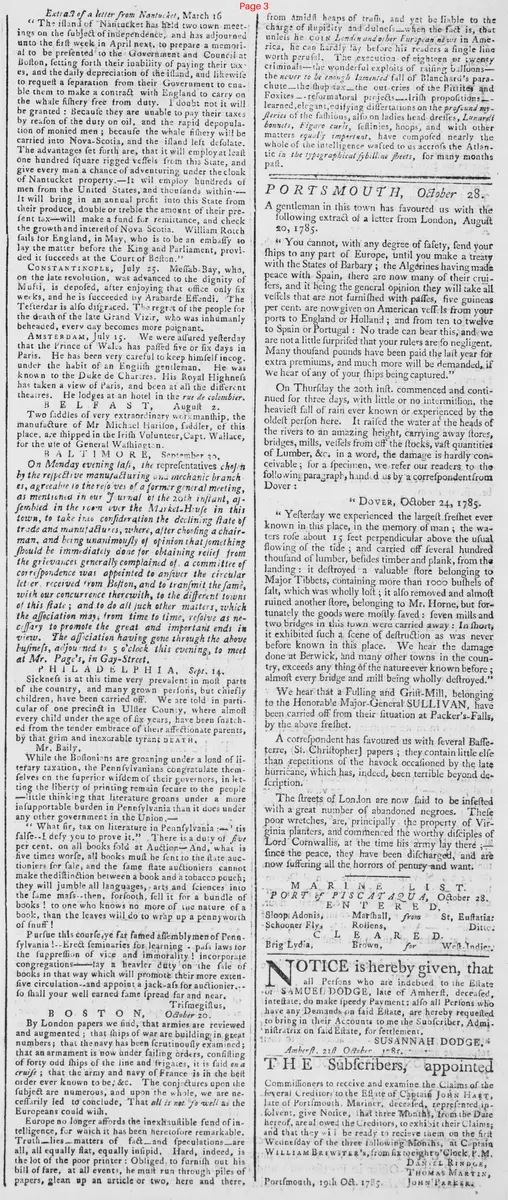
By London papers we find, that armies are reviewed and augmented; that ships of war are building in great numbers; that the navy has been scrutinously examined; that an armament is now under sailing orders, consisting of forty odd ships of the line and frigates, it is said on a cruise; that the army and navy of France is in the best order ever known to be, &c. The conjectures upon the subject are numerous, and upon the whole, we are necessarily led to conclude, That all is not so well as the Europeans could wish.
Europe no longer affords the inexhaustible fund of intelligence, for which it has been heretofore remarkable, Truth—lies—matters of fact—and speculations—are all, all equally flat, equally insipid. Hard, indeed, is the lot of the poor printer: Obliged, to furnish out his bill of fare, at all events, he must run through piles of papers, glean up an article or two, here and there, from amidst heaps of trash, and yet be liable to the charge of stupidity and dulness—when the fact is, that unless he coin London and other European news in America, he can hardly lay before his readers a single line worth perusal. The execution of eighteen or twenty criminals—the wonderful exploits of raising balloons—the never to be enough lamented fall of Blanchard's parachute—the shop tax, the out-cries of the Pittites and Foxites—reformatoral projects—Irish propositions—learned, elegant, edifying dissertations on the profound mysteries of the fashions, also on ladies' head-dresses, Lunardi bonnets, Figaro curls, festinies, hoops, and with other matters equally important, have composed nearly the whole of the intelligence wafted to us across the Atlantic in the typographical sibylline sheets, for many months past.
What sub-type of article is it?
Newspaper Business
What keywords are associated?
European News
Printer's Lot
Newspaper Content
What entities or persons were involved?
European Nations
Blanchard
Pittites
Foxites
Editorial Details
Primary Topic
The Scarcity Of Interesting European News And The Printer's Difficult Task
Stance / Tone
Plaintive, Humorous
Key Figures
European Nations
Blanchard
Pittites
Foxites
Key Arguments
- Europe no longer provides interesting news.
- Printers must scrape together content from trivial items.
- The news is flat and insipid.