Thanks for visiting SNEWPapers!
Sign up free today to connect your AI tools to the Library of Congress' newspaper collection.
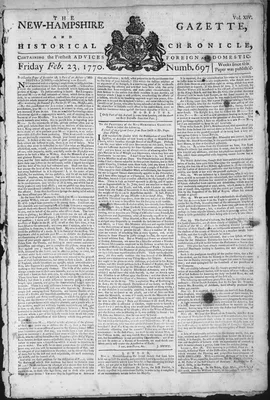
The New Hampshire Gazette And Historical Chronicle Letter to Editor February 23, 1770
Portsmouth, Rockingham, New Hampshire
What is this article about?
A reader submits an extract of Jonathan Swift's letter to Alexander Pope, in which Swift satirizes ministers and courts, argues no minister can be honest, and deems the doctrine that a king can do no wrong inconsistent.
Quality green show the numbers
Measured from the scan
— how cleanly the OCR engine read the characters
- Mean ink quality
- 99.0% The length-weighted average confidence across the OCR lines — the mean of exactly the per-line scores whose tails the two figures below report. Typical is 99%.
- Illegible ink
- 0.0% Text sitting in OCR-detected lines that scored below 80% confidence — very shaky reads. Weighted by line length, so one long bad line counts for more than a short one.
- Uncertain ink
- 0.9% Text in lines that scored 80–90% — somewhat shaky reads.
- Matches source
- 96.32% How closely the served text matches the raw OCR of the same boxes, letter by letter, after collapsing spacing and case. This measures agreement, not correctness: the OCR is often wrong and the extractor corrects it, so 100% does not mean perfect, and a low figure usually means poor scan text was rewritten rather than that text was lost (length vs source shows loss).
- Length vs source
- 99.09% Below 100% means text was dropped from the OCR; above means text was added to make it read.
Assembled by the extraction model
— whether the stitched-together text holds up; catches layout and segmentation errors, which the scores above cannot see
- Transcription confidence
- 98.0% (typical 96%) How cleanly the extractor could assemble what it was given. Low here with clean ink scores points at layout analysis — the characters were read correctly but grouped or ordered wrongly.
- Comprehension
- 95.0% Whether the piece reads coherently start to finish. Can stay high while transcription confidence drops, when only part of the component is affected.
Clipping
Full Text
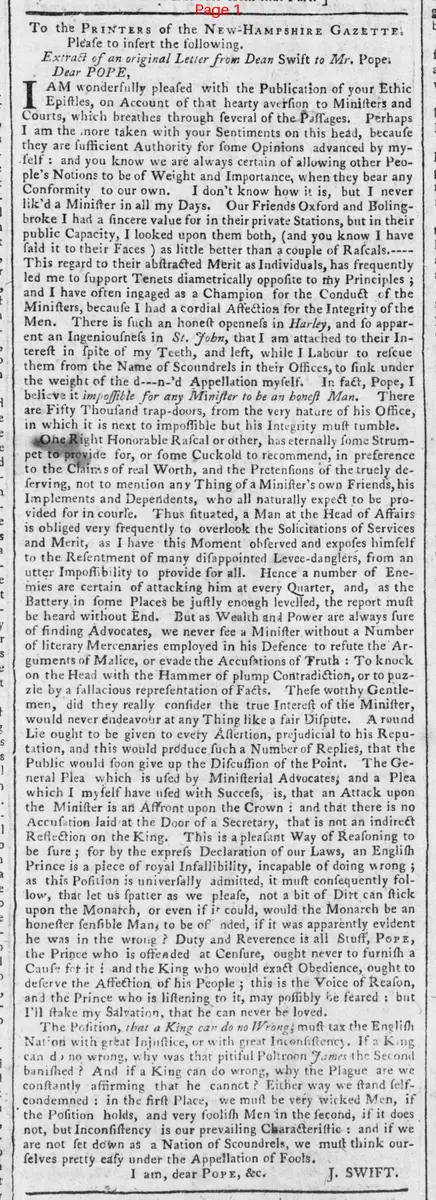
To the Printers of the New-Hampshire Gazette.
Please to insert the following.
Extract of an original Letter from Dean Swift to Mr. Pope
Dear POPE,
I AM wonderfully pleased with the Publication of your Ethic Epistles, on Account of that hearty aversion to Ministers and Courts, which breathes through several of the Passages. Perhaps I am the more taken with your Sentiments on this head, because they are sufficient Authority for some Opinions advanced by myself: and you know we are always certain of allowing other People's Notions to be of Weight and Importance, when they bear any Conformity to our own. I don't know how it is, but I never lik'd a Minister in all my Days. Our Friends Oxford and Bolingbroke I had a sincere value for in their private Stations, but in their public Capacity, I looked upon them both, (and you know I have said it to their Faces) as little better than a couple of Rascals.---- This regard to their abstracted Merit as Individuals, has frequently led me to support Tenets diametrically opposite to my Principles; and I have often engaged as a Champion for the Conduct of the Ministers, because I had a cordial Affection for the Integrity of the Men. There is such an honest openness in Harley, and so apparent an Ingeniousness in St. John, that I am attached to their Interest in spite of my Teeth, and lest, while I Labour to rescue them from the Name of Scoundrels in their Offices, to sink under the weight of the d---n-'d Appellation myself. In fact, Pope, I believe it impossible for any Minister to be an honest Man. There are Fifty Thousand trap-doors, from the very nature of his Office, in which it is next to impossible but his Integrity must tumble.
One Right Honorable Rascal or other, has eternally some Strumpet to provide for, or some Cuckold to recommend, in preference to the Claims of real Worth, and the Pretensions of the truly deserving, not to mention any Thing of a Minister's own Friends, his Implements and Dependents, who all naturally expect to be provided for in course. Thus situated, a Man at the Head of Affairs is obliged very frequently to overlook the Solicitations of Services and Merit, as I have this Moment observed and exposes himself to the Resentment of many disappointed Levee-danglers, from an utter Impossibility to provide for all. Hence a number of Enemies are certain of attacking him at every Quarter, and, as the Battery in some Places is justly enough levelled, the report must be heard without End. But as Wealth and Power are always sure of finding Advocates, we never see a Minister without a Number of literary Mercenaries employed in his Defence to refute the Arguments of Malice, or evade the Accusations of Truth: To knock on the Head with the Hammer of plump Contradiction, or to puzzle by a fallacious representation of Facts. These worthy Gentlemen, did they really consider the true Interest of the Minister, would never endeavour at any Thing like a fair Dispute. A round Lie ought to be given to every Assertion, prejudicial to his Reputation, and this would produce such a Number of Replies, that the Public would soon give up the Discussion of the Point. The General Plea which is used by Ministerial Advocates; and a Plea which I myself have used with Success, is, that an Attack upon the Minister is an Affront upon the Crown: and that there is no Accusation laid at the Door of a Secretary, that is not an indirect Reflection on the King. This is a pleasant Way of Reasoning to be sure; for by the express Declaration of our Laws, an English Prince is a piece of royal Infallibility, incapable of doing wrong; as this Position is universally admitted, it must consequently follow, that let us spatter as we please, not a bit of Dirt can stick upon the Monarch, or even if it could, would the Monarch be an honester sensible Man, to be offended, if it was apparently evident he was in the wrong? Duty and Reverence is all Stuff, Pope, the Prince who is offended at Censure, ought never to furnish a Cause for it: and the King who would exact Obedience, ought to deserve the Affection of his People; this is the Voice of Reason, and the Prince who is listening to it, may possibly be feared: but I'll stake my Salvation, that he can never be loved.
The Position, that a King can do no Wrong, must tax the English Nation with great Injustice, or with great Inconsistency. If a King can do no wrong, why was that pitiful Poltroon James the Second banished? And if a King can do wrong, why the Plague are we constantly affirming that he cannot? Either way we stand self-condemned: in the first Place, we must be very wicked Men, if the Position holds, and very foolish Men in the second, if it does not, but Inconsistency is our prevailing Characteristic: and if we are not set down as a Nation of Scoundrels, we must think ourselves pretty easy under the Appellation of Fools.
I am, dear Pope, &c. J. SWIFT.
What sub-type of article is it?
Satirical
Political
Philosophical
What themes does it touch?
Politics
Constitutional Rights
What keywords are associated?
Swift Letter To Pope
Ministerial Corruption
King Can Do No Wrong
Satire On Courts
What entities or persons were involved?
The Printers Of The New Hampshire Gazette
J. Swift
Letter to Editor Details
Author
J. Swift
Recipient
The Printers Of The New Hampshire Gazette
Main Argument
Satirically argues that ministers cannot be honest because their office forces them into corruption, and that the doctrine that a king can do no wrong is inconsistent with English history and reason.
Notable Details
- references Oxford and Bolingbroke
- criticizes ministerial advocates' plea that attacking a minister affronts the crown
- cites James II's banishment as inconsistency