Thanks for visiting SNEWPapers!
Sign up free today to connect your AI tools to the Library of Congress' newspaper collection.
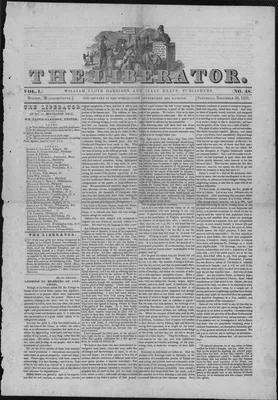
The Liberator Editorial November 26, 1831
Boston, Suffolk, Massachusetts
Cautionary note: slavery-era racial language and discussion of race and slavery
What is this article about?
An anti-slavery editorial arguing that racial equality and amalgamation improve society, quoting Jefferson on Indian genius and gradual emancipation, and criticizing African colonization as futile and dangerous, urging Congress to act.
Quality green show the numbers
Measured from the scan
— how cleanly the OCR engine read the characters
- Mean ink quality
- 99.0% The length-weighted average confidence across the OCR lines — the mean of exactly the per-line scores whose tails the two figures below report. Typical is 99%.
- Illegible ink
- 0.0% Text sitting in OCR-detected lines that scored below 80% confidence — very shaky reads. Weighted by line length, so one long bad line counts for more than a short one.
- Uncertain ink
- 0.0% Text in lines that scored 80–90% — somewhat shaky reads.
- Matches source
- 99.31% How closely the served text matches the raw OCR of the same boxes, letter by letter, after collapsing spacing and case. This measures agreement, not correctness: the OCR is often wrong and the extractor corrects it, so 100% does not mean perfect, and a low figure usually means poor scan text was rewritten rather than that text was lost (length vs source shows loss).
- Length vs source
- 99.13% Below 100% means text was dropped from the OCR; above means text was added to make it read.
Assembled by the extraction model
— whether the stitched-together text holds up; catches layout and segmentation errors, which the scores above cannot see
- Transcription confidence
- 97.0% (typical 96%) How cleanly the extractor could assemble what it was given. Low here with clean ink scores points at layout analysis — the characters were read correctly but grouped or ordered wrongly.
- Comprehension
- 95.0% Whether the piece reads coherently start to finish. Can stay high while transcription confidence drops, when only part of the component is affected.
Clipping
Full Text
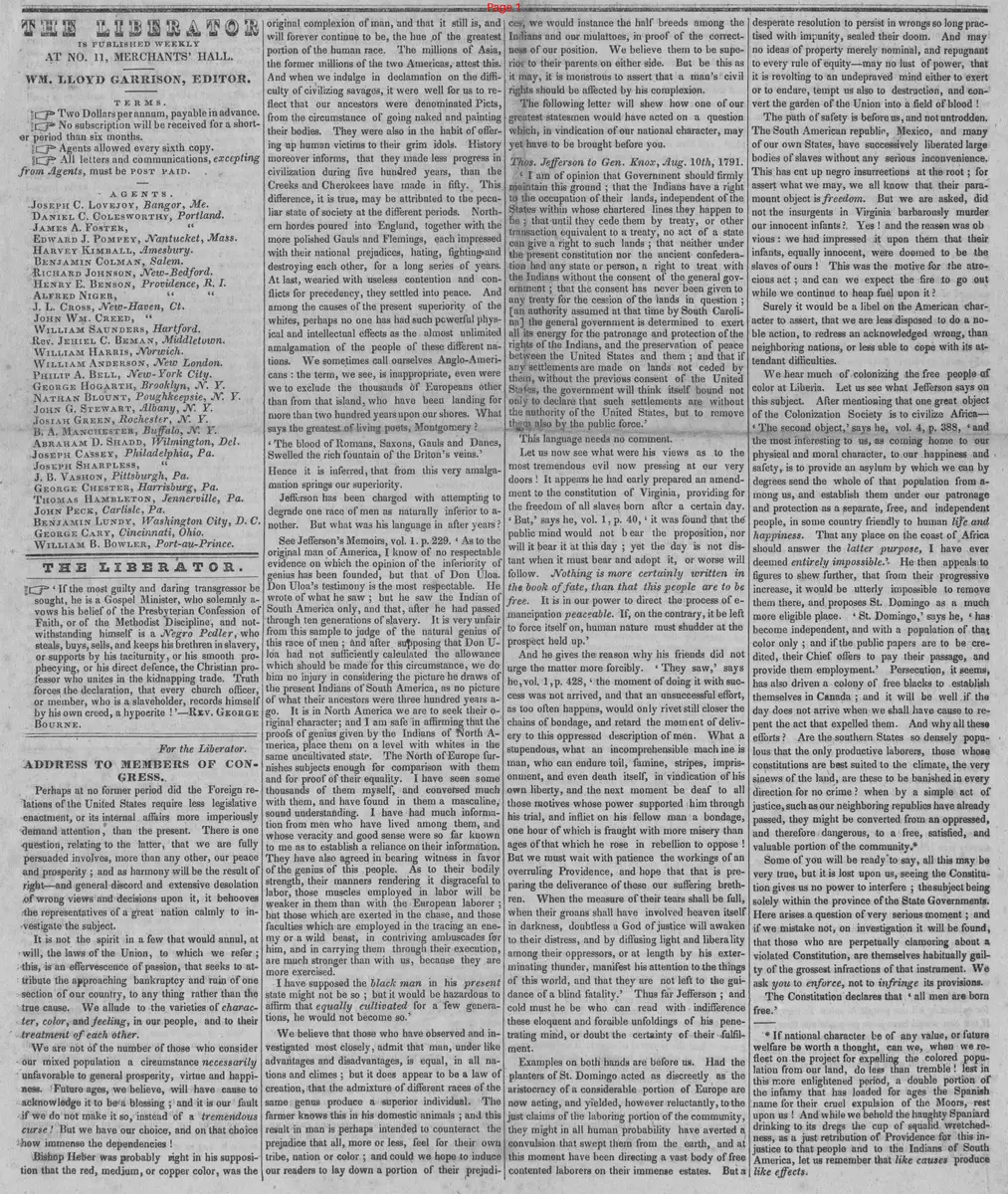
For the Liberator.
ADDRESS TO MEMBERS OF CONGRESS.
Perhaps at no former period did the Foreign relations of the United States require less legislative enactment, or its internal affairs more imperiously demand attention, than the present. There is one question, relating to the latter, that we are fully persuaded involves, more than any other, our peace and prosperity; and as harmony will be the result of right- and general-discord and extensive desolation of wrong views and decisions upon it, it behooves the representatives of a great nation calmly to investigate the subject.
It is not the spirit in a few that would annul, at will, the laws of the Union, to which we refer; this, is an effervescence of passion, that seeks to attribute the approaching bankruptcy and ruin of one section of our country, to any thing rather than the true cause. We allude to the varieties of character, color, and feeling, in our people, and to their treatment of each other.
We are not of the number of those who consider our mixed population a circumstance necessarily unfavorable to general prosperity, virtue and happiness. Future ages, we believe, will have cause to acknowledge it to be a blessing; and it is our fault if we do not make it so, instead of a tremendous curse! But we have our choice, and on that choice how immense the dependencies!
Bishop Heber was probably right in his supposition that the red, medium, or copper color, was the original complexion of man, and that it still is, and will forever continue to be, the hue of the greatest portion of the human race. The millions of Asia, the former millions of the two Americas, attest this. And when we indulge in declamation on the difficulty of civilizing savages, it were well for us to reflect that our ancestors were denominated Picts, from the circumstance of going naked and painting their bodies. They were also in the habit of offering up human victims to their grim idols. History moreover informs, that they made less progress in civilization during five hundred years, than the Creeks and Cherokees have made in fifty. This difference, it is true, may be attributed to the peculiar state of society at the different periods. Northern hordes poured into England, together with the more polished Gauls and Flemings, each impressed with their national prejudices, hating, fighting and destroying each other, for a long series of years. At last, wearied with useless contention and conflicts for precedency, they settled into peace. And among the causes of the present superiority of the whites, perhaps no one has had such powerful physical and intellectual effects as the almost unlimited amalgamation of the people of these different nations. We sometimes call ourselves Anglo-Americans: the term, we see, is inappropriate, even were we to exclude the thousands of Europeans other than from that island, who have been landing for more than two hundred years upon our shores. What says the greatest of living poets, Montgomery? 'The blood of Romans, Saxons, Gauls and Danes, Swelled the rich fountain of the Briton's veins.' Hence it is inferred, that from this very amalgamation springs our superiority.
Jefferson has been charged with attempting to degrade one race of men as naturally inferior to another. But what was his language in after years? See Jefferson's Memoirs, vol. 1. p. 229, 'As to the original man of America, I know of no respectable evidence on which the opinion of the inferiority of genius has been founded, but that of Don Ulloa. Don Ulloa's testimony is the most respectable. He wrote of what he saw; but he saw the Indian of South America only, and that, after he had passed through ten generations of slavery. It is very unfair from this sample to judge of the natural genius of this race of men; and after supposing that Don Ulloa had not sufficiently calculated the allowance which should be made for this circumstance, we do him no injury in considering the picture he draws of the present Indians of South America, as no picture of what their ancestors were three hundred years ago. It is in North America we are to seek their original character; and I am safe in affirming that the proofs of genius given by the Indians of North America, place them on a level with whites in the same uncultivated state. The North of Europe furnishes subjects enough for comparison with them and for proof of their equality. I have seen some thousands of them myself, and conversed much with them, and have found in them a masculine, sound understanding. I have had much information from men who have lived among them, and whose veracity and good sense were so far known to me as to establish a reliance on their information. They have also agreed in bearing witness in favor of the genius of this people. As to their bodily strength, their manners rendering it disgraceful to labor, those muscles employed in labor will be weaker in them than with the European laborer; but those which are exerted in the chase, and those faculties which are employed in the tracing an enemy or a wild beast, in contriving ambuscades for him, and in carrying them through their execution, are much stronger than with us, because they are more exercised.'
I have supposed the black man in his present state might not be so; but it would be hazardous to affirm that equally cultivated for a few generations, he would not become so.
We believe that those who have observed and investigated most closely, admit that man, under like advantages and disadvantages, is equal, in all nations and climes; but it does appear to be a law of creation, that the admixture of different races of the same genus produce a superior individual. The farmer knows this in his domestic animals; and this result in man is perhaps intended to counteract the prejudice that all, more or less, feel for their own tribe, nation or color; and could we hope to induce our readers to lay down a portion of their prejudices, we would instance the half breeds among the Indians and our mulattoes, in proof of the correctness of our position. We believe them to be superior to their parents on either side. But be this as it may, it is monstrous to assert that a man's civil rights should be affected by his complexion.
The following letter will shew how one of our greatest statesmen would have acted on a question which, in vindication of our national character, may yet have to be brought before you. Thos. Jefferson to Gen. Knox, Aug. 10th, 1791. 'I am of opinion that Government should firmly maintain this ground; that the Indians have a right to the occupation of their lands, independent of the States within whose chartered lines they happen to be; that until they cede them by treaty, or other transaction equivalent to a treaty, no act of a state can give a right to such lands; that neither under the present constitution nor the ancient confederation had any state or person, a right to treat with the Indians without the consent of the general government; that the consent has never been given to any treaty for the cession of the lands in question; [an authority assumed at that time by South Carolina] the general government is determined to exert all its energy for the patronage and protection of the rights of the Indians, and the preservation of peace between the United States and them; and that if any settlements are made on lands not ceded by them, without the previous consent of the United States, the government will think itself bound not only to declare that such settlements are without the authority of the United States, but to remove them also by the public force.'
This language needs no comment. Let us now see what were his views as to the most tremendous evil now pressing at our very doors! It appears he had early prepared an amendment to the constitution of Virginia, providing for the freedom of all slaves born after a certain day. But,' says he, vol. 1, p. 40,' it was found that the public mind would not bear the proposition, nor will it bear it at this day; yet the day is not distant when it must bear and adopt it, or worse will follow. Nothing is more certainly written in the book of fate, than that this people are to be free. It is in our power to direct the process of emancipation peaceable. If, on the contrary, it be left to force itself on, human nature must shudder at the prospect held up.'
And he gives the reason why his friends did not urge the matter more forcibly. They saw,' says he, vol.1, p. 428, the moment of doing it with success was not arrived, and that an unsuccessful effort, as too often happens, would only rivet still closer the chains of bondage, and retard the moment of deliverance to this oppressed description of men. What a stupendous, what an incomprehensible machine is man, who can endure toil, famine, stripes, imprisonment, and even death itself, in vindication of his own liberty, and the next moment be deaf to all those motives whose power supported him through his trial, and inflict on his fellow man a bondage, one hour of which is fraught with more misery than ages of that which he rose in rebellion to oppose! But we must wait with patience the workings of an overruling Providence, and hope that that is preparing the deliverance of these our suffering brethren. When the measure of their tears shall be full, when their groans shall have involved heaven itself in darkness, doubtless a God of justice will awaken to their distress, and by diffusing light and liberality among their oppressors, or at length by his exterminating thunder, manifest his attention to the things of this world, and that they are not left to the guidance of a blind fatality.' Thus far Jefferson; and cold must he be who can read with indifference these eloquent and forcible unfoldings of his penetrating mind, or doubt the certainty of their fulfilment.
Examples on both hands are before us. Had the planters of St. Domingo acted as discreetly as the aristocracy of a considerable portion of Europe are now acting, and yielded, however reluctantly, to the just claims of the laboring portion of the community, they might in all human probability have averted a convulsion that swept them from the earth, and at this moment have been directing a vast body of free contented laborers on their immense estates. But a desperate resolution to persist in wrongs so long practised with impunity, sealed their doom. And may no ideas of property merely nominal, and repugnant to every rule of equity-may no lust of power, that it is revolting to an undepraved mind either to exert or to endure, tempt us also to destruction, and convert the garden of the Union into a field of blood!
The path of safety is before us, and not untrodden. The South American republic, Mexico, and many of our own States, have successively liberated large bodies of slaves without any serious inconvenience. This has cut up negro insurrections at the root; for assert what we may, we all know that their paramount object is freedom. But we are asked, did not the insurgents in Virginia barbarously murder our innocent infants? Yes! and the reason was obvious: we had impressed it upon them that their infants, equally innocent, were doomed to be the slaves of ours! This was the motive for the atrocious act; and can we expect the fire to go out while we continue to heap fuel upon it?
Surely it would be a libel on the American character to assert, that we are less disposed to do a noble action, to redress an acknowledged wrong, than neighboring nations, or less able to cope with its attendant difficulties.
We hear much of colonizing the free people of color at Liberia. Let us see what Jefferson says on this subject. After mentioning that one great object of the Colonization Society is to civilize Africa—'The second object,' says he, vol. 4, p. 388, 'and the most interesting to us, as coming home to our physical and moral character, to our happiness and safety, is to provide an asylum by which we can by degrees send the whole of that population from among us, and establish them under our patronage and protection as a separate, free, and independent people, in some country friendly to human life and happiness. That any place on the coast of Africa should answer the latter purpose, I have ever deemed entirely impossible.' He then appeals to figures to shew further, that from their progressive increase, it would be utterly impossible to remove them there, and proposes St. Domingo as a much more eligible place. 'St. Domingo,' says he, 'has become independent, and with a population of that color only; and if the public papers are to be credited, their Chief offers to pay their passage, and provide them employment.' Persecution, it seems, has also driven a colony of free blacks to establish themselves in Canada; and it will be well if the day does not arrive when we shall have cause to repent the act that expelled them. And why all these efforts? Are the southern States so densely populous that the only productive laborers, those whose constitutions are best suited to the climate, the very sinews of the land, are these to be banished in every direction for no crime? when by a simple act of justice, such as our neighboring republics have already passed, they might be converted from an oppressed, and therefore dangerous, to a free, satisfied, and valuable portion of the community.*
Some of you will be ready to say, all this may be very true, but it is lost upon us, seeing the Constitution gives us no power to interfere; the subject being solely within the province of the State Governments. Here arises a question of very serious moment; and if we mistake not, on investigation it will be found, that those who are perpetually clamoring about a violated Constitution, are themselves habitually guilty of the grossest infractions of that instrument. We ask you to enforce, not to infringe its provisions. The Constitution declares that all men are born free.
* If national character be of any value, or future welfare be worth a thought, can we, when we reflect on the project for expelling the colored population from our land, do less than tremble! lest in this more enlightened period, a double portion of the infamy that has loaded for ages the Spanish name for their cruel expulsion of the Moors, rest upon us! And while we behold the haughty Spaniard drinking to its dregs the cup of squalid wretchedness, as a just retribution of Providence for this injustice to that people and to the Indians of South America, let us remember that like causes produce like effects.
What sub-type of article is it?
Slavery Abolition
Social Reform
Moral Or Religious
What keywords are associated?
Slavery
Emancipation
Colonization
Racial Equality
Amalgamation
Jefferson
Insurrection
What entities or persons were involved?
Thomas Jefferson
Bishop Heber
American Colonization Society
General Knox
Editorial Details
Primary Topic
Slavery And Race, Opposing Colonization, Advocating Emancipation
Stance / Tone
Strongly Anti Slavery, Moralistic, Critical Of Colonization
Key Figures
Thomas Jefferson
Bishop Heber
American Colonization Society
General Knox
Key Arguments
- Racial equality is possible; differences are due to circumstances.
- Amalgamation of races produces superior individuals.
- Jefferson supported gradual emancipation and opposed colonization.
- Colonization is futile and will not end slavery.
- Injustice and failure to emancipate lead to insurrection.