Thanks for visiting SNEWPapers!
Sign up free today to connect your AI tools to the Library of Congress' newspaper collection.
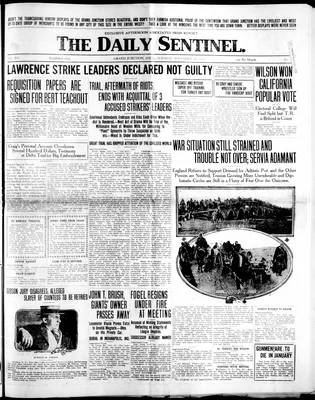
The Daily Sentinel Domestic News November 26, 1912
Grand Junction, Mesa, Colorado
What is this article about?
A Salem, Mass., jury acquits Joseph J. Ettor, Arturo Giovannitti and Joseph Caruso of charges in the death of Anna Lopizzo during the Lawrence textile strike; the trial drew worldwide attention.
Quality green show the numbers
Measured from the scan
— how cleanly the OCR engine read the characters
- Mean ink quality
- 98.0% The length-weighted average confidence across the OCR lines — the mean of exactly the per-line scores whose tails the two figures below report. Typical is 99%.
- Illegible ink
- 0.0% Text sitting in OCR-detected lines that scored below 80% confidence — very shaky reads. Weighted by line length, so one long bad line counts for more than a short one.
- Uncertain ink
- 0.92% Text in lines that scored 80–90% — somewhat shaky reads.
- Matches source
- 97.69% How closely the served text matches the raw OCR of the same boxes, letter by letter, after collapsing spacing and case. This measures agreement, not correctness: the OCR is often wrong and the extractor corrects it, so 100% does not mean perfect, and a low figure usually means poor scan text was rewritten rather than that text was lost (length vs source shows loss). Across pages, this is the worst fragment.
- Length vs source
- 98.93% Below 100% means text was dropped from the OCR; above means text was added to make it read.
Assembled by the extraction model
— whether the stitched-together text holds up; catches layout and segmentation errors, which the scores above cannot see
- Transcription confidence
- 95.0% (typical 96%) How cleanly the extractor could assemble what it was given. Low here with clean ink scores points at layout analysis — the characters were read correctly but grouped or ordered wrongly.
- Comprehension
- 90.0% Whether the piece reads coherently start to finish. Can stay high while transcription confidence drops, when only part of the component is affected.
Clippings
1 of 2
Full Text
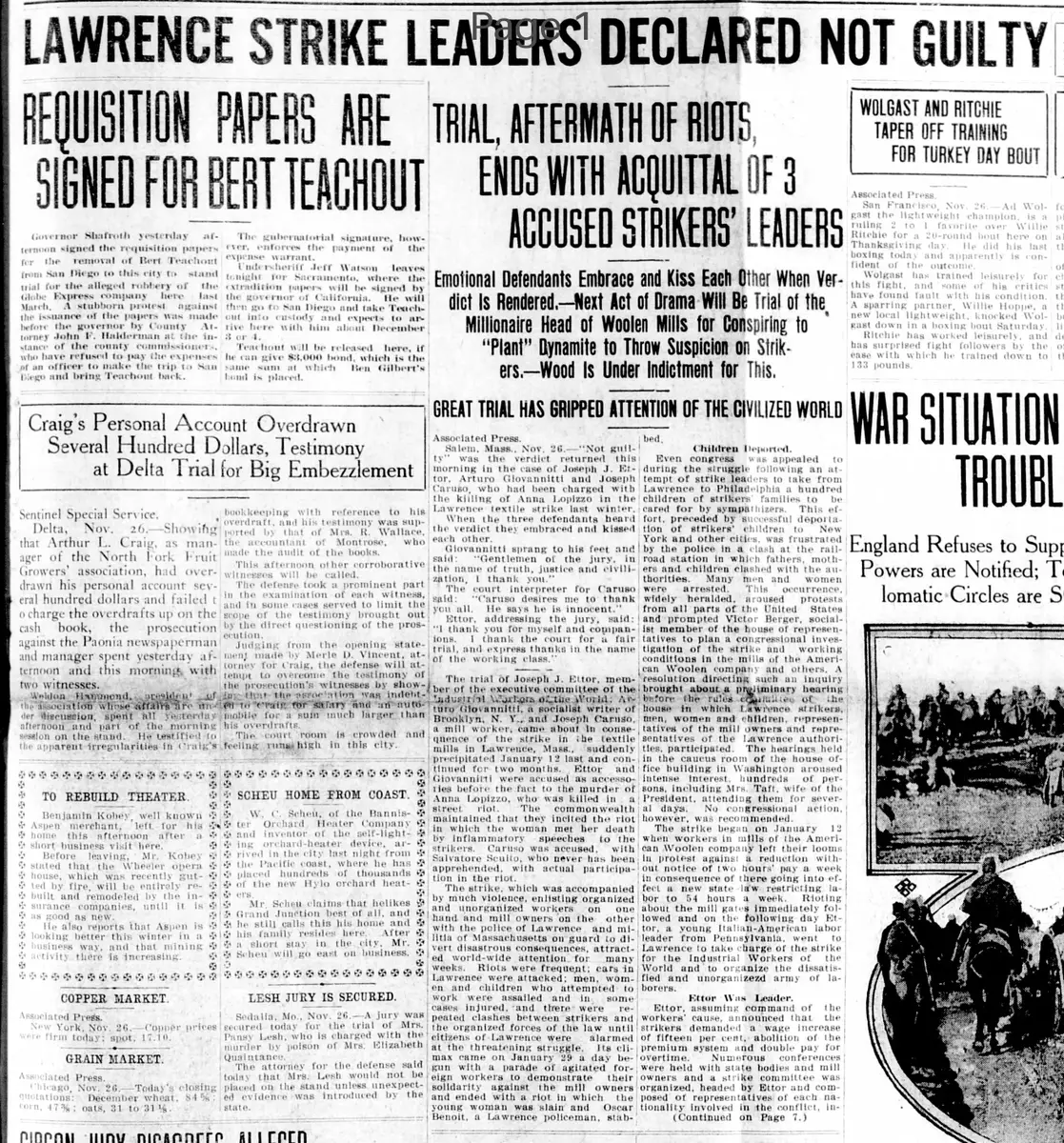
LAWRENCE STRIKE LEADERS DECLARED NOT GUILTY
TRIAL, AFTERMATH OF RIOTS ENDS WITH ACQUITTAL OF 3 ACCUSED STRIKERS' LEADERS
Emotional Defendants Embrace and Kiss Each Other When Verdict Is Rendered.—Next Act of Drama Will Be Trial of the Millionaire Head of Woolen Mills for Conspiring to "Plant" Dynamite to Throw Suspicion on Strikers.—Wood Is Under Indictment for This.
GREAT TRIAL HAS GRIPPED ATTENTION OF THE CIVILIZED WORLD
Associated Press
Salem, Mass., Nov. 26.—"Not guilty" was the verdict returned this morning in the case of Joseph J. Ettor, Arturo Giovannitti and Joseph Caruso, who had been charged with the killing of Anna Lopizzo in the Lawrence textile strike last winter.
When the three defendants heard the verdict they embraced and kissed each other.
Giovannitti sprang to his feet and said: "Gentlemen of the jury, in the name of truth, justice and civilization, I thank you."
The court interpreter for Caruso said: "Caruso desires me to thank you all. He says he is innocent."
Ettor, addressing the jury, said: "I thank you for myself and companions. I thank the court for a fair trial, and express thanks in the name of the working class."
The trial of Joseph J. Ettor, member of the executive committee of the Industrial Workers of the World; Arturo Giovannitti, a socialist writer of Brooklyn, N. Y., and Joseph Caruso, a mill worker, came about in consequence of the strike in the textile mills in Lawrence, Mass., suddenly precipitated January 12 last and continued for two months. Ettor and Giovannitti were accused as accessories before the fact to the murder of Anna Lopizzo, who was killed in a street riot. The commonwealth maintained that they incited the riot in which the woman met her death by inflammatory speeches to the strikers. Caruso was accused, with Salvatore Scuito, who never has been apprehended, with actual participation in the riot.
The strike, which was accompanied by much violence, enlisting organized and unorganized workers on one hand and mill owners on the other, with the police of Lawrence and militia of Massachusetts on guard to divert disastrous consequences, attracted world-wide attention for many weeks. Riots were frequent; cars in Lawrence were attacked; men, women and children who attempted to work were assailed and in some cases injured, and there were repeated clashes between strikers and the organized forces of the law until citizens of Lawrence were alarmed at the threatening struggle. Its climax came on January 29, a day begun with a parade of agitated foreign workers to demonstrate their solidarity against the mill owners and ended with a riot in which the young woman was slain and Oscar Benoit, a Lawrence policeman, stabbed.
Children Deported.
Even congress was appealed to during the struggle following an attempt of strike leaders to take from Lawrence to Philadelphia a hundred children of strikers' families to be cared for by sympathizers. This effort, preceded by successful deportation of strikers' children to New York and other cities, was frustrated by the police in a clash at the railroad station in which fathers, mothers and children clashed with the authorities. Many men and women were arrested. This occurrence, widely heralded, aroused protests from all parts of the United States and prompted Victor Berger, socialist member of the house of representatives, to plan a congressional investigation of the strike and working conditions in the mills of the American Woolen company and others. A resolution directing such an inquiry brought about a preliminary hearing before the rules committee of the house in which Lawrence strikers, men, women and children, representatives of the mill owners and representatives of the Lawrence authorities participated. The hearings held in the caucus room of the house office building in Washington aroused intense interest; hundreds of persons, including Mrs. Taft, wife of the President, attending them for several days. No congressional action, however, was recommended.
The strike began on January 12 when workers in mills of the American Woolen company left their looms in protest against a reduction without notice of two hours' pay a week in consequence of there going into effect a new state law restricting labor to 54 hours a week. Rioting about the mill gates immediately followed and on the following day Ettor, a young Italian-American labor leader from Pennsylvania, went to Lawrence to take charge of the strike for the Industrial Workers of the World and to organize the dissatisfied and unorganized army of laborers.
Ettor Was Leader.
Ettor, assuming command of the workers' cause, announced that the strikers demanded a wage increase of fifteen per cent, abolition of the premium system and double pay for overtime. Numerous conferences were held with state bodies and mill owners and a strike committee was organized, headed by Ettor and composed of representatives of each nationality involved in the conflict, in-
(Continued on Page 7.)
Lawrence Strike Leaders Not Guilty
(Continued from Page 1.)
cluding the Italians, who were most numerous, Poles, Syrians, Lithuanians, Hebrews, Americans and others.
In keeping up the enthusiasm thus he was aided by Arturo Giovannitti, who went to Lawrence from Brooklyn, William D. Haywood, the leader of the Industrial Workers of the World, and many other prominent men in the work of the organization.
Later business men and William M. Wood, president of the American Woolen company, were indicted for conspiracy to plant dynamite in Lawrence.
After a parade Ettor and Giovannitti addressed the strikers in Lawrence Common, where they are alleged to have urged the strikers to acts of violence. That evening the streets near the mills were jammed with the idle millworkers. Soldiers and police were ordered to clear the streets.
Woman Killed.
Many blocks of ice were thrown at the officers of the law. Policemen's clubs, in retaliation, were wielded over the backs of recalcitrant strikers, when suddenly shooting began and Anna Lopizzo fell lifeless in the street. Other riots followed the next day and that midnight Ettor and Giovannitti were arrested, charged with being accessories before the fact to the Lopizzo murder. Later Caruso was arrested, charged with Salvatore Scuito, as one of the principals to the crime as an actual participant in the fatal riot.
Indictments of the strike leaders and Caruso brought about an organized world-wide effort to raise a defense fund and workers from many countries responded. Threats of a general world strike in protest again were made, and since the beginning of the trial Lawrence has been flooded with circulars denouncing the agents of the courts and the conditions of the case. Threats to storm the jail have been made and feeling has run riot up to the very close of the case. When the trial began a 24-hour strike of protest was responded to by 50,000 workers in mills throughout New England.
Used 300 Talesmen.
The case, after several delays, was actually taken up early in October in the superior court of Essex county before Justice Joseph F. Quinn. Efforts to get a jury exhausted a panel of 300 veniremen, and another delay until October 14 followed. When taken up again a jury was procured within two days and the commonwealth began the presentation of testimony October 16. District Attorney Henry C. Atwill had charge of the case for the commonwealth. J. P. Mahoney for Ettor; W. Scott Peters for Giovannitti; James H. Sisk for Caruso, with George F. Roewer, Jr., and Fred H. Moore as advisory counsel, conducted the defense.
What sub-type of article is it?
Labor Dispute
Legal Or Court
Riot Or Protest
What keywords are associated?
Lawrence Strike
Ettor
Giovannitti
Caruso
Acquittal
Textile Strike
What entities or persons were involved?
Joseph J. Ettor
Arturo Giovannitti
Joseph Caruso
Anna Lopizzo
William M. Wood
Justice Joseph F. Quinn
Where did it happen?
Salem, Mass.
Domestic News Details
Primary Location
Salem, Mass.
Event Date
Nov. 26
Key Persons
Joseph J. Ettor
Arturo Giovannitti
Joseph Caruso
Anna Lopizzo
William M. Wood
Justice Joseph F. Quinn
Outcome
three defendants acquitted; anna lopizzo killed in strike riot; oscar benoit stabbed.