Thank you for visiting SNEWPapers!
Sign up free
The Virginia Gazette Letter to Editor January 13, 1776
Richmond, Richmond, Virginia
What is this article about?
A letter defending Lieutenant Boykin, arguing that a general court-martial is the last resort for officers and questioning Colonel Woodford's petition to have him brought before the Convention after his acquittal.
Quality yellow The extractor judged this less than fully coherent. show the numbers
- The extractor judged this less than fully coherent.
- The extractor was unsure its transcription reads as real language, even though the scan measures clean.
Measured from the scan
— how cleanly the OCR engine read the characters
- Mean ink quality
- 98.0% The length-weighted average confidence across the OCR lines — the mean of exactly the per-line scores whose tails the two figures below report. Typical is 99%.
- Illegible ink
- 4.6% Text sitting in OCR-detected lines that scored below 80% confidence — very shaky reads. Weighted by line length, so one long bad line counts for more than a short one.
- Uncertain ink
- 0.0% Text in lines that scored 80–90% — somewhat shaky reads.
- Matches source
- 97.36% How closely the served text matches the raw OCR of the same boxes, letter by letter, after collapsing spacing and case. This measures agreement, not correctness: the OCR is often wrong and the extractor corrects it, so 100% does not mean perfect, and a low figure usually means poor scan text was rewritten rather than that text was lost (length vs source shows loss).
- Length vs source
- 100.1% Below 100% means text was dropped from the OCR; above means text was added to make it read.
Assembled by the extraction model
— whether the stitched-together text holds up; catches layout and segmentation errors, which the scores above cannot see
- Transcription confidence
- 80.0% (typical 96%) How cleanly the extractor could assemble what it was given. Low here with clean ink scores points at layout analysis — the characters were read correctly but grouped or ordered wrongly.
- Comprehension
- 70.0% Whether the piece reads coherently start to finish. Can stay high while transcription confidence drops, when only part of the component is affected.
Clipping
Full Text
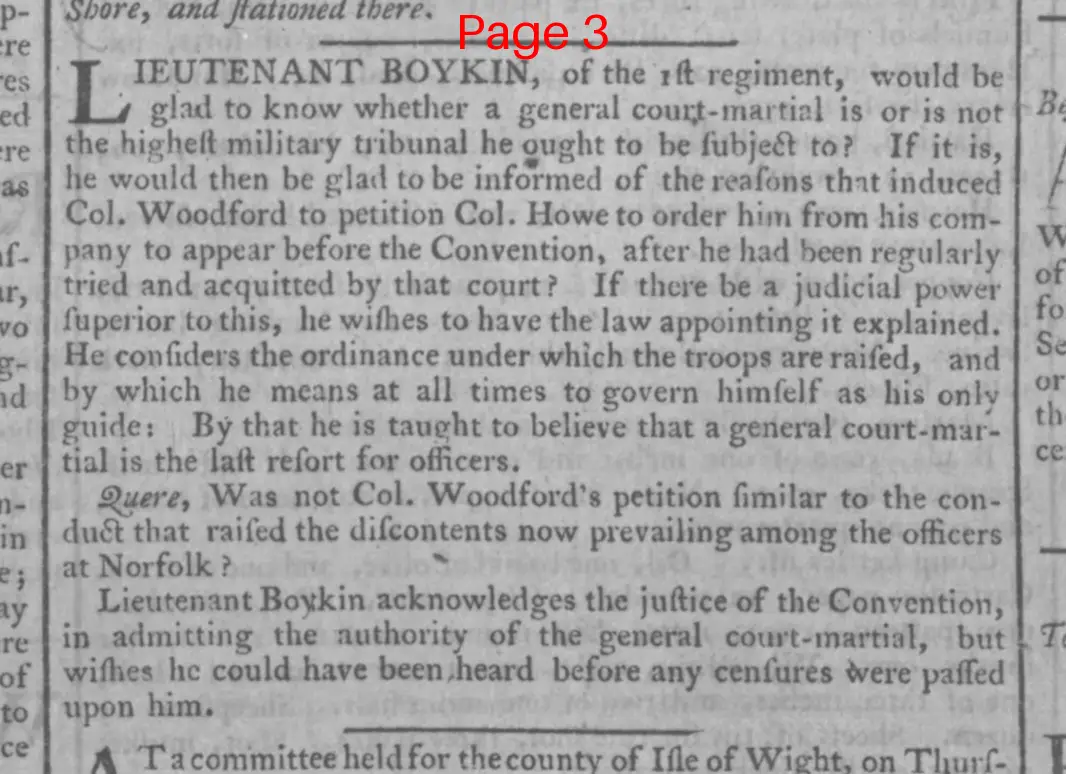
Lieutenant Boykin, of the first regiment, would be the highest military tribunal he ought to be subject to? If it is, he would then be glad to be informed of the reasons that induced Col. Woodford to petition Col. Howe to order him from his company to appear before the Convention, after he had been regularly tried and acquitted by that court? If there be a judicial power superior to this, he wishes to have the law appointing it explained. He considers the ordinance under which the troops are raised, and by which he means at all times to govern himself as his only guide: By that he is taught to believe that a general court-martial is the last resort for officers.
Quere, Was not Col. Woodford's petition similar to the conduct that raised the discontents now prevailing among the officers at Norfolk?
Lieutenant Boykin acknowledges the justice of the Convention, in admitting the authority of the general court-martial, but wishes he could have been heard before any censures were passed upon him.
What sub-type of article is it?
Persuasive
Political
What themes does it touch?
Military War
Constitutional Rights
What keywords are associated?
General Court Martial
Lieutenant Boykin
Military Tribunal
Colonel Woodford
Officers' Rights
Letter to Editor Details
Main Argument
A general court-martial is the last resort for officers; Boykin's acquittal should be final, and the Convention should not censure him without a hearing.
Notable Details
- mentions Col. Woodford's petition to Col. Howe
- references the ordinance for raising troops
- queries about discontents among officers at Norfolk
- Boykin acknowledges the Convention's justice but wishes to be heard before censure