Thanks for visiting SNEWPapers!
Sign up free today to connect your AI tools to the Library of Congress' newspaper collection.
The Hillsdale Standard Story November 25, 1851
Hillsdale, Hillsdale, Michigan
What is this article about?
Extract from a seaman's journal of the 1850-51 Arctic expedition: while moored to an iceberg in Baffin's Bay, he and two seamen row a dinghy through a vast natural ice arch; inside, the berg cracks and shifts, and they escape before it bursts that night.
Quality green show the numbers
Measured from the scan
— how cleanly the OCR engine read the characters
- Mean ink quality
- 97.0% The length-weighted average confidence across the OCR lines — the mean of exactly the per-line scores whose tails the two figures below report. Typical is 99%.
- Illegible ink
- 0.0% Text sitting in OCR-detected lines that scored below 80% confidence — very shaky reads. Weighted by line length, so one long bad line counts for more than a short one.
- Uncertain ink
- 0.1% Text in lines that scored 80–90% — somewhat shaky reads.
- Matches source
- 97.28% How closely the served text matches the raw OCR of the same boxes, letter by letter, after collapsing spacing and case. This measures agreement, not correctness: the OCR is often wrong and the extractor corrects it, so 100% does not mean perfect, and a low figure usually means poor scan text was rewritten rather than that text was lost (length vs source shows loss).
- Length vs source
- 98.79% Below 100% means text was dropped from the OCR; above means text was added to make it read.
Assembled by the extraction model
— whether the stitched-together text holds up; catches layout and segmentation errors, which the scores above cannot see
- Transcription confidence
- 95.0% (typical 96%) How cleanly the extractor could assemble what it was given. Low here with clean ink scores points at layout analysis — the characters were read correctly but grouped or ordered wrongly.
- Comprehension
- 98.0% Whether the piece reads coherently start to finish. Can stay high while transcription confidence drops, when only part of the component is affected.
Clipping
Full Text
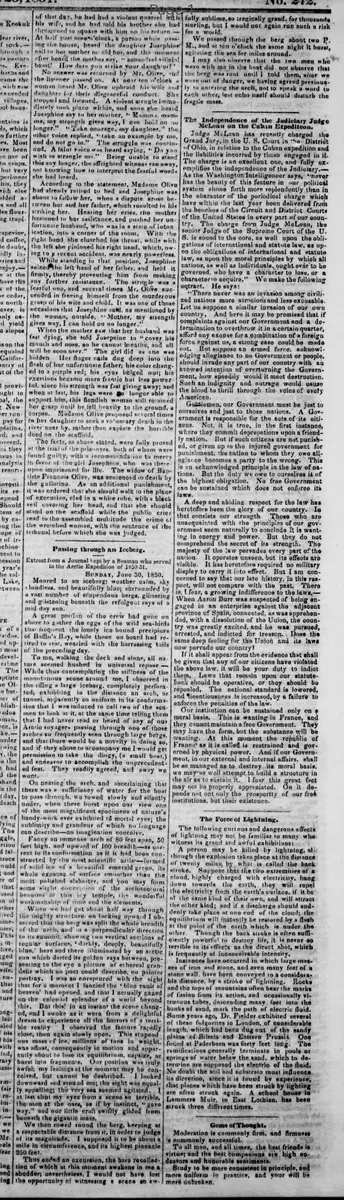
Passing through an Iceberg.
Extract from a Journal kept by a Seaman who served in the Arctic Expedition of 1850-51.
SUNDAY, June 30, 1850.
Moored to an iceberg; weather calm, sky cloudless, and beautifully blue; surrounded by a vast number of stupendous bergs, glittering and glistening beneath the refulgent rays of a mid-day sun.
A great portion of the crew had gone on shore to gather the eggs of the wild sea-birds that frequent the lonely ice-bound precipices of Baffin's Bay, while those on board had retired to rest, wearied with the harassing toils of the preceding day.
To me, walking the deck and alone, all nature seemed hushed in universal repose. While thus contemplating the stillness of the monotonous scene around me, I observed in the offing a large iceberg, completely perforated, exhibiting in the distance an arch, or tunnel, apparently so uniform in its conformation that I was induced to call two of the seamen to look at it, at the same time telling them that I had never read or heard of any of our Arctic voyagers passing through one of those arches so frequently seen through large bergs, and that there would be a novelty in doing so, and if they chose to accompany me I would get permission to take the dingy, (a small boat.) and endeavor to accomplish the unprecedented feat. They readily agreed, and away we went.
On nearing the arch, and ascertaining that there was a sufficiency of water for the boat to pass through, we rowed slowly and silently under, when there burst upon our view one of the most magnificent specimens of nature's handy-work ever exhibited to mortal eyes; the sublimity and grandeur of which no language can describe—no imagination conceive.
Fancy an immense arch of 80 feet span, 50 feet high, and upward of 100 feet breadth—as correct in its conformation as if it had been constructed by the most scientific artist—formed of solid ice of a beautiful emerald green, its whole expanse of surface smoother than the most polished alabaster, and you may form some slight conception of the architectural beauties of this icy temple, the wonderful workmanship of time and the elements.
When we had got about half way through the mighty structure, on looking upward I observed that the berg was split the whole breadth of the arch, and in a perpendicular direction to its summit, showing two vertical sections of regular surfaces, darkly, deeply, beautifully blue, here and there illuminated by an arctic sun which darted its golden rays between, presenting to the eye a picture of ethereal grandeur which no poet could describe, no painter portray. I was so enraptured with the sight that for a moment I fancied the 'blue vault of heaven' had opened, and that I actually gazed on the celestial splendor of a world beyond this. But this! in an instant the scene changed, and I awoke as it were from a delightful dream to experience all the horrors of a terrible reality. I observed the fracture rapidly close, then again slowly open. This stupendous mass of ice, millions of tons in weight, was afloat, consequently in motion and apparently about to lose its equilibrium, capsize, or burst into fragments. Our position was truly awful; my feelings at the moment may be conceived, but cannot be described. I looked downward and around me; the sight was equally appalling; the very sea seemed agitated. I at last shut my eyes from a scene so terrible, the men at the oars, as if by instinct, "gave way," and our little craft swiftly glided from beneath the gigantic mass.
We then rowed round the berg, keeping at a respectable distance from it, in order to judge of its magnitude. I supposed it to be about a mile in circumference, and its highest pinnacle 250 feet.
Thus ended an excursion, the bare recollection of which at this moment awakens in me a shudder; nevertheless, I would not have lost the opportunity of witnessing a scene so sublime, so fully sublime, so tragically grand, for thousands of sterling, but I would not again run such a risk for a world.
We passed through the berg about two P.M., and at ten o'clock the same night it burst, agitating the sea for miles around.
I may also observe that the two men who were with me in the boat did not observe that the berg was rent until I told them, after we were out of danger, we having agreed previously to entering the arch, not to speak a word to each other, lest echo itself should disturb the fragile mass.
What sub-type of article is it?
Adventure
Survival
What themes does it touch?
Survival
Nature
What keywords are associated?
Arctic Expedition
Iceberg
Ice Arch
Baffin's Bay
Seaman's Journal
Where did it happen?
Baffin's Bay
Story Details
Location
Baffin's Bay
Event Date
June 30, 1850