Thank you for visiting SNEWPapers!
Sign up free
The New Hampshire Gazette And Historical Chronicle Literary June 10, 1763
Portsmouth, Rockingham, New Hampshire
What is this article about?
A moral essay occasioned by a public execution, urging readers to shun drunkenness and passion, to repent, and to learn from the criminal's fate.
Quality yellow The extractor was unsure its transcription reads as real language, even though the scan measures clean. show the numbers
Measured from the scan
— how cleanly the OCR engine read the characters
- Mean ink quality
- 99.0% The length-weighted average confidence across the OCR lines — the mean of exactly the per-line scores whose tails the two figures below report. Typical is 99%.
- Illegible ink
- 0.0% Text sitting in OCR-detected lines that scored below 80% confidence — very shaky reads. Weighted by line length, so one long bad line counts for more than a short one.
- Uncertain ink
- 0.0% Text in lines that scored 80–90% — somewhat shaky reads.
- Matches source
- 96.5% How closely the served text matches the raw OCR of the same boxes, letter by letter, after collapsing spacing and case. This measures agreement, not correctness: the OCR is often wrong and the extractor corrects it, so 100% does not mean perfect, and a low figure usually means poor scan text was rewritten rather than that text was lost (length vs source shows loss).
- Length vs source
- 99.79% Below 100% means text was dropped from the OCR; above means text was added to make it read.
Assembled by the extraction model
— whether the stitched-together text holds up; catches layout and segmentation errors, which the scores above cannot see
- Transcription confidence
- 90.0% (typical 96%) How cleanly the extractor could assemble what it was given. Low here with clean ink scores points at layout analysis — the characters were read correctly but grouped or ordered wrongly.
- Comprehension
- 90.0% Whether the piece reads coherently start to finish. Can stay high while transcription confidence drops, when only part of the component is affected.
Clipping
Full Text
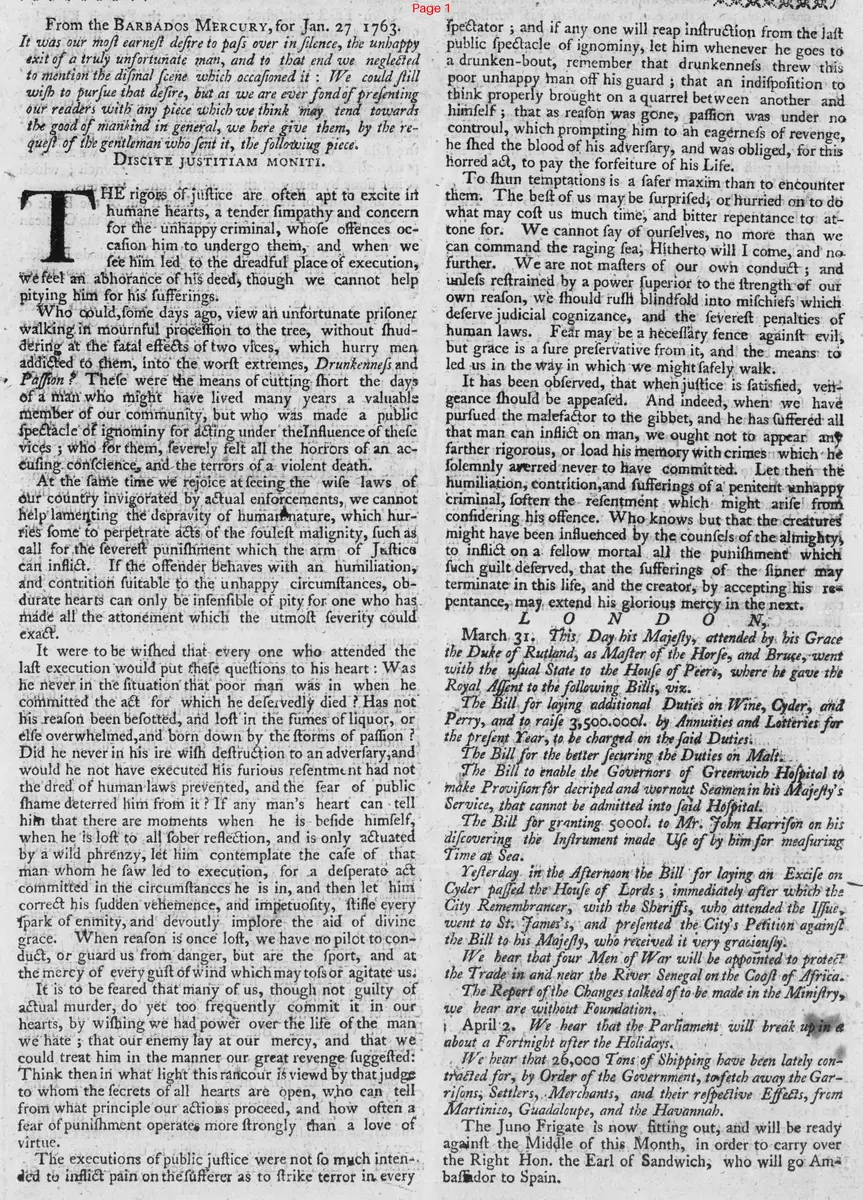
From the BARBADOS MERCURY, for Jan. 27 1763.
It was our most earnest desire to pass over in silence, the unhappy exit of a truly unfortunate man, and to that end we neglected to mention the dismal scene which occasioned it: We could still wish to pursue that desire, but as we are ever fond of presenting our readers with any piece which we think may tend towards the good of mankind in general, we here give them, by the request of the gentleman who sent it, the following piece.
DISCITE JUSTITIAM MONITI.
The rigors of justice are often apt to excite in humane hearts, a tender sympathy and concern for the unhappy criminal, whose offences occasion him to undergo them, and when we see him led to the dreadful place of execution, we feel an abhorrence of his deed, though we cannot help pitying him for his sufferings.
Who could, some days ago, view an unfortunate prisoner walking in mournful procession to the tree, without shuddering at the fatal effects of two vices, which hurry men addicted to them, into the worst extremes, Drunkenness and Passion? These were the means of cutting short the days of a man who might have lived many years a valuable member of our community, but who was made a public spectacle of ignominy for acting under the influence of these vices; who for them, severely felt all the horrors of an accusing conscience, and the terrors of a violent death.
At the same time we rejoice at seeing the wise laws of our country invigorated by actual enforcements, we cannot help lamenting the depravity of human nature, which hurries some to perpetrate acts of the foulest malignity, such as call for the severest punishment which the arm of Justice can inflict. If the offender behaves with an humiliation, and contrition suitable to the unhappy circumstances, obdurate hearts can only be insensible of pity for one who has made all the atonement which the utmost severity could exact.
It were to be wished that every one who attended the last execution would put these questions to his heart: Was he never in the situation that poor man was in when he committed the act for which he deservedly died? Has not his reason been besotted, and lost in the fumes of liquor, or else overwhelmed, and borne down by the storms of passion? Did he never in his ire wish destruction to an adversary, and would he not have executed his furious resentment had not the dread of human laws prevented, and the fear of public shame deterred him from it? If any man's heart can tell him that there are moments when he is beside himself, when he is lost to all sober reflection, and is only actuated by a wild phrenzy, let him contemplate the case of that man whom he saw led to execution, for a desperate act committed in the circumstances he is in, and then let him correct his sudden vehemence, and impetuosity, stifle every spark of enmity, and devoutly implore the aid of divine grace. When reason is once lost, we have no pilot to conduct, or guard us from danger, but are the sport, and at the mercy of every gust of wind which may toss or agitate us.
It is to be feared that many of us, though not guilty of actual murder, do yet too frequently commit it in our hearts, by wishing we had power over the life of the man we hate; that our enemy lay at our mercy, and that we could treat him in the manner our great revenge suggested: Think then in what light this rancour is viewed by that judge to whom the secrets of all hearts are open, who can tell from what principle our actions proceed, and how often a fear of punishment operates more strongly than a love of virtue.
The executions of public justice were not so much intended to inflict pain on the sufferer as to strike terror in every spectator; and if any one will reap instruction from the last public spectacle of ignominy, let him whenever he goes to a drunken-bout, remember that drunkenness threw this poor unhappy man off his guard; that an indisposition to think properly brought on a quarrel between another and himself; that as reason was gone, passion was under no controul, which prompting him to an eagerness of revenge, he shed the blood of his adversary, and was obliged, for this horrid act, to pay the forfeiture of his life.
To shun temptations is a safer maxim than to encounter them. The best of us may be surprised, or hurried on to do what may cost us much time, and bitter repentance to atone for. We cannot say of ourselves, no more than we can command the raging sea, Hitherto will I come, and no further. We are not masters of our own conduct; and unless restrained by a power superior to the strength of our own reason, we should rush blindfold into mischiefs which deserve judicial cognizance, and the severest penalties of human laws. Fear may be a necessary fence against evil, but grace is a sure preservative from it, and the means to lead us in the way in which we might safely walk.
It has been observed, that when justice is satisfied, vengeance should be appeased. And indeed, when we have pursued the malefactor to the gibbet, and he has suffered all that man can inflict on man, we ought not to appear any farther rigorous, or load his memory with crimes which he solemnly averred never to have committed. Let then the humiliation, contrition, and sufferings of a penitent unhappy criminal, soften the resentment which might arise from considering his offence. Who knows but that the creatures might have been influenced by the counsels of the Almighty to inflict on a fellow mortal all the punishment which such guilt deserved, that the sufferings of the sinner may terminate in this life, and the Creator, by accepting his repentance, may extend his glorious mercy in the next.
What sub-type of article is it?
Essay
What themes does it touch?
Moral Virtue
Death Mortality
Religious
What keywords are associated?
Moral Essay
Execution
Drunkenness
Passion
Repentance
Divine Grace
What entities or persons were involved?
From The Barbados Mercury
Literary Details
Title
Discite Justitiam Moniti
Author
From The Barbados Mercury
Subject
Moral Reflection On A Recent Execution And The Vices Of Drunkenness And Passion
Form / Style
Reflective Moral Didactic Prose Essay
Key Lines
Who Could, Some Days Ago, View An Unfortunate Prisoner Walking In Mournful Procession To The Tree, Without Shuddering At The Fatal Effects Of Two Vices, Which Hurry Men Addicted To Them, Into The Worst Extremes, Drunkenness And Passion?
To Shun Temptations Is A Safer Maxim Than To Encounter Them.