Thanks for visiting SNEWPapers!
Sign up free today to connect your AI tools to the Library of Congress' newspaper collection.
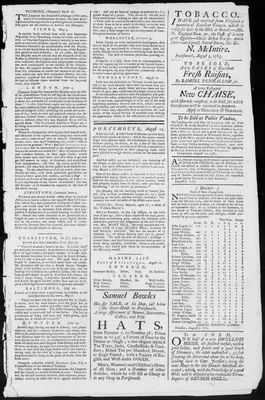
Fowle's New Hampshire Gazette And General Advertiser Domestic News August 12, 1785
Portsmouth, Rockingham, New Hampshire
What is this article about?
A letter from New York reports acute money scarcity, fear of legal-tender and paper-money laws, capital being sent to Great Britain for five percent interest, and a Dutch farmer refusing to lend at six percent after a New Jersey law he considered villainous.
Quality green show the numbers
Measured from the scan
— how cleanly the OCR engine read the characters
- Mean ink quality
- 98.0% The length-weighted average confidence across the OCR lines — the mean of exactly the per-line scores whose tails the two figures below report. Typical is 99%.
- Illegible ink
- 0.0% Text sitting in OCR-detected lines that scored below 80% confidence — very shaky reads. Weighted by line length, so one long bad line counts for more than a short one.
- Uncertain ink
- 4.6% Text in lines that scored 80–90% — somewhat shaky reads.
- Matches source
- 96.15% How closely the served text matches the raw OCR of the same boxes, letter by letter, after collapsing spacing and case. This measures agreement, not correctness: the OCR is often wrong and the extractor corrects it, so 100% does not mean perfect, and a low figure usually means poor scan text was rewritten rather than that text was lost (length vs source shows loss).
- Length vs source
- 98.37% Below 100% means text was dropped from the OCR; above means text was added to make it read.
Assembled by the extraction model
— whether the stitched-together text holds up; catches layout and segmentation errors, which the scores above cannot see
- Transcription confidence
- 97.0% (typical 96%) How cleanly the extractor could assemble what it was given. Low here with clean ink scores points at layout analysis — the characters were read correctly but grouped or ordered wrongly.
- Comprehension
- 90.0% Whether the piece reads coherently start to finish. Can stay high while transcription confidence drops, when only part of the component is affected.
Clipping
Full Text
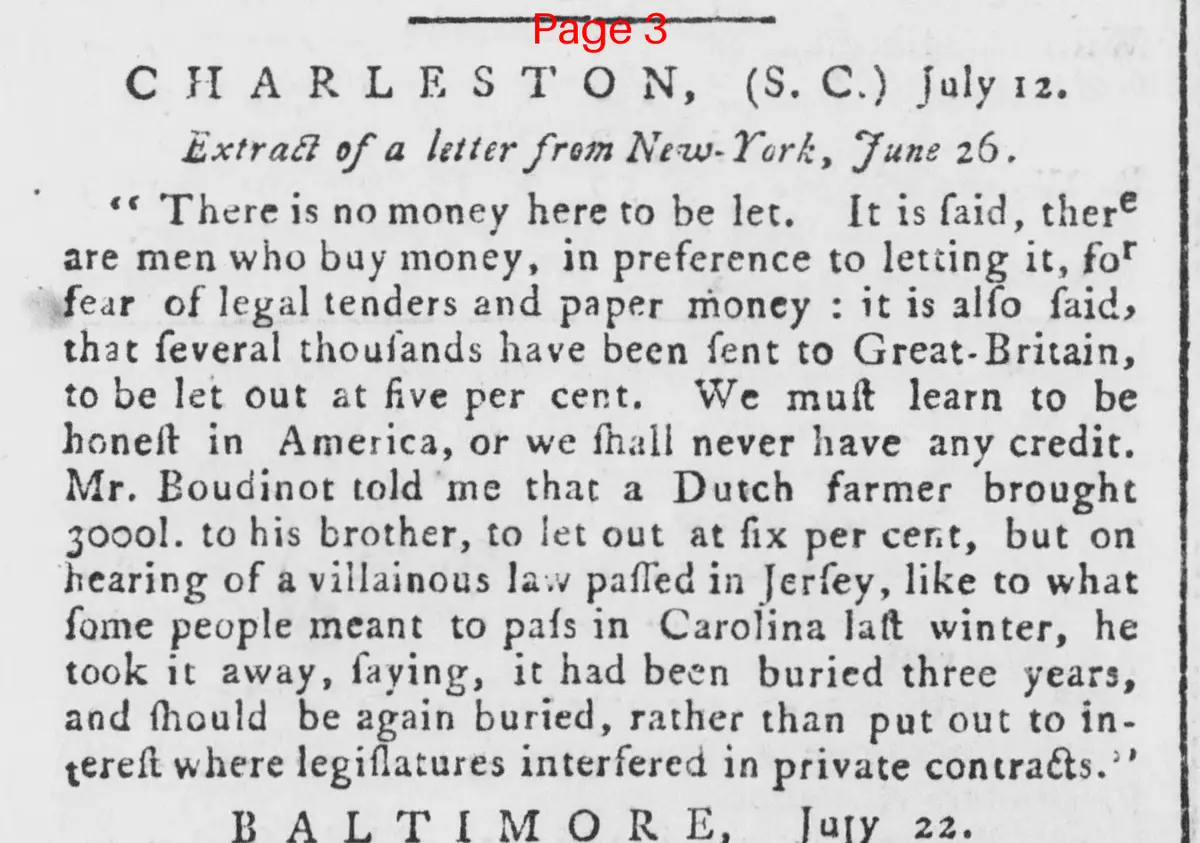
CHARLESTON, (S.C.) July 12.
Extract of a letter from New-York, June 26.
"There is no money here to be let. It is said, there are men who buy money, in preference to letting it, for fear of legal tenders and paper money: it is also said, that several thousands have been sent to Great-Britain, to be let out at five per cent. We must learn to be honest in America, or we shall never have any credit. Mr. Boudinot told me that a Dutch farmer brought 2000l. to his brother, to let out at six per cent, but on hearing of a villainous law passed in Jersey, like to what some people meant to pass in Carolina last winter, he took it away, saying, it had been buried three years, and should be again buried, rather than put out to interest where legislatures interfered in private contracts."
What sub-type of article is it?
Economic
What keywords are associated?
Money Scarcity
Paper Money
Legal Tender
Credit
New York
What entities or persons were involved?
Mr. Boudinot
Where did it happen?
New York
Domestic News Details
Primary Location
New York
Event Date
June 26
Key Persons
Mr. Boudinot
Outcome
money scarce; several thousand pounds sent to great britain; a dutch farmer declined to lend rather than risk legislative interference.