Thank you for visiting SNEWPapers!
Sign up free
The Virginia Gazette Domestic News December 1, 1768
Richmond, Richmond, Virginia
What is this article about?
Dispatch from Boston, Oct 24–Nov 10, 1768, reporting British troops quartered in town, customs seizures and prosecutions (including John Hancock's arrest for £9000), assaults on inhabitants by soldiers, incitement of Negro servants, execution of a deserter, and arrival of more troops.
Quality green show the numbers
Measured from the scan
— how cleanly the OCR engine read the characters
- Mean ink quality
- 98.0% The length-weighted average confidence across the OCR lines — the mean of exactly the per-line scores whose tails the two figures below report. Typical is 99%.
- Illegible ink
- 0.0% Text sitting in OCR-detected lines that scored below 80% confidence — very shaky reads. Weighted by line length, so one long bad line counts for more than a short one.
- Uncertain ink
- 0.1% Text in lines that scored 80–90% — somewhat shaky reads.
- Matches source
- 95.43% How closely the served text matches the raw OCR of the same boxes, letter by letter, after collapsing spacing and case. This measures agreement, not correctness: the OCR is often wrong and the extractor corrects it, so 100% does not mean perfect, and a low figure usually means poor scan text was rewritten rather than that text was lost (length vs source shows loss).
- Length vs source
- 100.02% Below 100% means text was dropped from the OCR; above means text was added to make it read.
Assembled by the extraction model
— whether the stitched-together text holds up; catches layout and segmentation errors, which the scores above cannot see
- Transcription confidence
- 96.0% (typical 96%) How cleanly the extractor could assemble what it was given. Low here with clean ink scores points at layout analysis — the characters were read correctly but grouped or ordered wrongly.
- Comprehension
- 95.0% Whether the piece reads coherently start to finish. Can stay high while transcription confidence drops, when only part of the component is affected.
Clipping
Full Text
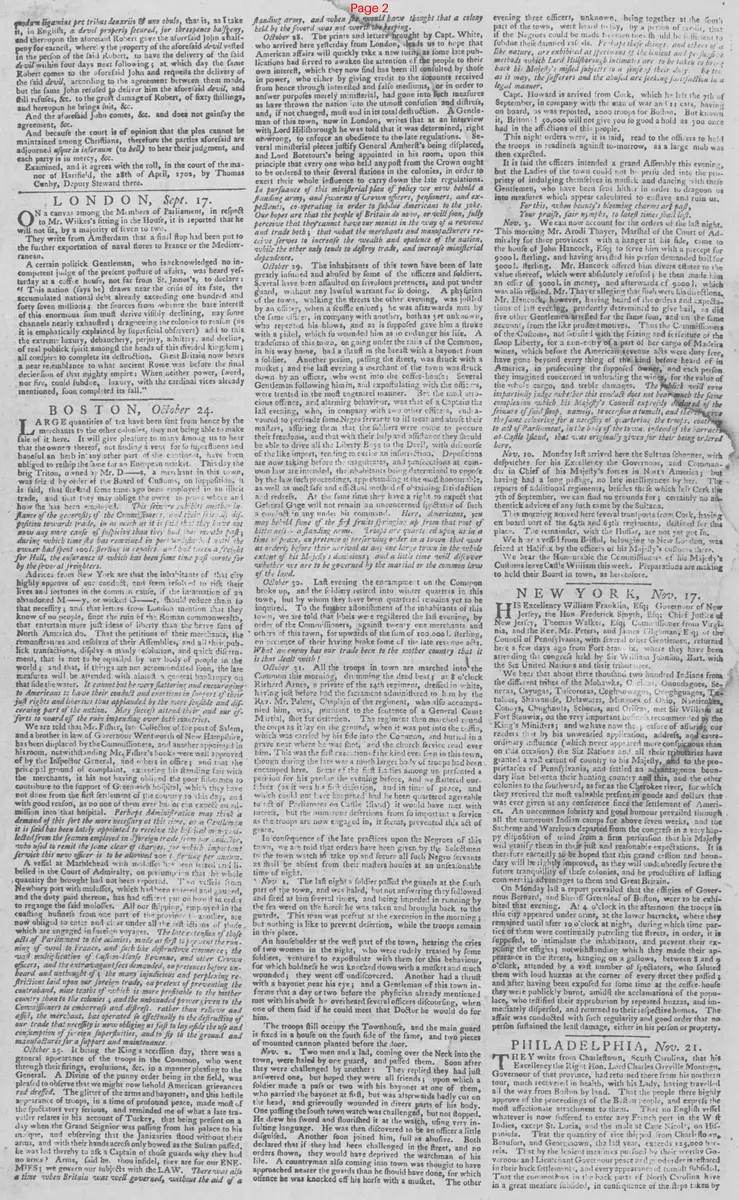
BOSTON, October 24.
Large quantities of tea have been sent from hence by the sale of it here. It will give pleasure to many among us to hear that the owners thereof, not finding a vent for so superfluous and baneful an herb in any other part of the continent, have been obliged to reship the same for an European market. This day the brig Triton, owned by Mr. D-s, a merchant in this town, was seized by order of the Board of Customs, on supposition, it is said, that she had some time ago been employed in an illicit trade, and that they may oblige the owner to prove where and how she has been employed. This seizure exhibits another instance of the generosity of the Commissioners, and their friendly disposition towards trade, in as much as it is said that they have not now any more cause of suspicion than they had four months past; during which time she has remained in port undisturbed until the owner had spent 100l. sterling in repairs, and had taken a freight for Hull, the insurance of which has been some time past wrote for by the several freighters.
Advices from New York are that the inhabitants of that city highly approve of our conduct, and seem resolved to risk their lives and fortunes in the common cause, if the infatuation of an abandoned M-y, or wicked G--r, should reduce them to that necessity; and that letters from London mention that they know of no people, since the ruin of the Roman commonwealth, that entertain more just ideas of liberty than the brave sons of North America do. That the petitions of their merchants, the remonstrances and resolves of their Assemblies, and all their publick transactions, display a manly resolution, and quick discernment, that is not to be equalled by any body of people in the world; and that, if things are not accommodated soon, the late measures will be attended with almost a general bankruptcy on that side the water. It cannot but be very flattering and encouraging to Americans to have their conduct and exertions in support of their just rights and liberties thus applauded by the more sensible and discerning part of the nation. May success attend their and our efforts to ward off the ruin impending over both countries.
We are told that Mr. Fisher, late Collector of the port of Salem, and a brother in law of Governor Wentworth of New Hampshire, has been displaced by the Commissioners, and another appointed in his room, notwithstanding Mr. Fisher's books were well approved of by the Inspector General, and others in office; and that the principal ground of complaint, excepting his standing fair with the merchants, is his not having obliged the poor fishermen to contribute to the support of Greenwich hospital, which they have not done from the first settlement of the country to this day, and with good reason, as no one of them ever has or can expect an admission into that hospital. Perhaps Administration may think a demand of this sort the more necessary at this time, as a Gentleman it is said has been lately appointed to receive the hospital money collected from the seamen employed in a foreign trade from our Collector, who used to remit the same clear of charges, for which important service this new officer is to be allowed 200l. sterling per annum.
A vessel at Marblehead with molasses has been seized and libelled in the Court of Admiralty, on presumption that the whole quantity she brought had not been reported. Two vessels from Newburyport with molasses, which had been entered and gauged, and the duty paid thereon, have had officers put on board in order to regauge the said molasses. All our shipping, employed in the coasting business from one part of the province to another, are now obliged to enter and clear under all the restrictions of those which are engaged in foreign voyages. The late extension of those acts of Parliament to the colonies, made at first to prevent the running of wool to France, and such like destructive commerce; the vast multiplication of Custom-House Revenue, and other Crown officers, and the extravagant fees demanded, on pretences before unheard and unthought of; the many injudicious and perplexing restrictions laid upon our foreign trade, on pretext of preventing the contraband, nine tenths of which is more profitable to the mother country than to the colonies; and the unbounded power given to the Commissioners to embarrass and distress, rather than relieve and assist, the merchant, has operated so effectually to the destruction of our trade that necessity is now obliging us fast to lay aside the use and consumption of foreign superfluities, and to fly to the ground and manufactures for a support and maintenance.
October 25. It being the King's accession day, there was a general appearance of the troops in the Common, who went through their firings, evolutions, &c. in a manner pleasing to the General. A Divine of the puny order being in the field, was pleased to observe that we might now behold American grievances redressed. The glitter of the arms and bayonets, and this hostile appearance of troops, in a time of profound peace, made most of the spectators very serious, and reminded me of what a late traveller relates in his account of Turkey, that being present on a day when the Grand Seignior was passing from his palace to his mosque, and observing that the Janizaries stood without their arms, and with their hands across only bowed as the Sultan passed, he was led thereby to ask a Captain of those guards why they had no arms? Arms, said he, thou infidel, they are for our ENEMIES; we govern our subjects with the LAW. There was also a time when Britain was well governed, without the aid of a standing army, and when she would have thought that a colony held by the sword was not worth the keeping.
October 28. The prints and letters brought by Capt. White, who arrived here yesterday from London, leads us to hope that American affairs will quickly take a new turn, as some late publications had served to awaken the attention of the people to their own interest, which they now find has been ill consulted by those in power, who either by giving credit to the accounts received from hence through interested and false mediums, or in order to answer purposes merely ministerial, had gone into such measures as have thrown the nation into the utmost confusion and distress, and, if not changed, must end in its total destruction. A Gentleman of this town, now in London, writes that at an interview with Lord Hillsborough he was told that it was determined, right or wrong, to enforce an obedience to the late regulations. Several ministerial pieces justify General Amherst's being displaced, and Lord Botetourt's being appointed in his room, upon this principle that every one who held any post from the Crown ought to be ordered to their several stations in the colonies, in order to exert their whole influence to carry down the late regulations. In pursuance of this ministerial plan of policy we now behold a standing army, and swarms of Crown officers, pensioners, and expectants, co-operating in order to subdue Americans to the yoke. Our hopes are that the people of Britain do now, or will soon, fully perceive that they cannot have our monies in the way of a revenue and trade both; that what the merchants and manufacturers receive serves to increase the wealth and opulence of the nation, while the other only tends to destroy trade, and increase ministerial dependence.
October 29. The inhabitants of this town have been of late greatly insulted and abused by some of the officers and soldiers. Several have been assaulted on frivolous pretences, and put under guard, without any lawful warrant for so doing. A physician of the town, walking the streets the other evening, was jostled by an officer, when a scuffle ensued; he was afterwards met by the same officer, in company with another, both as yet unknown, who repeated his blows, and as is supposed gave him a stroke with a pistol, which so wounded him as to endanger his life. A tradesman of this town, on going under the rails of the Common, in his way home, had a thrust in the breast with a bayonet from a soldier. Another person, passing the street, was struck with a musket; and the last evening a merchant of the town was struck down by an officer, who went into the coffee-house: Several Gentlemen following him in, and expostulating with the officers, were treated in the most ungenteel manner. But the most atrocious offence, and alarming behaviour, was that of a Captain the last evening, who, in company with two other officers, endeavoured to persuade some Negro servants to ill treat and abuse their masters, assuring them that the soldiers were come to procure their freedoms, and that with their help and assistance they should be able to drive all the Liberty Boys to the Devil, with discourse of the like import, tending to excite an insurrection. Depositions are now taking before the magistrates, and prosecutions at common law are intended, the inhabitants being determined to oppose by the law such proceedings, apprehending it the most honourable, as well as most safe and effectual method of obtaining satisfaction and redress. At the same time they have a right to expect that General Gage will not remain an unconcerned spectator of such a conduct in any under his command. Here, Americans, you may behold some of the first fruits springing up from that root of bitterness—a standing army. Troops are quartered upon us in a time of peace, on pretence of preserving order in a town that was as orderly before their arrival as any one large town in the whole extent of his Majesty's dominions; and a little time will discover whether we are to be governed by the martial or the common law of the land.
October 30. Last evening the encampment on the Common broke up, and the soldiery retired into winter quarters in this town, but by whom they have been quartered remains yet to be inquired. To the further astonishment of the inhabitants of this town, we are told that libels were registered the last evening, by order of the Commissioners, against twenty one merchants and others of this town, for upwards of the sum of 100,000l. sterling, on pretence of their having broke some of the late revenue acts. What an enemy has our trade been to the mother country that it is thus dealt with!
October 31. All the troops in town are marched into the Common this morning, drumming the dead beat; at 8 o'clock Richard Arnes, a private of the 14th regiment, dressed in white, having just before had the sacrament administered to him by the Rev. Mr. Palms, Chaplain of the regiment, who also accompanied him, was, pursuant to the sentence of a General Court Martial, shot for desertion. The regiment then marched round the corps as it lay on the ground, when it was put into the coffin, which was carried by his side into the Common, and buried in a grave near where he was shot, and the church service read over him. This was the first execution of the kind ever seen in this town, though during the late war a much larger body of troops had been encamped here. Some of the first Ladies among us presented a petition for his pardon the evening before, and we flattered ourselves (as it was his first desertion, and in time of peace, and which could not have happened had he been quartered agreeable to act of Parliament on Castle Island) it would have met with success, but the numerous desertions from so important a service as the troops are now engaged in, it seems, prevented this act of grace.
In consequence of the late practices upon the Negroes of this town, we are told that orders have been given by the Selectmen to the town watch to take up and secure all such Negro servants as shall be absent from their masters houses at an unseasonable time of night.
No. 1. The last night a soldier passed the guards at the south part of the town, and was hailed, but not answering they followed and fired at him several times, and being impeded in running by the sea weed on the beach he was taken and brought back to the guards. This man was present at the execution in the morning; but nothing is like to prevent desertion, while the troops remain in this place.
An householder at the west part of the town, hearing the cries of two women in the night, who were rudely treated by some soldiers, ventured to expostulate with them for this behaviour, for which boldness he was knocked down with a musket and much wounded; they went off undiscovered. Another had a thrust with a bayonet near his eye; and a Gentleman of this town informs that a day or two before the physician already mentioned met with his abuse he overheard several officers discoursing, when one of them said if he could meet that Doctor he would do for him.
The troops still occupy the Townhouse, and the main guard is fixed in a house on the south side of the same, and two pieces of mounted cannon planted before the door.
Nov. 2. Two men and a lad, coming over the Neck into the town, were hailed by one guard, and passed them. Soon after they were challenged by another: They replied they had just answered one, but hoped they were all friends; upon which a soldier made a pass or two with his bayonet at one of them, who parried the bayonet at first, but was afterwards badly cut on the head, and grievously wounded in divers parts of his body. One passing the south town watch was challenged, but not stopped. He drew his sword and flourished it at the watch, using very insulting language. He was then discovered to be an officer a little disguised. Another soon joined him, full as abusive. Both declared that if they had been challenged in the street, and no orders shown, they would have deprived the watchman of his life. A countryman also coming into town was thought to have approached nearer the guards than he should have done, for which offence he was knocked off his horse with a musket. The other evening three officers, unknown, being together at the south part of the town, were heard to say, by a person of credit, that if the Negroes could be made freemen they should be sufficient to subdue these damned rascals. Perhaps these doings, and others of a like nature, are exhibited as specimens of the lenient and persuasive methods which Lord Hillsborough intimates are to be taken to bring back his Majesty's misled subjects to a sense of their duty. Be it as it may, the sufferers and the abused are seeking satisfaction in a legal manner.
Capt. Howard is arrived from Cork, which he left the 7th of September, in company with the man of war and 11 cats, having on board, as was reported, 2000 troops for Boston. But know it, Britons! 50,000 will not give you so good a hold as you once had in the affections of this people.
This night orders were, it is said, read to the officers to hold the troops in readiness against to-morrow, as a large mob was then expected.
It is said the officers intended a grand Assembly this evening but the Ladies of the town could not be persuaded into the propriety of indulging themselves in musick and dancing with these Gentlemen, who have been sent hither in order to dragoon us into measures which appear calculated to enslave and ruin us.
For this, when beauty's blooming charms are past,
Your praise, fair nymphs, to latest times shall last.
Nov. 3. We can now account for the orders of the last night. This morning Mr. Arodi Thayer, Marshal of the Court of Admiralty for three provinces with a hanger at his side, came to the house of John Hancock, Esq; to serve him with a precept for 9000l. sterling. and having arrested his person demanded bail for 2000l. sterling. Mr. Hancock offered him divers estates to the value thereof, which were absolutely refused; he then made him an offer of 2000l. in money, and afterwards of 9000l. which was also refused, Mr. Thayer alleging that such were his directions. Mr. Hancock, however, having heard of the orders and expectations of last evening, prudently determined to give bail, as did five other Gentlemen arrested for the same sum, and on the same account, from the like prudent motives. Thus the Commissioners of the Customs, not satisfied with the seizing and forfeiture of the sloop Liberty, for a non-entry of a part of her cargo of Madeira wines, which before the American revenue acts were duty free, have gone beyond every thing of the kind before heard of in America, in prosecuting the supposed owner, and each person they imagined concerned in unloading the wines, for the value of the whole cargo, and treble damages. The publick will now impartially judge whether this conduct does not bear much the same complexion which his Majesty's Council expressly declared of the seizure of said sloop, namely, to occasion a tumult, and thereby give the same colouring for a necessity of quartering the troops, contra to act of Parliament, in the body of the town, instead of the barracks at Castle Island, that was originally given for their being ordered here.
Nov. 10. Monday last arrived here the Sultana schooner, with despatches for his Excellency the Governor, and Commander in Chief of his Majesty's forces in North America; but having had a long passage, no late intelligences by her. The reports of additional regiments, besides these which left Cork the 7th of September, we can find no grounds for; certainly no authentick advices of any such came by the Sultana.
This morning arrived here several transports from Cork, having on board part of the 64th and 65th regiments, destined for this place. The remainder, with the Hussar, are not yet got in.
We hear a vessel from Bristol, belonging to New London, was seized at Halifax by the officers of his Majesty's customs there.
We hear the Honourable the Commissioners of his Majesty's Customs leave Castle William this week. Preparations are making to hold their Board in town, as heretofore.
What sub-type of article is it?
Politics
Military
Legal Or Court
What keywords are associated?
Boston Occupation
British Troops
Customs Seizures
John Hancock Arrest
Deserter Execution
Political Tensions
What entities or persons were involved?
John Hancock
General Gage
Lord Hillsborough
Richard Arnes
Where did it happen?
Boston
Domestic News Details
Primary Location
Boston
Event Date
October 24 – November 10, 1768
Key Persons
John Hancock
General Gage
Lord Hillsborough
Richard Arnes
Outcome
assaults on townspeople; execution of deserter richard arnes; seizure of vessels; arrest of john hancock and five others; arrival of additional troops