Thank you for visiting SNEWPapers!
Sign up free
The Rhode Island American, And General Advertiser Domestic News April 20, 1819
Providence, Providence, Rhode Island
What is this article about?
A Boston article reviews the public quarrel between Generals Jackson and Scott over Scott's censure of Jackson's order, the anonymous letter Scott attributes to Governor Clinton, and Scott's refusal of a challenge.
Quality green show the numbers
Measured from the scan
— how cleanly the OCR engine read the characters
- Mean ink quality
- 98.0% The length-weighted average confidence across the OCR lines — the mean of exactly the per-line scores whose tails the two figures below report. Typical is 99%.
- Illegible ink
- 0.0% Text sitting in OCR-detected lines that scored below 80% confidence — very shaky reads. Weighted by line length, so one long bad line counts for more than a short one.
- Uncertain ink
- 0.0% Text in lines that scored 80–90% — somewhat shaky reads.
- Matches source
- 97.72% How closely the served text matches the raw OCR of the same boxes, letter by letter, after collapsing spacing and case. This measures agreement, not correctness: the OCR is often wrong and the extractor corrects it, so 100% does not mean perfect, and a low figure usually means poor scan text was rewritten rather than that text was lost (length vs source shows loss).
- Length vs source
- 97.95% Below 100% means text was dropped from the OCR; above means text was added to make it read.
Assembled by the extraction model
— whether the stitched-together text holds up; catches layout and segmentation errors, which the scores above cannot see
- Transcription confidence
- 95.0% (typical 96%) How cleanly the extractor could assemble what it was given. Low here with clean ink scores points at layout analysis — the characters were read correctly but grouped or ordered wrongly.
- Comprehension
- 90.0% Whether the piece reads coherently start to finish. Can stay high while transcription confidence drops, when only part of the component is affected.
Clipping
Full Text
BOSTON, April 16.
GENERALS JACKSON AND SCOTT.
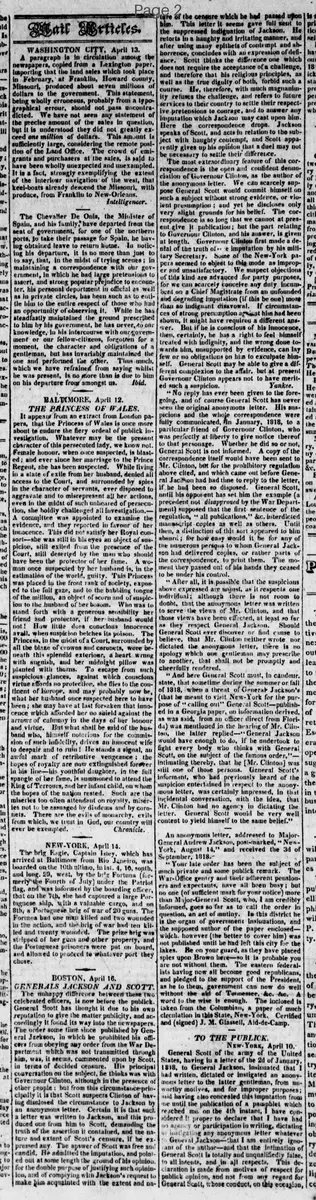
The unhappy difference between these two celebrated officers, is now before the publick. General Scott has thought it due to his own reputation to give the matter publicity, and accordingly it found its way into the newspapers. The order some time since published by General Jackson, in which he prohibited his officers from obeying any order from the War Department which was not transmitted through him, was, it seems, commented upon by Scott, in terms of decided censure. His principal conversation on the subject, he thinks was with Governor Clinton, although in the presence of other people: but from this circumstance principally it is that Scott suspects Clinton of having disclosed the circumstance to Jackson by an anonymous letter. Certain it is that such a letter was written to Jackson, and this produced one from him to Scott, demanding the truth of the assertion it contained, and the nature and extent of Scott's censure, if he expressed any. The answer of Scott was free and candid. He admitted the imputation, and pointed out at some length the ground of his opinion, for the double purpose of justifying such opinion, and of complying with Jackson's request to make him acquainted with the extent and nature of the censure which he had passed upon him. This letter it seems gave full vent to the suppressed indignation of Jackson. He retorts in a haughty and irritating manner, and after using many epithets of contempt and abhorrence, concludes with an expression of defiance. Scott thinks the difference one which does not require the acceptance of a challenge, and therefore that his religious principles, as well as the true dignity of both, forbid such a course. He, therefore, with much magnanimity refuses the challenge, and refers to future services to their country to settle their respective pretensions to courage, and to answer any imputation which Jackson may cast upon him. Here the correspondence drops. Jackson speaks of Scott, and acts in relation to the subject with haughty contempt, and Scott apparently gives up his opinion that a duel may not be necessary to settle their difference.
The most extraordinary feature of this correspondence is the open and confident denunciation of Governor Clinton, as the author of the anonymous letter. We can scarcely suppose General Scott would commit himself on such a subject without strong evidence, or violent presumption; and yet he discloses only very slight grounds for his belief. The correspondence is so long that we cannot at present give it publication; but the part relating to Governor Clinton, and his answer, is given at length. Governor Clinton first made a denial of the truth of the imputation by his military Secretary. Some of the New-York papers seemed to object to this mode as improper and unsatisfactory. We suspect objections of this kind are advanced for party purposes, for we can scarcely conceive any duty incumbent on a Chief Magistrate from an unfounded and degrading imputation (if this be one) more than an indignant disavowal. If circumstances of strong presumption against him had been shown, it might have required a different answer. But if he is conscious of his innocence, then, certainly, he has a right to feel himself treated with indignity, and the wrong done towards him, unsupported by evidence, can lay few or no obligations on him to exculpate himself. General Scott may be able to give a different complexion to the affair. but at present Governor Clinton appears not to have merited such a suspicion. Yankee.
What sub-type of article is it?
Politics
Military
What keywords are associated?
Jackson Scott Quarrel
Anonymous Letter
Governor Clinton
Duel
What entities or persons were involved?
General Jackson
General Scott
Governor Clinton
Where did it happen?
Boston
Domestic News Details
Primary Location
Boston
Event Date
April 16
Key Persons
General Jackson
General Scott
Governor Clinton