Thank you for visiting SNEWPapers!
Sign up free
Fowle's New Hampshire Gazette And General Advertiser Letter to Editor April 22, 1785
Portsmouth, Rockingham, New Hampshire
What is this article about?
A COUNTRYMAN replies to Candidus's defense of his favored candidate, arguing that Candidus builds his case on a printer's error and misrepresentations; he charges the candidate with opposing American measures, breaking parole, and self-serving office-seeking, and condemns political maneuvering that barters away the people's interests.
Quality green show the numbers
Measured from the scan
— how cleanly the OCR engine read the characters
- Mean ink quality
- 98.0% The length-weighted average confidence across the OCR lines — the mean of exactly the per-line scores whose tails the two figures below report. Typical is 99%.
- Illegible ink
- 0.4% Text sitting in OCR-detected lines that scored below 80% confidence — very shaky reads. Weighted by line length, so one long bad line counts for more than a short one.
- Uncertain ink
- 1.2% Text in lines that scored 80–90% — somewhat shaky reads.
- Matches source
- 95.78% How closely the served text matches the raw OCR of the same boxes, letter by letter, after collapsing spacing and case. This measures agreement, not correctness: the OCR is often wrong and the extractor corrects it, so 100% does not mean perfect, and a low figure usually means poor scan text was rewritten rather than that text was lost (length vs source shows loss).
- Length vs source
- 99.17% Below 100% means text was dropped from the OCR; above means text was added to make it read.
Assembled by the extraction model
— whether the stitched-together text holds up; catches layout and segmentation errors, which the scores above cannot see
- Transcription confidence
- 93.0% (typical 96%) How cleanly the extractor could assemble what it was given. Low here with clean ink scores points at layout analysis — the characters were read correctly but grouped or ordered wrongly.
- Comprehension
- 95.0% Whether the piece reads coherently start to finish. Can stay high while transcription confidence drops, when only part of the component is affected.
Clipping
Full Text
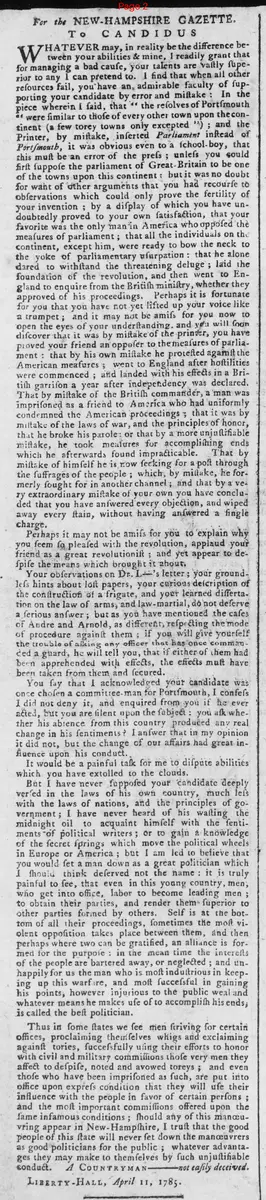
For the NEW-HAMPSHIRE GAZETTE.
TO CANDIDUS.
Whether, in reality, there be for managing a bad cause, your talents are vastly superior to any I can pretend to. I find that when all other resources fail, you have an admirable faculty of supporting your candidate by error and mistake: In the piece wherein I said, that the resolves of Portsmouth were similar to those of every other town upon the continent (a few tory towns only excepted); and the Printer, by mistake, inserted Parliament instead of Portsmouth, it was obvious even to a school-boy, that this must be an error of the press; unless you should first suppose the parliament of Great-Britain to be one of the towns upon this continent: but it was no doubt for want of other arguments that you had recourse to observations which could only prove the fertility of your invention; by a display of which you have undoubtedly proved to your own satisfaction, that your favorite was the only man in America who opposed the measures of parliament; that all the individuals on the continent, except him, were ready to bow the neck to the yoke of parliamentary usurpation: that he alone dared to withstand the threatening deluge; laid the foundation of the revolution, and then went to England to inquire from the British ministry, whether they approved of his proceedings. Perhaps it is fortunate for you that you have not yet lifted up your voice like a trumpet; and it may not be amiss for you now to open the eyes of your understanding, and you will soon discover that it was by mistake of the printer, you have proved your friend an opposer to the measures of parliament: that by his own mistake he protested against the American measures; went to England after hostilities were commenced; and landed with his effects in a British garrison a year after independency was declared. That by mistake of the British commander, a man was imprisoned as a friend to America who had uniformly condemned the American proceedings; that it was by mistake of the laws of war, and the principles of honor, that he broke his parole: or that by a more unjustifiable mistake, he took measures for accomplishing ends which he afterwards found impracticable. That by mistake of himself he is now seeking for a post through the suffrages of the people; which, by mistake, he formerly sought for in another channel; and that by a very extraordinary mistake of your own you have concluded that you have answered every objection, and wiped away every stain, without having answered a single charge.
Perhaps it may not be amiss for you to explain why you seem so pleased with the revolution, applaud your friend as a great revolutionist; and yet appear to despise the means which brought it about.
Your observations on Dr. L——'s letter; your groundless hints about lost papers, your curious description of the construction of a frigate, and your learned dissertation on the law of arms, and law-martial, do not deserve a serious answer; but as you have mentioned the cases of Andre and Arnold, as different, respecting the mode of procedure against them; if you will give yourself the trouble of asking any officer that has once commanded a guard, he will tell you, that if either of them had been apprehended with effects, the effects must have been taken from them and secured.
You say that I acknowledged your candidate was once chosen a committee-man for Portsmouth, I confess I did not deny it, and inquired from you if he ever acted, but you are silent upon the subject: you ask whether his absence from this country produced any real change in his sentiments? I answer that in my opinion it did not, but the change of our affairs had great influence upon his conduct.
It would be a painful task for me to dispute abilities which you have extolled to the clouds.
But I have never supposed your candidate deeply versed in the laws of his own country, much less with the laws of nations, and the principles of government; I have never heard of his wasting the midnight oil to acquaint himself with the sentiments of political writers; or to gain a knowledge of the secret springs which move the political wheels in Europe or America; but I am led to believe that you would set a man down as a great politician which I should think deserved not the name: it is truly painful to see, that even in this young country, men, who get into office, labour to become leading men; to obtain their parties, and render them superior to other parties formed by others. Self is at the bottom of all their proceedings, sometimes the most violent opposition takes place between them, and then perhaps where two can be gratified, an alliance is formed for the purpose: in the mean time the interests of the people are bartered away, or neglected; and unhappily for us the man who is most industrious in keeping up this warfare, and most successful in gaining his points, however injurious to the public weal and whatever means he makes use of to accomplish his ends is called the best politician.
Thus in some states we see men striving for certain offices, proclaiming themselves whigs and exclaiming against tories, successfully using their efforts to honor with civil and military commissions those very men they affect to despise, noted and avowed tories; and even those who have been imprisoned as such, are put into office upon express condition that they will use their influence with the people in favor of certain persons; and the most important commissions offered upon the same infamous conditions; should any of this manoeuvring appear in New-Hampshire, I trust that the good people of this state will never set down the manoeuverers as good politicians for the public; whatever advantages they may make to themselves by such unjustifiable conduct.
A COUNTRYMAN—not easily deceived.
LIBERTY-HALL, April 11, 1785.
What sub-type of article is it?
Persuasive
Political
Satirical
What themes does it touch?
Politics
Morality
What keywords are associated?
Candidus Reply
Printer's Error
Revolution Politics
Office Seeking
Political Maneuvering
New Hampshire
What entities or persons were involved?
Candidus
A Countryman—Not Easily Deceived.
Letter to Editor Details
Author
A Countryman—Not Easily Deceived.
Recipient
Candidus
Main Argument
Refutes Candidus's defense of his favored candidate, arguing that Candidus relies on a printer's mistake and distortions; the candidate opposed American measures, broke his parole, and now self-servingly seeks office.
Notable Details
- printer's error printed 'Parliament' instead of 'Portsmouth'
- candidate landed in a British garrison a year after independence was declared
- accusation that the candidate broke his parole
- comparison of the Andre and Arnold cases
- condemns politicians who barter away the people's interests for office