Thanks for visiting SNEWPapers!
Sign up free today to connect your AI tools to the Library of Congress' newspaper collection.
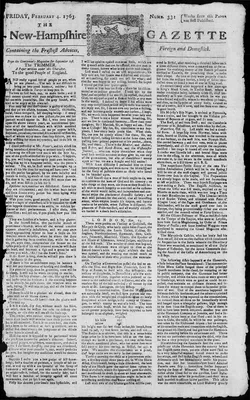
The New Hampshire Gazette Literary February 4, 1763
Portsmouth, Rockingham, New Hampshire
What is this article about?
A satirical essay addressed to the people of England, criticizing their habitual discontent and grumbling, illustrated with sketches of a farmer and a hop planter who always find cause for complaint, and an acquaintance disturbed by political pamphlets.
Quality green show the numbers
Measured from the scan
— how cleanly the OCR engine read the characters
- Mean ink quality
- 96.0% The length-weighted average confidence across the OCR lines — the mean of exactly the per-line scores whose tails the two figures below report. Typical is 99%.
- Illegible ink
- 0.0% Text sitting in OCR-detected lines that scored below 80% confidence — very shaky reads. Weighted by line length, so one long bad line counts for more than a short one.
- Uncertain ink
- 4.1% Text in lines that scored 80–90% — somewhat shaky reads.
- Matches source
- 94.94% How closely the served text matches the raw OCR of the same boxes, letter by letter, after collapsing spacing and case. This measures agreement, not correctness: the OCR is often wrong and the extractor corrects it, so 100% does not mean perfect, and a low figure usually means poor scan text was rewritten rather than that text was lost (length vs source shows loss).
- Length vs source
- 100.09% Below 100% means text was dropped from the OCR; above means text was added to make it read.
Assembled by the extraction model
— whether the stitched-together text holds up; catches layout and segmentation errors, which the scores above cannot see
- Transcription confidence
- 93.0% (typical 96%) How cleanly the extractor could assemble what it was given. Low here with clean ink scores points at layout analysis — the characters were read correctly but grouped or ordered wrongly.
- Comprehension
- 95.0% Whether the piece reads coherently start to finish. Can stay high while transcription confidence drops, when only part of the component is affected.
Clipping
Full Text
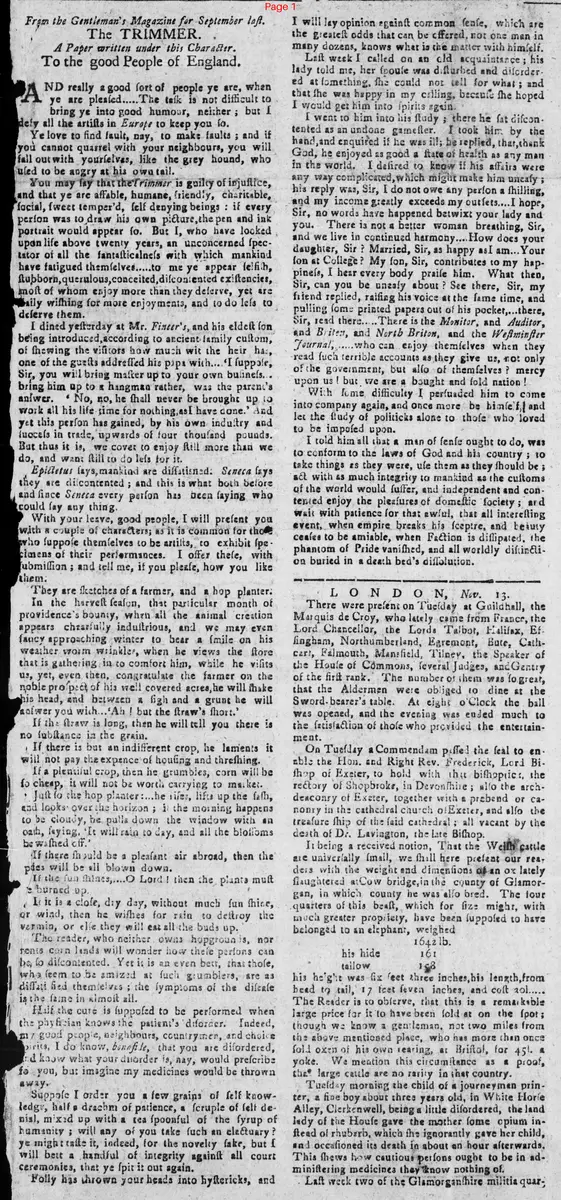
From the Gentleman's Magazine for September last.
The TRIMMER.
A Paper written under this Character.
To the good People of England.
And really a good sort of people ye are, when ye are pleased.....The task is not difficult to bring ye into good humour, neither; but I defy all the artists in Europe to keep you so. Ye love to find fault, nay, to make faults; and if you cannot quarrel with your neighbours, you will fall out with yourselves, like the grey hound, who used to be angry at his own tail.
You may say that the Trimmer is guilty of injustice, and that ye are affable, humane, friendly, charitable, social, sweet temper'd, self denying beings: if every person was to draw his own picture, the pen and ink portrait would appear so. But I, who have looked upon life above twenty years, an unconcerned spectator of all the fantasticalness with which mankind have fatigued themselves.....to me ye appear selfish, stubborn, querulous, conceited, discontented existencies, most of whom enjoy more than they deserve, yet are always wishing for more enjoyments, and to do less to deserve them.
I dined yesterday at Mr. Fineer's, and his eldest son being introduced, according to ancient family custom, of showing the visitors how much wit the heir has, one of the guests addressed his papa with...'I suppose, Sir, you will bring master up to your own business...' bring him up to a hangman rather, was the parent's answer. 'No, no, he shall never be brought up to work all his life time for nothing, as I have done.' And yet this person has gained, by his own industry and success in trade, upwards of four thousand pounds. But thus it is, we covet to enjoy still more than we do, and want skill to do less for it.
Epictetus says, mankind are dissatisfied: Seneca says they are discontented; and this is what both before and since Seneca every person has been saying who could say any thing.
With your leave, good people, I will present you with a couple of characters; as it is common for those who suppose themselves to be artists, to exhibit specimens of their performances. I offer these, with submission; and tell me, if you please, how you like them:
They are sketches of a farmer, and a hop planter:
In the harvest season, that particular month of providence's bounty, when all the animal creation appears cheerfully industrious, and we may even fancy approaching winter to bear a smile on his weather worn wrinkles, when he views the store that is gathering in to comfort him, while he visits us, yet, even, then, congratulate the farmer on the noble prospect of his well covered acres, he will shake his head, and between a sigh and a grunt he will answer you with...'Ah! but the straw's short.' If the straw is long, then he will tell you there is no substance in the grain. If there is but an indifferent crop, he laments it will not pay the expense of housing and threshing. If a plentiful crop, then he grumbles, corn will be so cheap, it will not be worth carrying to market. Just to the hop planter:..he rises, lifts up the sash, and looks over the horizon; if the morning happens to be cloudy, he pulls down the window with an oath, saying. 'It will rain to-day, and all the blossoms be washed off.' If there should be a pleasant air abroad, then the plants will be all blown down. If the sun shines,...O Lord! then the plants must be burned up. If it is a close, dry day, without much sunshine, or wind, then he wishes for rain to destroy the vermin, or else they will eat all the buds up.
The reader, who neither owns hop-grounds, nor rents corn lands will wonder how these persons can be so discontented. Yet it is an even bet, that those, who seem to be amazed at such grumblers, are as disaffected themselves; the symptoms of the disease is the same in almost all.
Half the cure is supposed to be performed when the physician knows the patient's disorder. Indeed, my good people, neighbours, countrymen, and choice spirits, I do know, believe, that you are disordered, and know what your disorder is, nay, would prescribe for you, but imagine my medicines would be thrown away.
Suppose I order you a few grains of self-knowledge, half a drachm of patience, a scruple of self denial, mixed up with a tea spoonful of the syrup of humanity; will any of you take such an electuary? ye might taste it, indeed, for the novelty sake, but I will bet a handful of integrity against all court ceremonies, that ye spit it out again.
Folly has thrown your heads into hysterics, and I will lay opinion against common sense, which are the greatest odds that can be offered, not one man in many dozens, knows what is the matter with himself.
Last week I called on an old acquaintance; his lady told me, her spouse was disturbed and disordered at something, she could not tell for what; and that she was happy in my calling, because she hoped I would get him into spirits again.
I went to him into his study; there he sat discontented as an undone gamester. I took him, by the hand, and enquired if he was ill; he replied, that, thank God, he enjoyed as good a state of health as any man in the world. I desired to know if his affairs were any way complicated, which might make him uneasy; his reply was, Sir, I do not owe any person a shilling, and my income greatly exceeds my outgoings....I hope, Sir, no words have happened betwixt your lady and you. There is not a better woman breathing, Sir, and we live in continued harmony....How does your daughter, Sir? Married, Sir, as happy as I am...Your son at College? My son, Sir, contributes to my happiness, I hear every body praise him. What then, Sir, can you be uneasy about? See there, Sir, my friend replied, raising his voice at the same time, and pulling some printed papers out of his pocket,...there, Sir, read there...There is the Monitor, and Auditor, and Briton, and North Briton, and the Westminster Journal,......who can..enjoy themselves when they read such terrible accounts as they give us, not only of the government, but also of themselves? mercy upon us! but we are a bought and sold nation!
With some difficulty I persuaded him to come into company again, and once more be himself and let the study of politicks alone to those who loved to be imposed upon.
I told him all that a man of sense ought to do, was to conform to the laws of God and his country; to take things as they were, use them as they should be; act with as much integrity to mankind as the customs of the world would suffer, and independent and contented enjoy the pleasures of domestic society; and wait with patience for that awful, that all interesting event, when empire breaks his sceptre, and beauty ceases to be amiable, when Faction is dissipated, the phantom of Pride vanished, and all worldly distinction buried in a death bed's dissolution.
What sub-type of article is it?
Essay
Satire
What themes does it touch?
Social Manners
Moral Virtue
What keywords are associated?
Satire
Discontent
Farmer
Hop Planter
Grumblers
Self Knowledge
Literary Details
Title
The Trimmer.
Subject
Satire On Human Discontent And Grumbling
Form / Style
Satirical Essay In Prose
Key Lines
If Every Person Was To Draw His Own Picture, The Pen And Ink Portrait Would Appear So.
But I, Who Have Looked Upon Life Above Twenty Years, An Unconcerned Spectator Of All The Fantasticalness With Which Mankind Have Fatigued Themselves.....To Me Ye Appear Selfish, Stubborn, Querulous, Conceited, Discontented Existencies