Thank you for visiting SNEWPapers!
Sign up free
Daily National Intelligencer Letter to Editor August 12, 1819
Washington, District Of Columbia
What is this article about?
A correspondent signing 'Civis' satirically critiques 'A Citizen's' financial plan for the Louisiana debt and Treasury notes, arguing it favors the banks and costs the public, and contrasts it with a simpler plan saving $1,100,000 a year.
Quality green show the numbers
Measured from the scan
— how cleanly the OCR engine read the characters
- Mean ink quality
- 99.0% The length-weighted average confidence across the OCR lines — the mean of exactly the per-line scores whose tails the two figures below report. Typical is 99%.
- Illegible ink
- 0.0% Text sitting in OCR-detected lines that scored below 80% confidence — very shaky reads. Weighted by line length, so one long bad line counts for more than a short one.
- Uncertain ink
- 0.0% Text in lines that scored 80–90% — somewhat shaky reads.
- Matches source
- 99.11% How closely the served text matches the raw OCR of the same boxes, letter by letter, after collapsing spacing and case. This measures agreement, not correctness: the OCR is often wrong and the extractor corrects it, so 100% does not mean perfect, and a low figure usually means poor scan text was rewritten rather than that text was lost (length vs source shows loss).
- Length vs source
- 99.12% Below 100% means text was dropped from the OCR; above means text was added to make it read.
Assembled by the extraction model
— whether the stitched-together text holds up; catches layout and segmentation errors, which the scores above cannot see
- Transcription confidence
- 96.0% (typical 96%) How cleanly the extractor could assemble what it was given. Low here with clean ink scores points at layout analysis — the characters were read correctly but grouped or ordered wrongly.
- Comprehension
- 95.0% Whether the piece reads coherently start to finish. Can stay high while transcription confidence drops, when only part of the component is affected.
Clipping
Full Text
TO THE EDITORS
GENTLEMEN:
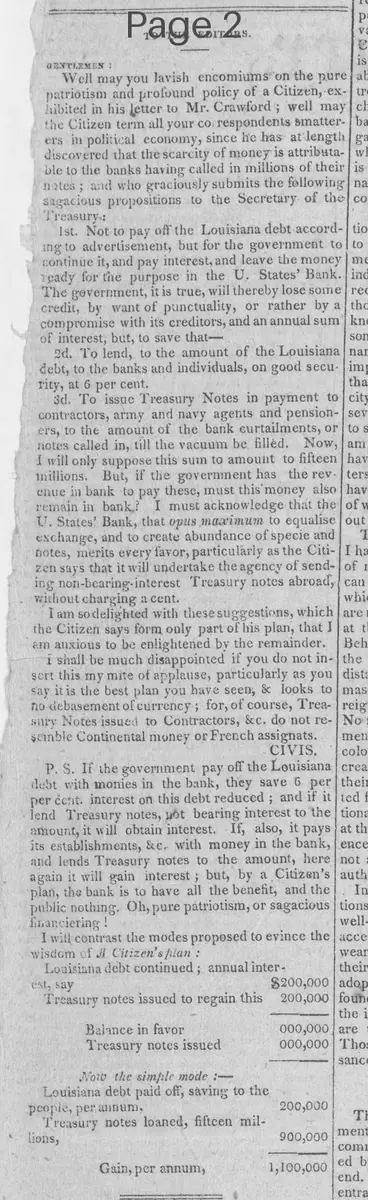
Well may you lavish encomiums on the pure patriotism and profound policy of a Citizen, exhibited in his letter to Mr. Crawford; well may the Citizen term all your correspondents smatterers in political economy, since he has at length discovered that the scarcity of money is attributable to the banks having called in millions of their notes; and who graciously submits the following sagacious propositions to the Secretary of the Treasury:
1st. Not to pay off the Louisiana debt according to advertisement, but for the government to continue it, and pay interest, and leave the money ready for the purpose in the U. States' Bank. The government, it is true, will thereby lose some credit, by want of punctuality, or rather by a compromise with its creditors, and an annual sum of interest, but, to save that—
2d. To lend, to the amount of the Louisiana debt, to the banks and individuals, on good security, at 6 per cent.
3d. To issue Treasury Notes in payment to contractors, army and navy agents and pensioners, to the amount of the bank curtailments, or notes called in, till the vacuum be filled. Now, I will only suppose this sum to amount to fifteen millions. But, if the government has the revenue in bank to pay these, must this money also remain in bank? I must acknowledge that the U. States' Bank, that opus maximum to equalise exchange, and to create abundance of specie and notes, merits every favor, particularly as the Citizen says that it will undertake the agency of sending non-bearing-interest Treasury notes abroad, without charging a cent.
I am so delighted with these suggestions, which the Citizen says form only part of his plan, that I am anxious to be enlightened by the remainder. I shall be much disappointed if you do not insert this my mite of applause, particularly as you say it is the best plan you have seen, & looks to no debasement of currency; for, of course, Treasury Notes issued to Contractors, &c. do not resemble Continental money or French assignats.
CIVIS.
P. S. If the government pay off the Louisiana debt with monies in the bank, they save 6 per cent. interest on this debt reduced; and if it lend Treasury notes, not bearing interest to the amount, it will obtain interest. If, also, it pays its establishments, &c, with money in the bank, and lends Treasury notes to the amount, here again it will gain interest; but, by a Citizen's plan, the bank is to have all the benefit, and the public nothing. Oh, pure patriotism, or sagacious financiering!
I will contrast the modes proposed to evince the wisdom of A Citizen's plan:
Louisiana debt continued; annual interest, say $200,000
Treasury notes issued to regain this 200,000
Balance in favor 000,000
Treasury notes issued 000,000
Now the simple mode:
Louisiana debt paid off, saving to the people, per annum, 200,000
Treasury notes loaned, fifteen millions, 900,000
Gain, per annum, 1,100,000
What sub-type of article is it?
Satirical
Political
What themes does it touch?
Economic Policy
What keywords are associated?
Louisiana Debt
Treasury Notes
Bank Curtailment
Public Finance
A Citizen's Plan
What entities or persons were involved?
The Editors
Civis
Letter to Editor Details
Author
Civis
Recipient
The Editors
Main Argument
Satirically attacks 'A Citizen's' plan to continue the Louisiana debt, lend to banks, and issue Treasury notes, arguing it benefits the bank while the public gains nothing, and proposes a simpler plan that saves $1,100,000 annually.
Notable Details
- references 'pure patriotism and profound policy'
- three-point plan quoted
- contrast table of the two modes
- comparison to Continental money and French assignats