Thank you for visiting SNEWPapers!
Sign up free
National Gazette Letter to Editor October 16, 1793
Philadelphia, Philadelphia, Pennsylvania
What is this article about?
A Philadelphia citizen's religious letter arguing that the yellow-fever pestilence is divine punishment for the city's sins — Sabbath-breaking, theater-going, extortion and pride — and urging repentance.
Quality green show the numbers
Measured from the scan
— how cleanly the OCR engine read the characters
- Mean ink quality
- 98.0% The length-weighted average confidence across the OCR lines — the mean of exactly the per-line scores whose tails the two figures below report. Typical is 99%.
- Illegible ink
- 0.0% Text sitting in OCR-detected lines that scored below 80% confidence — very shaky reads. Weighted by line length, so one long bad line counts for more than a short one.
- Uncertain ink
- 1.2% Text in lines that scored 80–90% — somewhat shaky reads.
- Matches source
- 96.01% How closely the served text matches the raw OCR of the same boxes, letter by letter, after collapsing spacing and case. This measures agreement, not correctness: the OCR is often wrong and the extractor corrects it, so 100% does not mean perfect, and a low figure usually means poor scan text was rewritten rather than that text was lost (length vs source shows loss).
- Length vs source
- 99.24% Below 100% means text was dropped from the OCR; above means text was added to make it read.
Assembled by the extraction model
— whether the stitched-together text holds up; catches layout and segmentation errors, which the scores above cannot see
- Transcription confidence
- 93.0% (typical 96%) How cleanly the extractor could assemble what it was given. Low here with clean ink scores points at layout analysis — the characters were read correctly but grouped or ordered wrongly.
- Comprehension
- 92.0% Whether the piece reads coherently start to finish. Can stay high while transcription confidence drops, when only part of the component is affected.
Clipping
Full Text
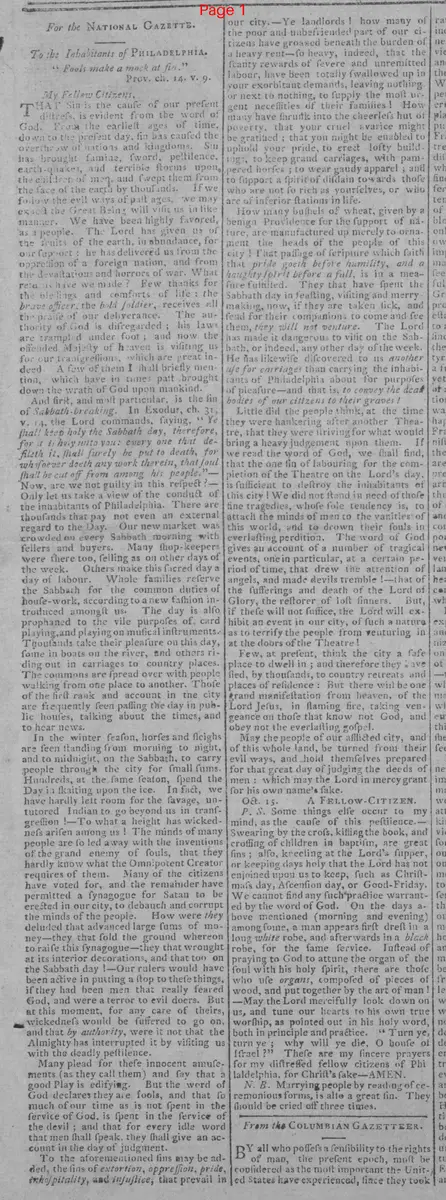
For the National Gazette.
To the Inhabitants of Philadelphia.
"Fools make a mock at sin."
Prov. ch. 14. v. 9.
My Fellow Citizens,
That sin is the cause of our present distress, is evident from the word of God. From the earliest ages of time, down to the present day, sin has caused the overthrow of nations and kingdoms. Sin has brought famine, sword, pestilence, earthquakes, and terrible storms upon the children of men, and swept them from the face of the earth by thousands. If we follow the evil ways of past ages, we may expect the Great Being will visit us in like manner. We have been highly favored, as a people. The Lord has given us of the fruits of the earth, in abundance, for our support: he has delivered us from the oppression of a foreign nation, and from the devastations and horrors of war. What returns have we made? Few thanks for the blessings and comforts of life: the brave officer, the bold soldier, receives all the praise of our deliverance. The authority of God is disregarded; his laws are trampled under foot; and now the offended Majesty of heaven is visiting us for our transgressions, which are great indeed. A few of them I shall briefly mention, which have in times past brought down the wrath of God upon mankind.
And first, and most particular, is the sin of Sabbath-breaking. In Exodus, ch. 31, v. 14, the Lord commands, saying, "Ye shall keep holy the Sabbath day, therefore, for it is holy unto you: every one that defileth it, shall surely be put to death, for whosoever doeth any work therein, that soul shall be cut off from among his people."—Now, are we not guilty in this respect? Only let us take a view of the conduct of the inhabitants of Philadelphia. There are thousands that pay not even an external regard to the Day. Our new market was crowded on every Sabbath morning with sellers and buyers. Many shop-keepers were there too, selling as on other days of the week. Others make this sacred day a day of labour. Whole families reserve the Sabbath for the common duties of house-work, according to a new fashion introduced amongst us. The day is also profaned to the vile purposes of card playing, and playing on musical instruments. Thousands take their pleasure on this day, some in boats on the river, and others riding out in carriages to country places. The commons are spread over with people walking from one place to another. Those of the first rank and account in the city are frequently seen passing the day in public houses, talking about the times, and to hear news.
In the winter season, horses and sleighs are seen standing from morning to night, and to midnight, on the Sabbath, to carry people through the city for small sums. Hundreds, at the same season, spend the Day in skating upon the ice. In fact, we have hardly left room for the savage, untutored Indian to go beyond us in transgression!—To what a height has wickedness arisen among us! The minds of many people are so led away with the inventions of the grand enemy of souls, that they hardly know what the Omnipotent Creator requires of them. Many of the citizens have voted for, and the remainder have permitted a synagogue for Satan to be erected in our city, to debauch and corrupt the minds of the people. How were they deluded that advanced large sums of money—they that sold the ground whereon to raise this synagogue—they that wrought at its interior decorations, and that too on the Sabbath day!—Our rulers would have been active in putting a stop to these things, if they had been men that really feared God, and were a terror to evil doers. But at this moment, for any care of theirs, wickedness would be suffered to go on, and that by authority, were it not that the Almighty has interrupted it by visiting us with the deadly pestilence.
Many plead for these innocent amusements (as they call them) and say that a good Play is edifying. But the word of God declares they are fools, and that so much of our time as is not spent in the service of God, is spent in the service of the devil; and that for every idle word that men shall speak, they shall give an account in the day of judgment.
To the aforementioned sins may be added, the sins of extortion, oppression, pride, inhospitality, and injustice, that prevail in our city.—Ye landlords! how many of the poor and unbefriended part of our citizens have groaned beneath the burden of a heavy rent—so heavy, indeed, that the scanty rewards of severe and unremitted labour, have been totally swallowed up in your exorbitant demands, leaving nothing or next to nothing, to supply the most urgent necessities of their families! How many have shrunk into the cheerless hut of poverty, that your cruel avarice might be gratified; that you might be enabled to uphold your pride, to erect lofty buildings, to keep grand carriages, with pampered horses; to wear gaudy apparel; and to support a spirit of disdain towards those who are not so rich as yourselves, or who are of inferior stations in life.
How many bushels of wheat, given by a benign Providence for the support of nature, are manufactured up merely to ornament the heads of the people of this city! That passage of scripture which saith that pride goeth before humility, and a haughty spirit before a fall, is in a measure fulfilled. They that have spent the Sabbath day in feasting, visiting and merry making, now, if they are taken sick, and send for their companions to come and see them, they will not venture. The Lord has made it dangerous to visit on the Sabbath, or indeed, any other day of the week. He has likewise discovered to us another use for carriages than carrying the inhabitants of Philadelphia about for purposes of pleasure—and that is, to convey the dead bodies of our citizens to their graves!
Little did the people think, at the time they were hankering after another Theatre, that they were striving for what would bring a heavy judgement upon them. If we read the word of God, we shall find, that the one sin of labouring for the completion of the Theatre on the Lord's day, is sufficient to destroy the inhabitants of this city! We did not stand in need of those fine tragedies, whose sole tendency is, to attach the minds of men to the vanities of this world, and to drown their souls in everlasting perdition. The word of God gives an account of a number of tragical events, one in particular, at a certain period of time, that drew the attention of angels, and made devils tremble!—that of the sufferings and death of the Lord of Glory, the restorer of lost sinners. But, if these will not suffice, the Lord will exhibit an event in our city, of such a nature as to terrify the people from venturing in at the doors of the Theatre!
Few, at present, think the city a safe place to dwell in; and therefore they are fled, by thousands, to country retreats and places of residence: But there will be one grand manifestation from heaven, of the Lord Jesus, in flaming fire, taking vengeance on those that know not God, and obey not the everlasting gospel.
May the people of our afflicted city, and of this whole land, be turned from their evil ways, and hold themselves prepared for that great day of judging the deeds of men: which may the Lord in mercy grant for his own name's sake.
Oct. 15. A FELLOW-CITIZEN.
P. S. Some things else occur to my mind, as the cause of this pestilence.—Swearing by the cross, kissing the book, and crossing of children in baptism, are great sins; also, kneeling at the Lord's supper, or keeping days holy that the Lord has not enjoined upon us to keep, such as Christmas day, Ascension day, or Good-Friday. We cannot find any such practice warranted by the word of God. On the days above mentioned (morning and evening) among some, a man appears first dressed in a long white robe, and afterwards in a black robe, for the same service. Instead of praying to God to attune the organ of the soul with his holy spirit, there are those who use organs, composed of pieces of wood, and put together by the art of man!—May the Lord mercifully look down on us, and tune our hearts to his own true worship, as pointed out in his holy word, both in principle and practice. "Turn ye, turn ye; why will ye die, O house of Israel?" These are my sincere prayers for my distressed fellow citizens of Philadelphia, for Christ's sake—AMEN.
N. B. Marrying people by reading of ceremonious forms, is also a great sin. They should be cried off three times.
What sub-type of article is it?
Religious
Persuasive
Ethical Moral
What themes does it touch?
Religion
Health Medicine
Morality
What keywords are associated?
Yellow Fever Divine Punishment
Sabbath Breaking
Philadelphia Sin
Theatre Condemnation
Repentance
What entities or persons were involved?
The Inhabitants Of Philadelphia
A Fellow Citizen
Letter to Editor Details
Author
A Fellow Citizen
Recipient
The Inhabitants Of Philadelphia
Main Argument
The yellow-fever pestilence is God's punishment for Philadelphia's sins — above all Sabbath-breaking, theater-going, extortion and pride — and the city must repent.
Notable Details
- quotes Proverbs 14:9 and Exodus 31:14
- denounces Sabbath market trading, sleighing, skating and card-playing
- calls the new theatre a 'synagogue for Satan'
- condemns Christmas, Ascension Day and Good-Friday observances as unwarranted