Thanks for visiting SNEWPapers!
Sign up free today to connect your AI tools to the Library of Congress' newspaper collection.
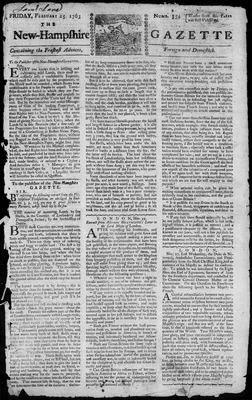
The New Hampshire Gazette Foreign News February 25, 1763
Portsmouth, Rockingham, New Hampshire
What is this article about?
Alderman Heathcote, in a letter to the Lord Mayor of London, argues against making peace on the published preliminaries, urging Britain to retain its conquests from France and warning against trusting a treaty-breaking nation.
Quality green show the numbers
Measured from the scan
— how cleanly the OCR engine read the characters
- Mean ink quality
- 99.0% The length-weighted average confidence across the OCR lines — the mean of exactly the per-line scores whose tails the two figures below report. Typical is 99%.
- Illegible ink
- 0.0% Text sitting in OCR-detected lines that scored below 80% confidence — very shaky reads. Weighted by line length, so one long bad line counts for more than a short one.
- Uncertain ink
- 0.0% Text in lines that scored 80–90% — somewhat shaky reads.
- Matches source
- 94.9% How closely the served text matches the raw OCR of the same boxes, letter by letter, after collapsing spacing and case. This measures agreement, not correctness: the OCR is often wrong and the extractor corrects it, so 100% does not mean perfect, and a low figure usually means poor scan text was rewritten rather than that text was lost (length vs source shows loss).
- Length vs source
- 98.96% Below 100% means text was dropped from the OCR; above means text was added to make it read.
Assembled by the extraction model
— whether the stitched-together text holds up; catches layout and segmentation errors, which the scores above cannot see
- Transcription confidence
- 93.0% (typical 96%) How cleanly the extractor could assemble what it was given. Low here with clean ink scores points at layout analysis — the characters were read correctly but grouped or ordered wrongly.
- Comprehension
- 96.0% Whether the piece reads coherently start to finish. Can stay high while transcription confidence drops, when only part of the component is affected.
Clipping
Full Text
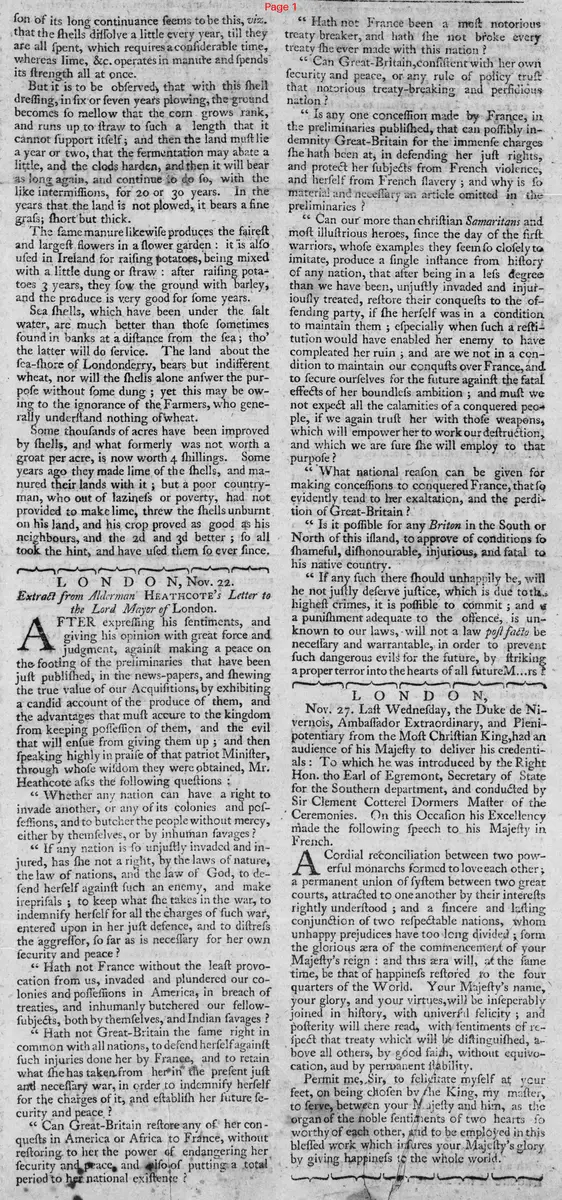
LONDON, Nov. 22.
Extract from Alderman HEATHCOTE's Letter to the Lord Mayor of London.
AFTER expressing his sentiments, and giving his opinion with great force and judgment, against making a peace on the footing of the preliminaries that have been just published, in the news-papers, and showing the true value of our Acquisitions, by exhibiting a candid account of the produce of them, and the advantages that must accrue to the kingdom from keeping possession of them, and the evil that will ensue from giving them up; and then speaking highly in praise of that patriot Minister, through whose wisdom they were obtained, Mr. Heathcote asks the following questions:
"Whether any nation can have a right to invade another, or any of its colonies and possessions, and to butcher the people without mercy, either by themselves, or by inhuman savages?
"If any nation is so unjustly invaded and injured, has she not a right, by the laws of nature, the law of nations, and the law of God, to defend herself against such an enemy, and make reprisals; to keep what she takes in the war, to indemnify herself for all the charges of such war, entered upon in her just defence, and to distress the aggressor, so far as is necessary for her own security and peace?
"Hath not France without the least provocation from us, invaded and plundered our colonies and possessions in America, in breach of treaties, and inhumanly butchered our fellow-subjects, both by themselves, and Indian savages?
"Hath not Great-Britain the same right in common with all nations, to defend herself against such injuries done her by France, and to retain what she has taken from her in the present just and necessary war, in order to indemnify herself for the charges of it, and establish her future security and peace?
"Can Great-Britain restore any of her conquests in America or Africa to France, without restoring to her the power of endangering her security and peace and of putting a total period to her national existence?
"Hath not France been a most notorious treaty breaker, and hath she not broke every treaty she ever made with this nation?
"Can Great-Britain, consistent with her own security and peace, or any rule of policy trust that notorious treaty-breaking and perfidious nation?
"Is any one concession made by France, in the preliminaries published, that can possibly indemnify Great-Britain for the immense charges she hath been at, in defending her just rights, and protect her subjects from French violence, and herself from French slavery; and why is so material and necessary an article omitted in the preliminaries?
"Can our more than christian Samaritans and most illustrious heroes, since the day of the first warriors, whose examples they seem so closely to imitate, produce a single instance from history of any nation, that after being in a less degree than we have been, unjustly invaded and injuriously treated, restore their conquests to the offending party, if she herself was in a condition to maintain them; especially when such a restitution would have enabled her enemy to have compleated her ruin; and are we not in a condition to maintain our conquests over France, and to secure ourselves for the future against the fatal effects of her boundless ambition; and must we not expect all the calamities of a conquered people, if we again trust her with those weapons which will empower her to work our destruction, and which we are sure she will employ to that purpose?
"What national reason can be given for making concessions to conquered France, that so evidently tend to her exaltation, and the perdition of Great-Britain?
"Is it possible for any Briton in the South or North of this island, to approve of conditions so shameful, dishonourable, injurious, and fatal to his native country.
"If any such there should unhappily be, will he not justly deserve justice, which is due to the highest crimes, it is possible to commit; and a punishment adequate to the offence, is unknown to our laws, will not a law post facto be necessary and warrantable, in order to prevent such dangerous evils for the future, by striking a proper terror into the hearts of all future M—rs?
What sub-type of article is it?
Political
Diplomatic
War Report
What keywords are associated?
Peace Preliminaries
Heathcote Letter
British Conquests
France Treaty
Seven Years War
What entities or persons were involved?
Alderman Heathcote
Where did it happen?
London
Foreign News Details
Primary Location
London
Event Date
Nov. 22
Key Persons
Alderman Heathcote