Thanks for visiting SNEWPapers!
Sign up free today to connect your AI tools to the Library of Congress' newspaper collection.
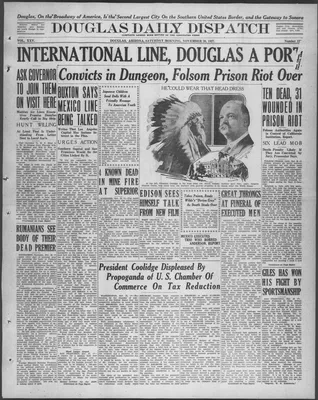
Douglas Daily Dispatch Domestic News November 26, 1927
Douglas, Cochise, Arizona
What is this article about?
Thomas A. Edison watched the first showing of a talking movie of his recent radio interview at his West Orange laboratory, a synchronized film-and-sound process developed by General Electric with recording done in Schenectady.
Quality green show the numbers
Measured from the scan
— how cleanly the OCR engine read the characters
- Mean ink quality
- 99.0% The length-weighted average confidence across the OCR lines — the mean of exactly the per-line scores whose tails the two figures below report. Typical is 99%.
- Illegible ink
- 0.0% Text sitting in OCR-detected lines that scored below 80% confidence — very shaky reads. Weighted by line length, so one long bad line counts for more than a short one.
- Uncertain ink
- 0.0% Text in lines that scored 80–90% — somewhat shaky reads.
- Matches source
- 98.63% How closely the served text matches the raw OCR of the same boxes, letter by letter, after collapsing spacing and case. This measures agreement, not correctness: the OCR is often wrong and the extractor corrects it, so 100% does not mean perfect, and a low figure usually means poor scan text was rewritten rather than that text was lost (length vs source shows loss). Across pages, this is the worst fragment.
- Length vs source
- 98.49% Below 100% means text was dropped from the OCR; above means text was added to make it read.
Assembled by the extraction model
— whether the stitched-together text holds up; catches layout and segmentation errors, which the scores above cannot see
- Transcription confidence
- 96.0% (typical 96%) How cleanly the extractor could assemble what it was given. Low here with clean ink scores points at layout analysis — the characters were read correctly but grouped or ordered wrongly.
- Comprehension
- 96.0% Whether the piece reads coherently start to finish. Can stay high while transcription confidence drops, when only part of the component is affected.
Clippings
1 of 2
Full Text
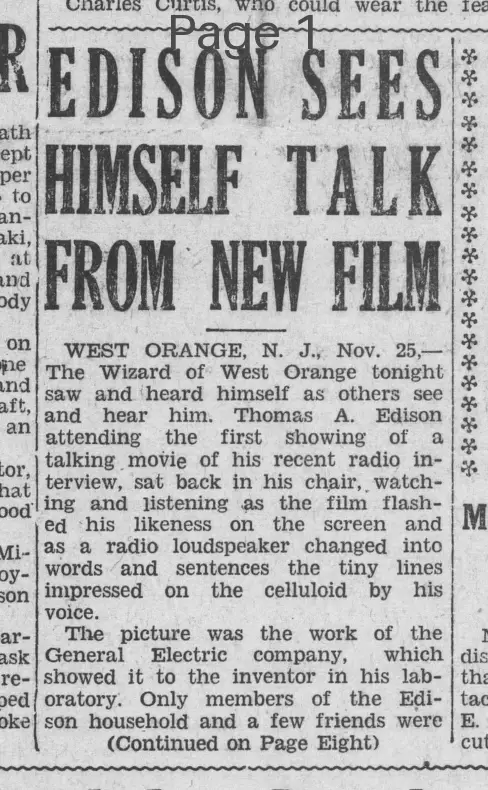
EDISON SEES HIMSELF TALK FROM NEW FILM
WEST ORANGE, N. J., Nov. 25.—The Wizard of West Orange tonight saw and heard himself as others see and hear him. Thomas A. Edison, attending the first showing of a talking movie of his recent radio interview, sat back in his chair, watching and listening as the film flashed his likeness on the screen and as a radio loudspeaker changed into words and sentences the tiny lines impressed on the celluloid by his voice.
The picture was the work of the General Electric company, which showed it to the inventor in his laboratory. Only members of the Edison household and a few friends were
(Continued on Page Eight)
Edison
(Continued from Page One)
present.
A dextrous synchronization of two electric motors made possible this realistic appearance of Mr. Edison on the screen. Picture and voice were recorded nearly 200 miles apart, the former in the Edison library, where the interview was held, and the latter in the General Electric research laboratory at Schenectady.
The inventor's replies to the questions of his interrogator were carried as electric impulses over a telephone wire to the upstate city, where they were recorded on a film at exactly the same rate of speed of the camera that was taking the pictures here. Two negative films, after development, were transposed on a single positive, which was used this evening.
So delicate were the adjustments that a variance of one sixty-fourth of a second in the speed of either the motor running the camera or the other, operating the voice film would have made the talking movie impossible. A tie-in of power between the lines of the two utility companies furnishing the current for the motors avoided a variation in the frequency, for a difference of one quarter of motor revolution in a thousand would have upset the plans.
The talking film is of standard size. Along a narrow margin in one side the voice is recorded in tiny zig-zag lines. As a beam of light passes through these lines, the broken ray falls upon a photo-electric cell which changes the light rays into electric impulses, similar to radio impulses. These in turn are changed into sound by a radio receiver and amplified by loud speaker. The projector is of standard type.
What sub-type of article is it?
Invention Technology
What keywords are associated?
Edison
Talking Movie
General Electric
Sound Film
Radio Interview
What entities or persons were involved?
Thomas A. Edison
Where did it happen?
West Orange, New Jersey
Domestic News Details
Primary Location
West Orange, New Jersey
Event Date
Nov. 25
Key Persons
Thomas A. Edison