Thanks for visiting SNEWPapers!
Sign up free today to connect your AI tools to the Library of Congress' newspaper collection.
Fort Worth Gazette Commercial November 26, 1892
Fort Worth, Tarrant, Texas
What is this article about?
Report on America's declining cotton supremacy: Russia, once a $45,000,000 annual customer, is expanding Turkestan cotton production and building a railway that may end American cotton exports to Russia within ten years.
Quality green show the numbers
Measured from the scan
— how cleanly the OCR engine read the characters
- Mean ink quality
- 96.0% The length-weighted average confidence across the OCR lines — the mean of exactly the per-line scores whose tails the two figures below report. Typical is 99%.
- Illegible ink
- 0.0% Text sitting in OCR-detected lines that scored below 80% confidence — very shaky reads. Weighted by line length, so one long bad line counts for more than a short one.
- Uncertain ink
- 0.0% Text in lines that scored 80–90% — somewhat shaky reads.
- Matches source
- 97.19% How closely the served text matches the raw OCR of the same boxes, letter by letter, after collapsing spacing and case. This measures agreement, not correctness: the OCR is often wrong and the extractor corrects it, so 100% does not mean perfect, and a low figure usually means poor scan text was rewritten rather than that text was lost (length vs source shows loss).
- Length vs source
- 99.47% Below 100% means text was dropped from the OCR; above means text was added to make it read.
Assembled by the extraction model
— whether the stitched-together text holds up; catches layout and segmentation errors, which the scores above cannot see
- Transcription confidence
- 94.0% (typical 96%) How cleanly the extractor could assemble what it was given. Low here with clean ink scores points at layout analysis — the characters were read correctly but grouped or ordered wrongly.
- Comprehension
- 95.0% Whether the piece reads coherently start to finish. Can stay high while transcription confidence drops, when only part of the component is affected.
Clipping
Full Text
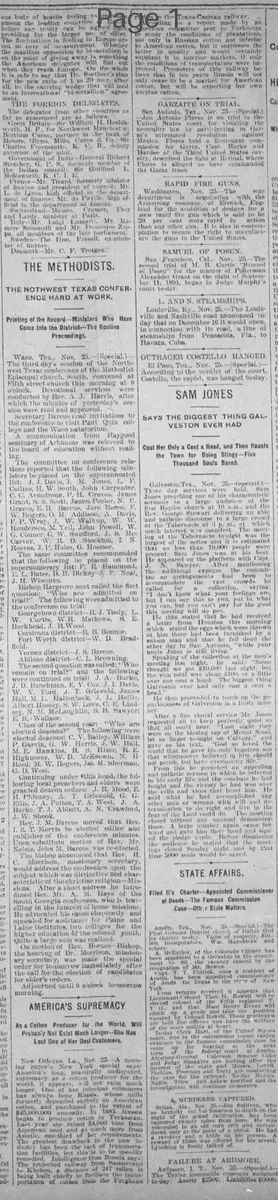
AMERICA'S SUPREMACY
As a Cotton Producer for the World, Will Probably Not Exist Much Longer—She Has Lost One of Her Best Customers.
New Orleans, La., Nov. 25.—A morning paper's New York special says: America's long, practically undisputed, supremacy as a cotton producer for the world, it appears, will not exist much longer. One of her principal customers has always been Russia, whose mills formerly depended entirely on American cotton, and purchased to the extent of $45,000,000 annually. In 1881 Russia began to produce cotton in Turkestan. Last year she raised 54,000 tons from American seed and as much more from Asiatic, one-third of her requirements. The greatest drawback to the new industry has been the lack of transportation facilities, but this is being speedily remedied. Intelligence from Russia says: The projected railway from Samarcand to Khokand, a distance of 247 miles, is being built chiefly to facilitate the transportation of cotton from the Ferghana region to the Trans-Caspian railway. According to a report made by an American committee sent to Turkestan to study the conditions of plantations, not only is Russian cotton not inferior to American cotton, but it surpasses the latter in quality and would certainly supplant it in interior markets, if only the conditions of transportation were improved. Promoters of this railway believe that in ten years Russia will not only cease to be a market for American cotton, but will be exporting her own surplus cotton.
What sub-type of article is it?
Trade Or Economy
Agriculture
Market Condition
What keywords are associated?
Cotton Trade
Russia Cotton
Turkestan
American Cotton Supremacy
What entities or persons were involved?
Russia
Turkestan
Where did it happen?
New Orleans
Commercial Details
Location
New Orleans
Event Date
Nov. 25
Commodities
Cotton
Key Figures
Russia
Turkestan
Notable Details
- Russia bought up to $45,000,000 of American cotton annually
- Russia raised 54,000 tons from American seed last year plus Asiatic cotton
- Samarcand-Khokand railway (247 miles) to move Ferghana cotton
- American committee found Russian cotton superior in quality