Thank you for visiting SNEWPapers!
Sign up free
The Virginia Gazette Editorial November 25, 1775
Cautionary note: Colonial-era discussion of slavery and emancipation, including an appeal addressed directly to enslaved people.
What is this article about?
Editorial refuting Lord Dunmore's proclamation imposing martial law and offering freedom to enslaved people and indentured servants who join British forces; argues colonial resistance is lawful, not rebellion, and warns Negroes that Dunmore's offer is cruel and self-interested.
Quality green show the numbers
- Mean ink quality
- 99.0% The length-weighted average confidence across the OCR lines — the mean of exactly the per-line scores whose tails the two figures below report. Typical is 99%.
- Illegible ink
- 0.0% Text sitting in OCR-detected lines that scored below 80% confidence — very shaky reads. Weighted by line length, so one long bad line counts for more than a short one.
- Uncertain ink
- 0.0% Text in lines that scored 80–90% — somewhat shaky reads.
- Matches source
- 96.7% How closely the served text matches the raw OCR of the same boxes, letter by letter, after collapsing spacing and case. This measures agreement, not correctness: the OCR is often wrong and the extractor corrects it, so 100% does not mean perfect, and a low figure usually means poor scan text was rewritten rather than that text was lost (length vs source shows loss).
- Length vs source
- 99.48% Below 100% means text was dropped from the OCR; above means text was added to make it read.
- Transcription confidence
- 97.0% (typical 96%) How cleanly the extractor could assemble what it was given. Low here with clean ink scores points at layout analysis — the characters were read correctly but grouped or ordered wrongly.
- Comprehension
- 92.0% Whether the piece reads coherently start to finish. Can stay high while transcription confidence drops, when only part of the component is affected.
Clipping
Full Text
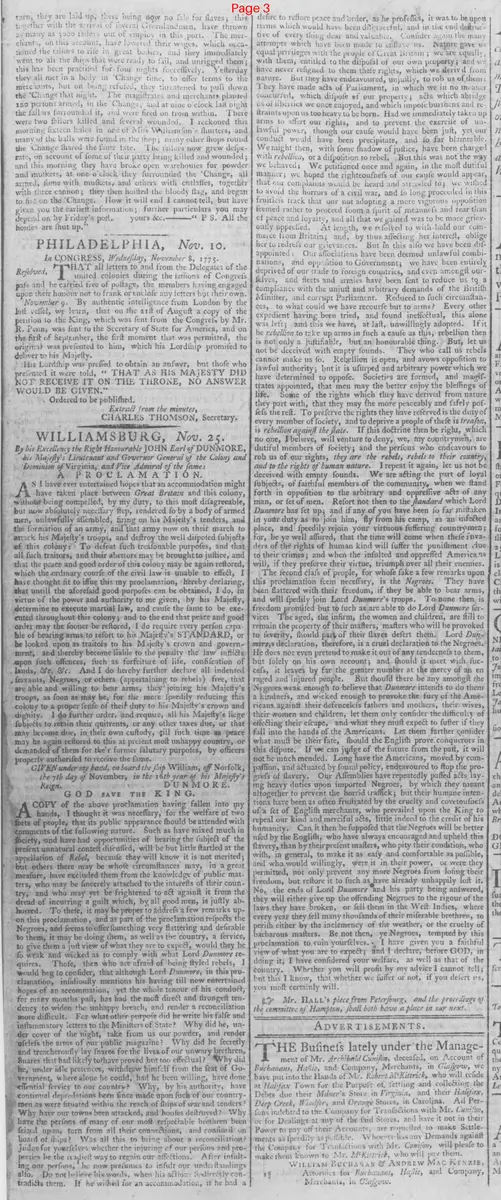
By his Excellency the Right Honourable JOHN Earl of DUNMORE, his Majesty's Lieutenant and Governor General of the Colony and Dominion of Virginia, and Vice Admiral of the same:
A PROCLAMATION.
AS I have ever entertained hopes that an accommodation might have taken place between Great Britain and this colony, without being compelled, by my duty, to this most disagreeable, but now absolutely necessary step, rendered so by a body of armed men, unlawfully assembled, firing on his Majesty's tenders, and the formation of an army, and that army now on their march to attack his Majesty's troops, and destroy the well disposed subjects of this colony: To defeat such treasonable purposes, and that all such traitors, and their abettors may be brought to justice, and that the peace and good order of this colony may be again restored, which the ordinary course of the civil law is unable to effect, I have thought fit to issue this my proclamation, hereby declaring, that until the aforesaid good purposes can be obtained, I do, in virtue of the power and authority to me given, by his Majesty, determine to execute martial law, and cause the same to be executed throughout this colony; and to the end that peace and good order may the sooner be restored, I do require every person capable of bearing arms to resort to his Majesty's STANDARD, or be looked upon as traitors to his Majesty's crown and government, and thereby become liable to the penalty the law inflicts upon such offences, such as forfeiture of life, confiscation of lands, &c. &c. And I do hereby further declare all indented servants, Negroes, or others (appertaining to rebels) free, that are able and willing to bear arms, they joining his Majesty's troops, as soon as may be, for the more speedily reducing this colony to a proper sense of their duty to his Majesty's crown and dignity. I do further order and require, all his Majesty's liege subjects to retain their quitrents, or any other taxes due, or that may become due, in their own custody, till such time as peace may be again restored to this at present most unhappy country, or demanded of them for their former salutary purposes, by officers properly authorised to receive the same.
GIVEN under my hand, on board the ship William, off Norfolk, the 7th day of November, in the 16th year of his Majesty's Reign. DUNMORE.
GOD SAVE THE KING.
COPY of the above proclamation having fallen into my hands, I thought it was necessary, for the welfare of two sorts of people, that its public appearance should be attended with comments of the following nature. Such as have mixed much in society, and have had opportunities of hearing the subject of the present unnatural contest discussed, will be but little startled at the appellation of Rebel, because they will know it is not merited; but others there may be whose circumstances may, in a great measure, have excluded them from the knowledge of public matters, who may be sincerely attached to the interests of their country, and who may yet be frightened to act against it from the dread of incurring a guilt which, by all good men, is justly abhorred. To these, it may be proper to address a few remarks upon this proclamation, and as part of the proclamation respects the Negroes, and seems to offer something very flattering and desirable to them, it may be doing them, as well as the country, a service, to give them a just view of what they are to expect, would they be so weak and wicked as to comply with what Lord Dunmore requires. Those, then who are afraid of being styled rebels, I would beg to consider, that although Lord Dunmore, in this proclamation, insidiously mentions his having till now entertained hopes of an accommodation, yet the whole tenour of his conduct, for many months past, has had the most direct and strongest tendency to widen the unhappy breach, and render a reconciliation more difficult. For what other purpose did he write his false and inflammatory letters to the Ministers of State? Why did he, under cover of the night, take from us our powder, and render useless the arms of our public magazine? Why did he secretly and treacherously lay snares for the lives of our unwary brethren, snares that had likely to have proved but too effectual? Why did he, under idle pretences, withdraw himself from the seat of Government, where alone he could, had he been willing, have done essential service to our country? Why, by his authority, have continual depredations been since made upon such of our countrymen as were situated within the reach of ships of war and tenders? Why have our towns been attacked, and houses destroyed? Why have the persons of many of our most respectable brethren been seized upon, torn from all their connections, and confined on board of ships? Was all this to bring about a reconciliation? Judge for yourselves whether the injuring of our persons and properties be the readiest way to regain our affections. After insulting our persons, he now presumes to insult our understandings also. Do not believe his words, when his actions so directly contradict them. If he wished for an accommodation, if he had a desire to restore peace and order, as he professes, it was to be upon terms which would have been disgraceful, and in the end destructive of every thing dear and valuable. Consider again the many attempts which have been made to enslave us. Nature gave us equal privileges with the people of Great Britain; we are equally, with them, entitled to the disposal of our own property; and we have never resigned to them these rights, which we derived from nature. But they have endeavoured, unjustly, to rob us of them: They have made acts of Parliament, in which we in no manner concurred, which dispose of our property; acts which abridge us of liberties we once enjoyed, and which impose burthens and restraints upon us too heavy to be born. Had we immediately taken up arms to assert our rights, and to prevent the exercise of unlawful power, though our cause would have been just, yet our conduct would have been precipitate, and so far blameable. We might then, with some shadow of justice, have been charged with rebellion, or a disposition to rebel. But this was not the way we behaved: We petitioned once and again, in the most dutiful manner; we hoped the righteousness of our cause would appear, that our complaints would be heard and attended to; we wished to avoid the horrors of a civil war, and so long proceeded in this fruitless track that our not adopting a more vigorous opposition seemed rather to proceed from a spirit of meanness and fear than of peace and loyalty, and all that we gained was to be more grievously oppressed. At length, we resolved to with-hold our commerce from Britain; and, by thus affecting her interest, oblige her to redress our grievances. But in this also we have been disappointed: Our associations have been deemed unlawful combinations, and opposition to Government; we have been entirely deprived of our trade to foreign countries, and even amongst ourselves, and fleets and armies have been sent to reduce us to a compliance with the unjust and arbitrary demands of the British Minister, and corrupt Parliament. Reduced to such circumstances, to what could we have recourse but to arms? Every other expedient having been tried, and found ineffectual, this alone was left; and this we have, at last, unwillingly adopted. If it be rebellion to take up arms in such a cause as this; rebellion then is not only a justifiable, but an honourable thing. But, let us not be deceived with empty sounds. They who call us rebels cannot make us so. Rebellion is open, and avows opposition to lawful authority; but it is usurped and arbitrary power which we have determined to oppose. Societies are formed, and magistrates appointed, that men may the better enjoy the blessings of life. Some of the rights which they have derived from nature they part with, that they may the more peaceably and safely possess the rest. To preserve the rights they have reserved is the duty of every member of society, and to deprive a people of these is treason, is rebellion against the state. If this doctrine then be right, which no one, I believe, will venture to deny, we, my countrymen, are dutiful members of society; and the persons who endeavours to rob us of our rights, they are the rebels, rebels to their country, and to the rights of human nature. I repeat it again, let us not be deceived with empty sounds. We are acting the part of loyal subjects, of faithful members of the community, when we stand forth in opposition to the arbitrary and oppressive acts of any man, or set of men. Resort not then to the standard which Lord Dunmore has set up; and if any of you have been so far mistaken in your duty as to join him, fly from his camp, as an infected place, and speedily rejoin your virtuous suffering countrymen; for, be ye well assured, that the time will come when these invaders of the rights of human kind will suffer the punishment due to their crimes; and when the insulted and oppressed Americans will, if they preserve their virtue, triumph over all their enemies.
The second class of people, for whose sake a few remarks upon this proclamation seem necessary, is the Negroes. They have been flattered with their freedom, if they be able to bear arms, and will speedily join Lord Dunmore's troops. To none then is freedom promised but to such as are able to do Lord Dunmore service: The aged, the infirm, the women and children, are still to remain the property of their masters, masters who will be provoked to severity, should part of their slaves desert them. Lord Dunmore's declaration, therefore, is a cruel declaration to the Negroes. He does not even pretend to make it out of any tenderness to them, but solely on his own account; and should it meet with success, it leaves by far the greater number at the mercy of an enraged and injured people. But should there be any amongst the Negroes weak enough to believe that Dunmore intends to do them a kindness, and wicked enough to provoke the fury of the Americans against their defenceless fathers and mothers, their wives, their women and children, let them only consider the difficulty of effecting their escape, and what they must expect to suffer if they fall into the hands of the Americans. Let them farther consider what must be their fate, should the English prove conquerors in this dispute. If we can judge of the future from the past, it will not be much mended. Long have the Americans, moved by compassion, and actuated by sound policy, endeavoured to stop the progress of slavery. Our Assemblies have repeatedly passed acts laying heavy duties upon imported Negroes, by which they meant altogether to prevent the horrid traffick; but their humane intentions have been as often frustrated by the cruelty and covetousness of a set of English merchants, who prevailed upon the King to repeal our kind and merciful acts, little indeed to the credit of his humanity. Can it then be supposed that the Negroes will be better used by the English, who have always encouraged and upheld this slavery, than by their present masters, who pity their condition, who wish, in general, to make it as easy and comfortable as possible, and who would willingly, were it in their power, or were they permitted, not only prevent any more Negroes from losing their freedom, but restore it to such as have already unhappily lost it. No, the ends of Lord Dunmore and his party being answered, they will either give up the offending Negroes to the rigour of the laws they have broken, or sell them in the West Indies, where every year they sell many thousands of their miserable brethren, to perish either by the inclemency of the weather, or the cruelty of barbarous masters. Be not then, ye Negroes, tempted by this proclamation to ruin yourselves. I have given you a faithful view of what you are to expect; and I declare, before GOD, in doing it, I have considered your welfare, as well as that of the country. Whether you will profit by my advice I cannot tell; but this I know, that whether we suffer or not, if you desert us, you most certainly will.
Mr. Hall's piece from Petersburg, and the proceedings of the committee of Hampton, shall both have a place in our next.
What sub-type of article is it?
What keywords are associated?
What entities or persons were involved?
Editorial Details
Primary Topic
Refutation Of Lord Dunmore's Martial Law Proclamation And His Offer Of Freedom To Slaves And Indentured Servants Who Join The British
Stance / Tone
Patriot, Anti British; Defends Colonial Armed Resistance As Lawful And Warns Enslaved People Not To Trust Dunmore
Key Figures
Key Arguments
- Dunmore's conduct shows he never truly sought accommodation; he provoked the breach.
- Colonists took up arms only as a last resort after petitions and commercial resistance failed.
- True rebels are those who usurp arbitrary power, not those who defend their natural rights.
- Dunmore's freedom offer is self-interested and cruel: only able-bodied men are promised freedom, leaving the aged, infirm, women, and children vulnerable.
- English merchants upheld and profited from slavery, so enslaved people can expect worse from the British than from their American masters.
- Colonists should not resort to Dunmore's standard, and any who joined should return.