Thanks for visiting SNEWPapers!
Sign up free today to connect your AI tools to the Library of Congress' newspaper collection.
Literary Cadet And Rhode Island Statesman Editorial July 28, 1827
Providence, Providence, Rhode Island
What is this article about?
The editor praises Col. William L. Stone of the New-York Commercial Advertiser for sympathizing with an aged matron imprisoned for debt in Providence, condemns a weak attempt to justify her incarceration, and reports that a lady's gift of thirty dollars enabled her to pay her debt and redeem her bed.
Quality green show the numbers
Measured from the scan
— how cleanly the OCR engine read the characters
- Mean ink quality
- 97.0% The length-weighted average confidence across the OCR lines — the mean of exactly the per-line scores whose tails the two figures below report. Typical is 99%.
- Illegible ink
- 0.0% Text sitting in OCR-detected lines that scored below 80% confidence — very shaky reads. Weighted by line length, so one long bad line counts for more than a short one.
- Uncertain ink
- 3.2% Text in lines that scored 80–90% — somewhat shaky reads.
- Matches source
- 95.91% How closely the served text matches the raw OCR of the same boxes, letter by letter, after collapsing spacing and case. This measures agreement, not correctness: the OCR is often wrong and the extractor corrects it, so 100% does not mean perfect, and a low figure usually means poor scan text was rewritten rather than that text was lost (length vs source shows loss).
- Length vs source
- 100.0% Below 100% means text was dropped from the OCR; above means text was added to make it read.
Assembled by the extraction model
— whether the stitched-together text holds up; catches layout and segmentation errors, which the scores above cannot see
- Transcription confidence
- 93.0% (typical 96%) How cleanly the extractor could assemble what it was given. Low here with clean ink scores points at layout analysis — the characters were read correctly but grouped or ordered wrongly.
- Comprehension
- 90.0% Whether the piece reads coherently start to finish. Can stay high while transcription confidence drops, when only part of the component is affected.
Clipping
Full Text
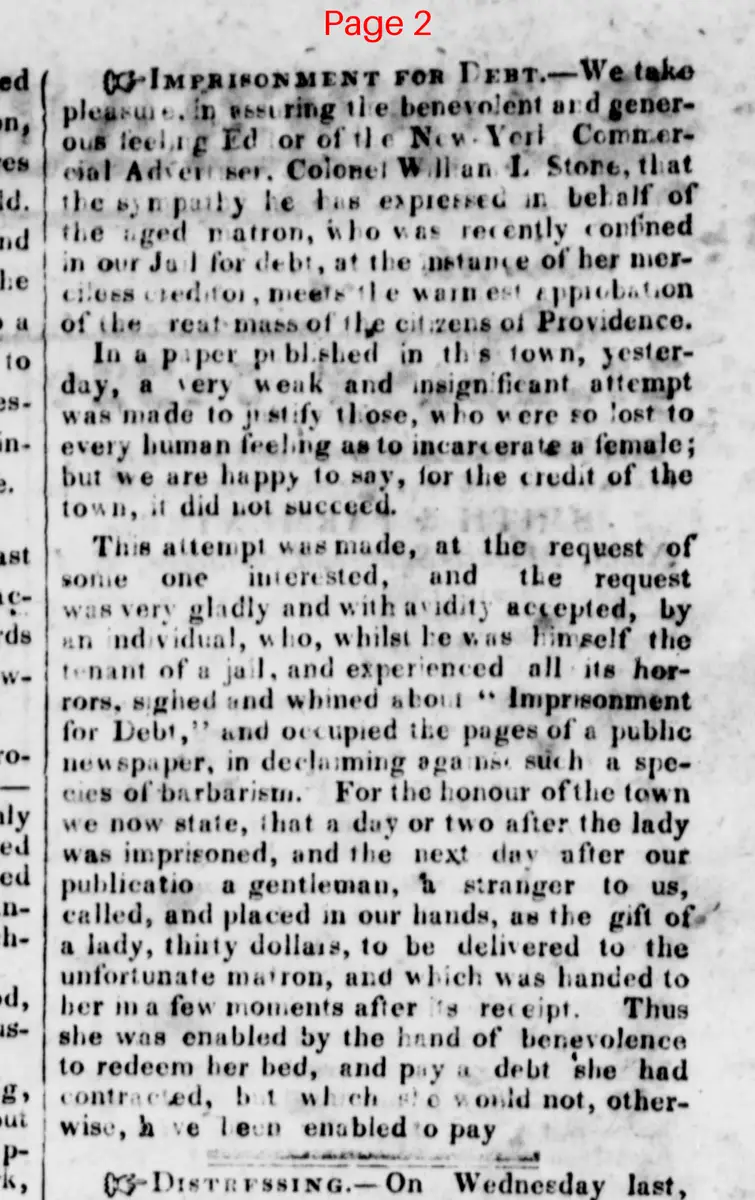
IMPRISONMENT FOR DEBT.—We take pleasure in assuring the benevolent and generous feeling Editor of the New-York Commercial Advertiser, Colonel William L. Stone, that the sympathy he has expressed in behalf of the aged matron, who was recently confined in our Jail for debt, at the instance of her merciless creditor, meets the warmest approbation of the great mass of the citizens of Providence.
In a paper published in this town, yesterday, a very weak and insignificant attempt was made to justify those, who were so lost to every human feeling as to incarcerate a female; but we are happy to say, for the credit of the town, it did not succeed.
This attempt was made, at the request of some one interested, and the request was very gladly and with avidity accepted, by an individual, who, whilst he was himself the tenant of a jail, and experienced all its horrors, sighed and whined about "Imprisonment for Debt," and occupied the pages of a public newspaper, in declaiming against such a species of barbarism. For the honour of the town we now state, that a day or two after the lady was imprisoned, and the next day after our publication a gentleman, a stranger to us, called, and placed in our hands, as the gift of a lady, thirty dollars, to be delivered to the unfortunate matron, and which was handed to her in a few moments after its receipt. Thus she was enabled by the hand of benevolence to redeem her bed, and pay a debt she had contracted, but which she would not, otherwise, have been enabled to pay.
What sub-type of article is it?
Crime Or Punishment
Legal Reform
Social Reform
What keywords are associated?
Imprisonment For Debt
Debtors' Prison
Benevolence
Providence
William L. Stone
What entities or persons were involved?
Colonel William L. Stone
The Aged Matron
The Merciless Creditor
The Anonymous Lady Donor
Editorial Details
Primary Topic
Opposition To Imprisonment For Debt
Stance / Tone
Strongly Against Imprisonment For Debt; Approving Of Benevolence
Key Figures
Colonel William L. Stone
The Aged Matron
The Merciless Creditor
The Anonymous Lady Donor
Key Arguments
- Imprisoning a female for debt is barbarous and inhuman
- The attempt to justify the imprisonment was weak and insignificant
- Benevolence, not punishment, is the proper response to debt