Thanks for visiting SNEWPapers!
Sign up free today to connect your AI tools to the Library of Congress' newspaper collection.
Daily State Sentinel Editorial May 7, 1864
Indianapolis, Marion, Indiana
What is this article about?
Editorial rebukes the Daily Times for sympathizing with English operatives while ignoring the imprisonment and exile of American mechanics in Tennessee by military order without trial.
Quality green show the numbers
Measured from the scan
— how cleanly the OCR engine read the characters
- Mean ink quality
- 98.0% The length-weighted average confidence across the OCR lines — the mean of exactly the per-line scores whose tails the two figures below report. Typical is 99%.
- Illegible ink
- 0.0% Text sitting in OCR-detected lines that scored below 80% confidence — very shaky reads. Weighted by line length, so one long bad line counts for more than a short one.
- Uncertain ink
- 0.2% Text in lines that scored 80–90% — somewhat shaky reads.
- Matches source
- 98.34% How closely the served text matches the raw OCR of the same boxes, letter by letter, after collapsing spacing and case. This measures agreement, not correctness: the OCR is often wrong and the extractor corrects it, so 100% does not mean perfect, and a low figure usually means poor scan text was rewritten rather than that text was lost (length vs source shows loss).
- Length vs source
- 99.32% Below 100% means text was dropped from the OCR; above means text was added to make it read.
Assembled by the extraction model
— whether the stitched-together text holds up; catches layout and segmentation errors, which the scores above cannot see
- Transcription confidence
- 94.0% (typical 96%) How cleanly the extractor could assemble what it was given. Low here with clean ink scores points at layout analysis — the characters were read correctly but grouped or ordered wrongly.
- Comprehension
- 90.0% Whether the piece reads coherently start to finish. Can stay high while transcription confidence drops, when only part of the component is affected.
Clipping
Full Text
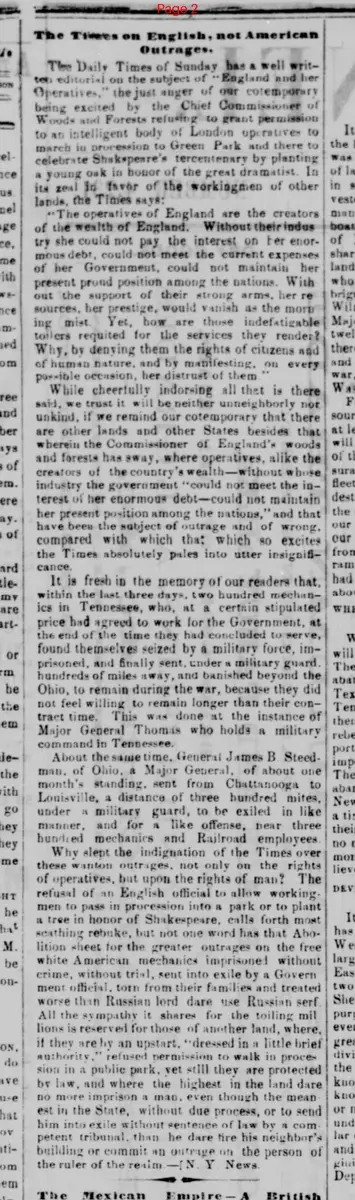
The Treason English, not American Outrages
The Daily Times of Sunday has a well written editorial on the subject of 'England and her Operatives.' the just anger of our contemporary being excited by the Chief Commissioner of Woods and Forests refusing to grant permission to an intelligent body of London operatives to march in procession to Green Park and there to celebrate Shakespeare's tercentenary by planting a young oak in honor of the great dramatist. In its zeal in favor of the workingmen of other lands, the Times says:
"The operatives of England are the creators of the wealth of England. Without their industry she could not pay the interest on her enormous debt, could not meet the current expenses of her Government, could not maintain her present proud position among the nations. Without the support of their strong arms, her resources, her prestige, would vanish as the morning mist. Yet, how are those indefatigable toilers requited for the services they render? Why, by denying them the rights of citizens and of human nature, and by manifesting, on every possible occasion, her distrust of them."
While cheerfully endorsing all that is there said, we trust it will be neither unneighborly nor unkind, if we remind our contemporary that there are other lands and other States besides that wherein the Commissioner of England's woods and forests has sway, where operatives, alike the creators of the country's wealth—without whose industry the government "could not meet the interest of her enormous debt—could not maintain her present position among the nations," and that have been the subject of outrage and of wrong, compared with which that which so excites the Times absolutely pales into utter insignificance.
It is fresh in the memory of our readers that, within the last three days, two hundred mechanics in Tennessee, who, at a certain stipulated price had agreed to work for the Government, at the end of the time they had concluded to serve, found themselves seized by a military force, imprisoned, and finally sent, under a military guard, hundreds of miles away, and banished beyond the Ohio, to remain during the war, because they did not feel willing to remain longer than their contract time. This was done at the instance of Major General Thomas who holds a military command in Tennessee.
About the same time, General James B. Steedman, of Ohio, a Major General, of about one month's standing, sent from Chattanooga to Louisville, a distance of three hundred miles, under a military guard, to be exiled in like manner, and for a like offense, near three hundred mechanics and Railroad employees.
Why slept the indignation of the Times over these wanton outrages, not only on the rights of operatives, but upon the rights of man? The refusal of an English official to allow workingmen to pass in procession into a park or to plant a tree in honor of Shakespeare, calls forth most scathing rebuke, but not one word has that Abolition sheet for the greater outrages on the free white American mechanics imprisoned without crime, without trial, sent into exile by a Government official, torn from their families and treated worse than Russian lord dare use Russian serf. All the sympathy it has for the toiling millions is reserved for those of another land, where, if they are by an upstart, "dressed in a little brief authority," refused permission to walk in procession in a public park, yet still they are protected by law, and where the highest in the land dare no more imprison a man, even though the meanest in the State, without due process, or to send him into exile without sentence of law by a competent tribunal, than he dare fire his neighbor's building or commit an outrage on the person of the ruler of the realm.—[N. Y. News
What sub-type of article is it?
Labor
Constitutional
War Or Peace
What keywords are associated?
English Operatives
American Mechanics
Military Exile
Times Hypocrisy
What entities or persons were involved?
Daily Times
Chief Commissioner Of Woods And Forests
Major General Thomas
General James B. Steedman
London Operatives
Editorial Details
Primary Topic
Hypocrisy Of The Daily Times Over Outrages Against Workingmen
Stance / Tone
Critical Of The Times, Sympathetic To American Mechanics, Anti Administration
Key Figures
Daily Times
Chief Commissioner Of Woods And Forests
Major General Thomas
General James B. Steedman
London Operatives
Key Arguments
- The Times ignores far worse outrages against American mechanics
- American mechanics were imprisoned and exiled without trial
- The Times' sympathy for workingmen is selective and hypocritical