Thanks for visiting SNEWPapers!
Sign up free today to connect your AI tools to the Library of Congress' newspaper collection.
Alexandria Gazette & Daily Advertiser Foreign News March 10, 1819
Alexandria, Virginia
What is this article about?
The Argus of Chile reports General San Martin's entrance into Santiago on the night of October 29, with official visits, entertainments, illuminations, and a ball, followed by a comparison of San Martin to Epaminondas.
Quality green show the numbers
Measured from the scan
— how cleanly the OCR engine read the characters
- Mean ink quality
- 99.0% The length-weighted average confidence across the OCR lines — the mean of exactly the per-line scores whose tails the two figures below report. Typical is 99%.
- Illegible ink
- 0.0% Text sitting in OCR-detected lines that scored below 80% confidence — very shaky reads. Weighted by line length, so one long bad line counts for more than a short one.
- Uncertain ink
- 0.0% Text in lines that scored 80–90% — somewhat shaky reads.
- Matches source
- 98.64% How closely the served text matches the raw OCR of the same boxes, letter by letter, after collapsing spacing and case. This measures agreement, not correctness: the OCR is often wrong and the extractor corrects it, so 100% does not mean perfect, and a low figure usually means poor scan text was rewritten rather than that text was lost (length vs source shows loss).
- Length vs source
- 99.35% Below 100% means text was dropped from the OCR; above means text was added to make it read.
Assembled by the extraction model
— whether the stitched-together text holds up; catches layout and segmentation errors, which the scores above cannot see
- Transcription confidence
- 92.0% (typical 96%) How cleanly the extractor could assemble what it was given. Low here with clean ink scores points at layout analysis — the characters were read correctly but grouped or ordered wrongly.
- Comprehension
- 95.0% Whether the piece reads coherently start to finish. Can stay high while transcription confidence drops, when only part of the component is affected.
Clipping
Full Text
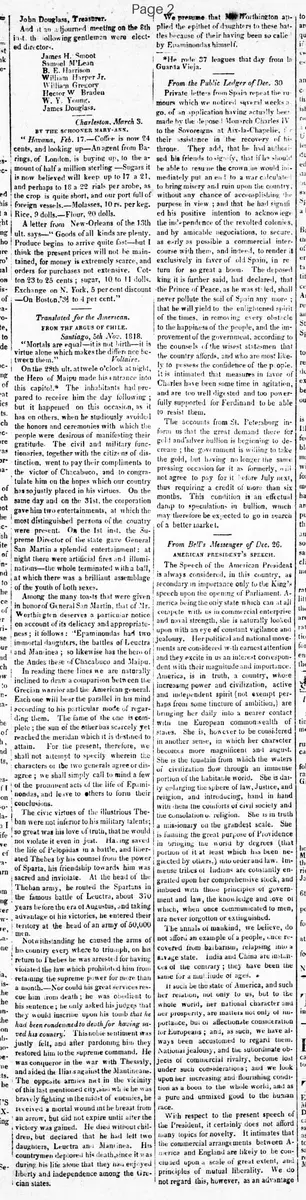
Translated for the American.
FROM THE ARGUS OF CHILE.
Santiago, 5th Nov. 1818.
"Mortals are equal—it is not birth—it is virtue alone which makes the difference between them." — Voltaire.
On the 29th ult. at twelve o'clock at night, the Hero of Maipu made his entrance into this capital.* The inhabitants had prepared to receive him the day following; but it happened on this occasion, as it has on others, when he studiously avoided the honors and ceremonies with which the people were desirous of manifesting their gratitude. The civil and military functionaries, together with the citizens of distinction, went to pay their compliments to the victor of Chacabuco, and to congratulate him on the hopes which our country has so justly placed in his virtues. On the same day and on the 31st, the corporation gave him two entertainments, at which the most distinguished persons of the country were present. On the 1st inst. the Supreme Director of the state gave General San Martin a splendid entertainment: at night there were artificial fires and illuminations—the whole terminated with a ball, at which there was a brilliant assemblage of the youth of both sexes.
Among the many toasts that were given in honor of General San Martin, that of Mr. Worthington deserves a particular notice on account of its delicacy and appropriateness; it follows: "Epaminondas had two immortal daughters, the battles of Leuctra and Mantinea; so likewise has the hero of the Andes these of Chacabuco and Maipu."
In reading these lines we are naturally inclined to draw a comparison between the Grecian warrior and the American general. Each one will bear the parallel in his mind according to his particular mode of regarding them. The fame of the one is complete; the sun of the other has scarcely yet reached the meridian which it is destined to attain. For the present, therefore, we shall not attempt to specify wherein the characters of the two generals agree or disagree; we shall simply call to mind a few of the prominent acts of the life of Epaminondas, and leave to others to form their conclusions.
The civic virtues of the illustrious Theban were not inferior to his military talents; so great was his love of truth, that he would not violate it even in jest. Having saved the life of Pelopidas in a battle, and liberated Thebes by his counsel from the power of Sparta, his friendship towards him was sacred and inviolate. At the head of the Theban army, he routed the Spartans in the famous battle of Leuctra, about 370 years before the era of Augustus, and taking advantage of his victories, he entered their territory at the head of an army of 50,000 men.
Notwithstanding he caused the arms of his country every where to triumph, on his return to Thebes he was arrested for having violated the law which prohibited him from retaining the supreme power for more than a month.—Nor could his great services rescue him from death; he was obedient to his sentence; he only asked his judges that they would inscribe upon his tomb that he had been condemned to death for having saved his country: This noble sentiment was justly felt, and after pardoning him they restored him to the supreme command. He was conqueror in the war with Thessaly, and aided the Thebans against the Mantineans. The opposite armies met in the vicinity of this last mentioned city, and while he was bravely fighting in the midst of enemies, he received a mortal wound in the breast from an arrow, but did not expire until after the victory was gained. He died without children, but declared that he had left two daughters, Leuctra and Mantinea. His countrymen deplored his death, since it was during his life alone that they had enjoyed liberty and independence among the Grecian states.
We presume that Mr. Worthington applied the epithet of daughters to these battles because of their having been so called by Epaminondas himself.
*He rode 37 leagues that day from la Guarda Vieja.
What sub-type of article is it?
Military Campaign
Political
Cultural Event
What keywords are associated?
San Martin
Santiago Chile
Maipu
Epaminondas
Celebration
What entities or persons were involved?
General San Martin
Mr. Worthington
Where did it happen?
Santiago, Chile
Foreign News Details
Primary Location
Santiago, Chile
Event Date
29th Ult. (Reported 5th Nov. 1818)
Key Persons
General San Martin
Mr. Worthington