Thanks for visiting SNEWPapers!
Sign up free today to connect your AI tools to the Library of Congress' newspaper collection.
The Virginian Literary November 26, 1827
Lynchburg, Virginia
What is this article about?
A tourist's recollection of a grand ball at Bordeaux given for the Duke and Duchess of Angouleme, interrupted by news of Napoleon's escape from Elba; the Duchess's futile attempts to hold the city as troops defect and the tricolor flag rises, heralding the Hundred Days.
Quality green show the numbers
Measured from the scan
— how cleanly the OCR engine read the characters
- Mean ink quality
- 98.0% The length-weighted average confidence across the OCR lines — the mean of exactly the per-line scores whose tails the two figures below report. Typical is 99%.
- Illegible ink
- 0.0% Text sitting in OCR-detected lines that scored below 80% confidence — very shaky reads. Weighted by line length, so one long bad line counts for more than a short one.
- Uncertain ink
- 0.0% Text in lines that scored 80–90% — somewhat shaky reads.
- Matches source
- 97.39% How closely the served text matches the raw OCR of the same boxes, letter by letter, after collapsing spacing and case. This measures agreement, not correctness: the OCR is often wrong and the extractor corrects it, so 100% does not mean perfect, and a low figure usually means poor scan text was rewritten rather than that text was lost (length vs source shows loss).
- Length vs source
- 99.56% Below 100% means text was dropped from the OCR; above means text was added to make it read.
Assembled by the extraction model
— whether the stitched-together text holds up; catches layout and segmentation errors, which the scores above cannot see
- Transcription confidence
- 95.0% (typical 96%) How cleanly the extractor could assemble what it was given. Low here with clean ink scores points at layout analysis — the characters were read correctly but grouped or ordered wrongly.
- Comprehension
- 92.0% Whether the piece reads coherently start to finish. Can stay high while transcription confidence drops, when only part of the component is affected.
Clipping
Full Text
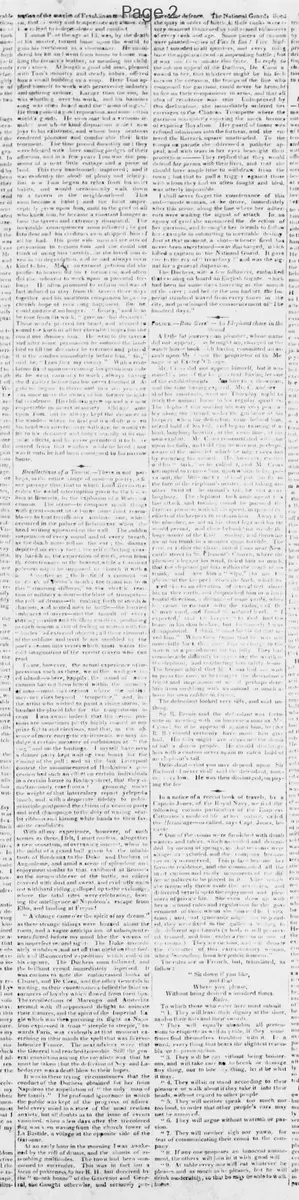
Recollections of a Tourist.
There is not perhaps, in the entire range of modern poetry, a finer passage than that in which Lord Byron describes the awful interruption given to the festivities at Brussels, by the explosion of a Waterloo cannon. The scene—to compare small things with great—must have borne some faint resemblance to that terrifically sublime one, which occurred in the palace of Belshazzar when the hand writing appeared on the wall. The sudden suspension of every sound and of every breath, as the death notes fell on the ear; the dismay depicted on every face; the self collecting gravity banishing the expression of mirth, even from the countenance of the bravest, while a transient paleness might be supposed to launch it with a hue as fugitive as the hectic of a moment on the cheek of Sterne's monk; the transition from this "stunning stillness," to the electric reaction of military ardour—the blast of trumpets—the roll of drums—the rushing forth of steeds & chariots, and armed men to battle—the hurried embraces of lovers—and the tumult of every stirring passion and thrilling emotion. producing in each bosom a riot of feeling in unison with the "hurly-burly" of external objects; all these elements of the sublime and terrible are moulded by the poet's genius into verses which must warm the cold imagination of the veriest craven who can read.
To see, however, the actual experience of impressions such as these, we of this well governed island—where, happily, the sound of hostile cannon has not been heard within the memory of man—must visit regions where the political mercury rises beyond 'temperate,' and, like the artist who wished to paint a rising storm, abandon the placid lake for the tempestuous ocean. I am aware indeed that the heroic passions are sometimes pretty highly roused at our prize fights and elections, and that, in the absence of more energetic excitements, we may indulge a certain measure of enthusiasm at "the ring" and on the hustings. I myself have seen a dinner party kept waiting two hours for the closing of the poll; and at the last Liverpool contest, the announcement of Huskisson's procession had such an effect on certain individuals in a certain house in Rodney street, that they simultaneously rose from a table groaning under the weight of that intercalary repast ycleped a lunch, and, with a desperate fidelity to public principle, postponed the claims of a venison pasty and iced champagne to the duty of waving scarlet ribbons and kissing white hands to their favourite candidates.
With all my experience, however, of such scenes as these, I felt, I must confess. altogether a new sensation, of overawing interest, when in the midst of a grand ball given by the inhabitants of Bordeaux to the Duke and Duchess of Angouleme, and amid a scene of splendour and enjoyment similar to that exhibited at Brussels on the memorable eve of the battle, an officer covered with dust and sweat, and evidently worn out with hard riding, galloped up to the exchange, where the fatal rites were celebrating, bearing the intelligence of Napoleon's escape from Elba, and landing at Frejus!
"A change came o'er the spirit of my dream," as these strange tidings were buzzed about the room, and a vague anticipation of subsequent events flitted before my mind like the visions of an imperfect second sight. The Duke immediately withdrew, and set off that night on that foolish and ill-concerted expedition which ended in his capture. The Duchess soon followed, and the brilliant crowd immediately dispersed. It was curious to note the embarrassed looks of Clausel, and De Caen, and the other Generals in waiting. as their countenances belied the faint assurances of loyalty which flowed from their lips. The recollections of Marengo and Austerlitz seemed with ill-suppressed delight to animate their features, and the spirit of the Imperial Eagle which was then pursuing its flight as Napoleon expressed it, from "steeple to steeple," towards Paris, was evidently at that moment exercising in their minds the spell that was to revolutionize France. The next advices were that the General had reached Grenoble. Still the general conviction among the royalists was that he must be taken; but the defection of Ney and Labedoyere was a death blow to their hopes.
It was in these trying circumstances that the conduct of the Duchess obtained for her from Napoleon the appellation of "the only man of her family." The profound ignorance in which the public was kept of the progress of affairs. held every mind in a state of the most restless anxiety, but all doubts as to the issue of events vanished. when a few days after the tri-colored flag was seen waving from the church tower of La Bastide, a village at the opposite side of the Garonne.
At an early hour in the morning I was awakened by the roll of drums, and the shouts of assembling multitudes. The town had been summoned to surrender. This was in fact but a form of politeness to her R. H. but deceived by the" mouth honor" of the Governor and General, she thought otherwise, and seriously prepared for defence.. The National Guards lined the quay in order of battle, & their ranks were every moment thickened by half-armed volunteers of every rank and age. Some pieces of cannon were planted—cries of Vive le Roi! Vive Madame! sounded in all quarters, and every thing bore the appearance of an impending battle; but it was time to terminate this farce. In reply to the solemn appeal of the Duchess, De Caen avowed to her, that whatever might be his feelings on the occasion, the troops of the line who composed the garrison, could never be brought to fire on their companions in arms, and that all idea of resistance was vain. Unimproved by this declaration, she immediately ordered her carriages to the Chateau Trompette where the garrison was quietly enjoying the mock heroics of expiring Royalism. Her guard of honor was refused admission into the fortress, and she entered the Barrack square unattended. To the troops on parade she addressed a pathetic appeal, and with tears in her eyes besought their protection.—They replied that they would defend her person with their lives, and that she should have ample time to withdraw from the town; but that to pull a trigger against those with whom they had so often fought and bled, was utterly impossible.
I shall never forget the countenance of this unfortunate woman, as she drove, immediately after this scene, along the line where her adherents were waiting the signal of attack. In an agony of grief she announced the defection of her garrison, and besought her friends to follow her example in submitting to inevitable destiny. Just at that moment, a shot—whence fired has never been ascertained—was discharged, which killed a captain in the National Guard. It gave rise to the cry of" treachery !" and was the signal for a general dispersion.
The Duchess, with a few followers, embarked that evening on board an English frigate, which had been for some days hovering at the mouth of the river; and before the sun had set, the Imperial standard waved from every tower in the city, and proclaimed the commencement of "The hundred days."
What sub-type of article is it?
Essay
Journey Narrative
What themes does it touch?
Political
War Peace
What keywords are associated?
Napoleon Escape Elba
Duchess Of Angouleme
Bordeaux
Hundred Days
Bourbon Restoration
Travel Recollection
Literary Details
Title
Recollections Of A Tourist.
Subject
The Duchess Of Angouleme's Ball At Bordeaux And The City's Fall To Napoleon During The Hundred Days
Form / Style
First Person Narrative Essay With Literary Allusions And Descriptive Prose
Key Lines
"A Change Came O'er The Spirit Of My Dream," As These Strange Tidings Were Buzzed About The Room
The Conduct Of The Duchess Obtained For Her From Napoleon The Appellation Of "The Only Man Of Her Family."
The Imperial Standard Waved From Every Tower In The City, And Proclaimed The Commencement Of "The Hundred Days."