Thank you for visiting SNEWPapers!
Sign up free
The Virginia Gazette Foreign News June 4, 1772
Richmond, Richmond, Virginia
What is this article about?
The case of James Somerset, a Negro, came before the King's Bench; his counsel argued that slavery is local and that a slave becomes free in England; the case was deferred.
Quality green show the numbers
Measured from the scan
— how cleanly the OCR engine read the characters
- Mean ink quality
- 98.0% The length-weighted average confidence across the OCR lines — the mean of exactly the per-line scores whose tails the two figures below report. Typical is 99%.
- Illegible ink
- 0.0% Text sitting in OCR-detected lines that scored below 80% confidence — very shaky reads. Weighted by line length, so one long bad line counts for more than a short one.
- Uncertain ink
- 0.0% Text in lines that scored 80–90% — somewhat shaky reads.
- Matches source
- 96.74% How closely the served text matches the raw OCR of the same boxes, letter by letter, after collapsing spacing and case. This measures agreement, not correctness: the OCR is often wrong and the extractor corrects it, so 100% does not mean perfect, and a low figure usually means poor scan text was rewritten rather than that text was lost (length vs source shows loss).
- Length vs source
- 100.31% Below 100% means text was dropped from the OCR; above means text was added to make it read.
Assembled by the extraction model
— whether the stitched-together text holds up; catches layout and segmentation errors, which the scores above cannot see
- Transcription confidence
- 97.0% (typical 96%) How cleanly the extractor could assemble what it was given. Low here with clean ink scores points at layout analysis — the characters were read correctly but grouped or ordered wrongly.
- Comprehension
- 95.0% Whether the piece reads coherently start to finish. Can stay high while transcription confidence drops, when only part of the component is affected.
Clipping
Full Text
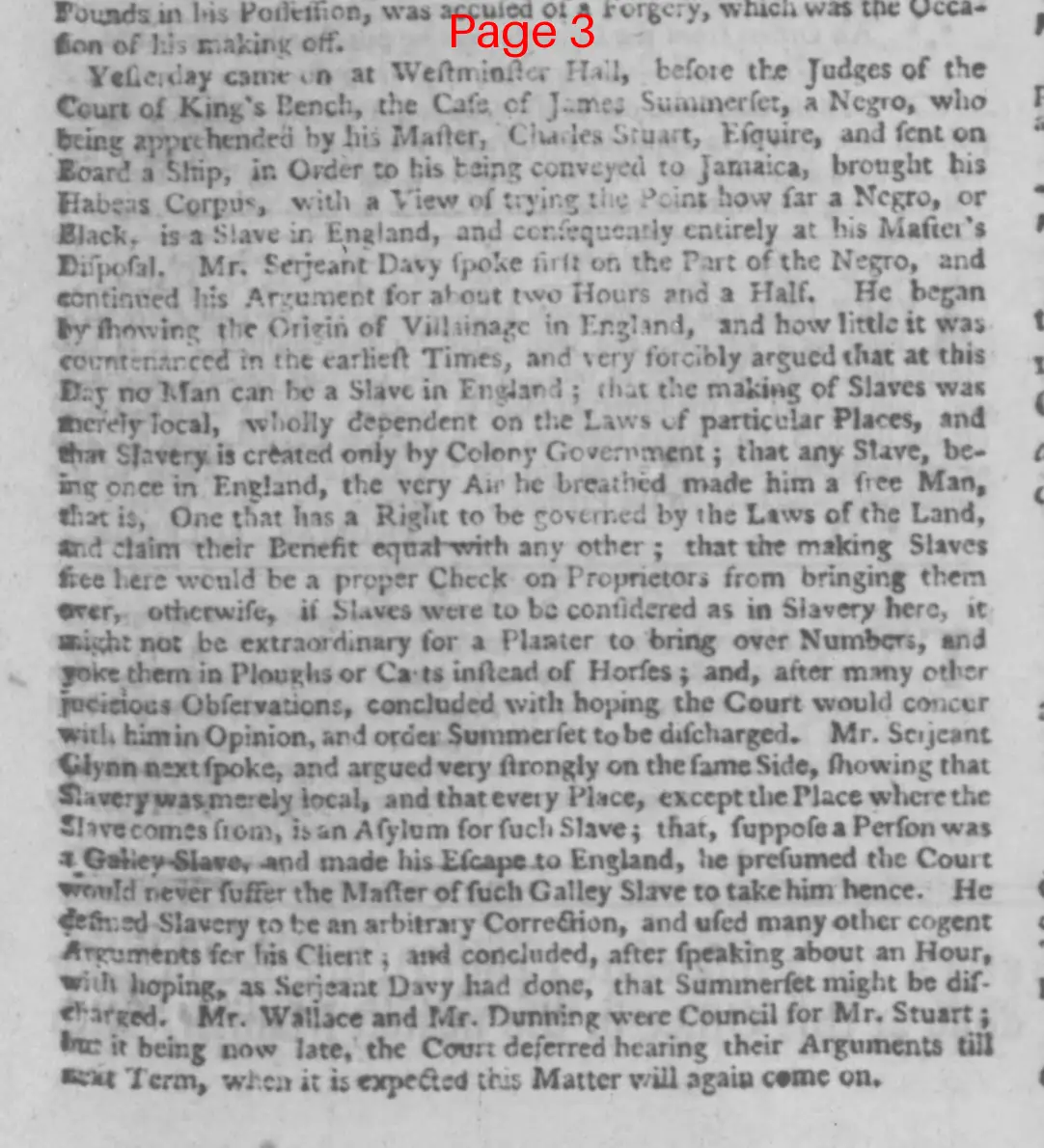
Yesterday came on at Westminster Hall, before the Judges of the Court of King's Bench, the Case of James Somerset, a Negro, who being apprehended by his Master, Charles Stuart, Esquire, and sent on Board a Ship, in Order to his being conveyed to Jamaica, brought his Habeas Corpus, with a View of trying the Point how far a Negro, or Black, is a Slave in England, and consequently entirely at his Master's Disposal.
Mr. Serjeant Davy spoke first on the Part of the Negro, and continued his Argument for about two Hours and a Half. He began by showing the Origin of Villainage in England, and how little it was countenanced in the earliest Times, and very forcibly argued that at this Day no Man can be a Slave in England; that the making of Slaves was merely local, wholly dependent on the Laws of particular Places, and that Slavery is created only by Colony Government; that any Slave, being once in England, the very Air he breathed made him a free Man, that is, One that has a Right to be governed by the Laws of the Land, and claim their Benefit equal with any other; that the making Slaves free here would be a proper Check on Proprietors from bringing them over, otherwise, if Slaves were to be considered as in Slavery here, it might not be extraordinary for a Planter to bring over Numbers, and yoke them in Ploughs or Carts instead of Horses; and, after many other judicious Observations, concluded with hoping the Court would concur with him in Opinion, and order Somerset to be discharged.
Mr. Serjeant Glynn next spoke, and argued very strongly on the same Side, showing that Slavery was merely local, and that every Place, except the Place where the Slave comes from, is an Asylum for such Slave; that, suppose a Person was a Galley-Slave, and made his Escape to England, he presumed the Court would never suffer the Master of such Galley Slave to take him hence. He defined Slavery to be an arbitrary Correction, and used many other cogent Arguments for his Client; and concluded, after speaking about an Hour, with hoping, as Serjeant Davy had done, that Somerset might be discharged.
Mr. Wallace and Mr. Dunning were Counsel for Mr. Stuart; but it being now late, the Court deferred hearing their Arguments till next Term, when it is expected this Matter will again come on.
What sub-type of article is it?
Political
Social Customs
What keywords are associated?
Somerset
Slavery
Habeas Corpus
King's Bench
What entities or persons were involved?
James Somerset
Charles Stuart
Serjeant Davy
Serjeant Glynn
Mr. Wallace
Mr. Dunning
Where did it happen?
Westminster Hall
Foreign News Details
Primary Location
Westminster Hall
Event Date
Yesterday
Key Persons
James Somerset
Charles Stuart
Serjeant Davy
Serjeant Glynn
Mr. Wallace
Mr. Dunning
Outcome
case deferred