Thanks for visiting SNEWPapers!
Sign up free today to connect your AI tools to the Library of Congress' newspaper collection.
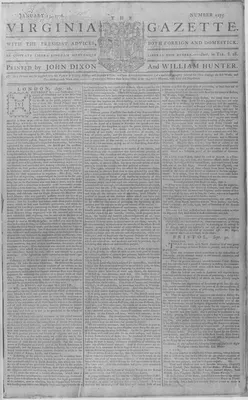
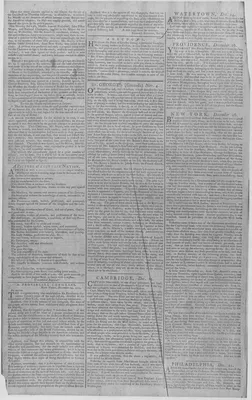
The Virginia Gazette Foreign News January 13, 1776
Richmond, Richmond, Virginia
What is this article about?
Bristol merchants and citizens pass six resolutions on the importance of American trade, petition the King against the ruinous civil war with the colonies, and approve an address to the King; a rival petitioning group unsuccessfully tries to obstruct the meeting.
Quality green show the numbers
Measured from the scan
— how cleanly the OCR engine read the characters
- Mean ink quality
- 99.0% The length-weighted average confidence across the OCR lines — the mean of exactly the per-line scores whose tails the two figures below report. Typical is 99%.
- Illegible ink
- 0.0% Text sitting in OCR-detected lines that scored below 80% confidence — very shaky reads. Weighted by line length, so one long bad line counts for more than a short one.
- Uncertain ink
- 1.05% Text in lines that scored 80–90% — somewhat shaky reads.
- Matches source
- 95.07% How closely the served text matches the raw OCR of the same boxes, letter by letter, after collapsing spacing and case. This measures agreement, not correctness: the OCR is often wrong and the extractor corrects it, so 100% does not mean perfect, and a low figure usually means poor scan text was rewritten rather than that text was lost (length vs source shows loss). Across pages, this is the worst fragment.
- Length vs source
- 99.62% Below 100% means text was dropped from the OCR; above means text was added to make it read.
Assembled by the extraction model
— whether the stitched-together text holds up; catches layout and segmentation errors, which the scores above cannot see
- Transcription confidence
- 95.0% (typical 96%) How cleanly the extractor could assemble what it was given. Low here with clean ink scores points at layout analysis — the characters were read correctly but grouped or ordered wrongly.
- Comprehension
- 95.0% Whether the piece reads coherently start to finish. Can stay high while transcription confidence drops, when only part of the component is affected.
Clippings
1 of 2
Full Text
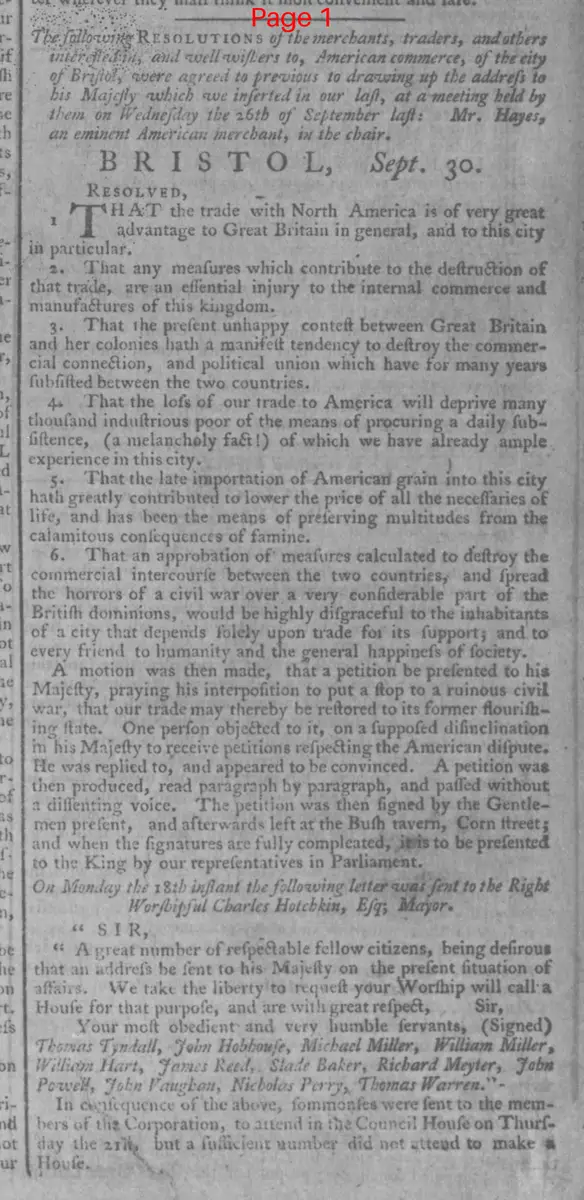
The following RESOLUTIONS of the merchants, traders, and others interested in, and well wishers to, American commerce, of the city of Bristol, were agreed to previous to drawing up the address to his Majesty which we inserted in our last, at a meeting held by them on Wednesday the 26th of September last: Mr. Hayes, an eminent American merchant, in the chair.
BRISTOL, Sept. 30.
RESOLVED,
1. That the American trade is of the greatest advantage to Great Britain in general, and to this city in particular.
2. That any measures which contribute to the destruction of that trade, are an essential injury to the internal commerce and manufactures of this kingdom.
3. That the present unhappy contest between Great Britain and her colonies hath a manifest tendency to destroy the commercial connection, and political union which have for many years subsisted between the two countries.
4. That the loss of our trade to America will deprive many thousand industrious poor of the means of procuring a daily subsistence, (a melancholy fact!) of which we have already ample experience in this city.
5. That the late importation of American grain into this city hath greatly contributed to lower the price of all the necessaries of life, and has been the means of preserving multitudes from the calamitous consequences of famine.
6. That an approbation of measures calculated to destroy the commercial intercourse between the two countries, and spread the horrors of a civil war over a very considerable part of the British dominions, would be highly disgraceful to the inhabitants of a city that depends solely upon trade for its support; and to every friend to humanity and the general happiness of society.
A motion was then made, that a petition be presented to his Majesty, praying his interposition to put a stop to a ruinous civil war, that our trade may thereby be restored to its former flourishing state. One person objected to it, on a supposed disinclination in his Majesty to receive petitions respecting the American dispute. He was replied to, and appeared to be convinced. A petition was then produced, read paragraph by paragraph, and passed without a dissenting voice. The petition was then signed by the Gentlemen present, and afterwards left at the Bush tavern, Corn street; and when the signatures are fully completed, it is to be presented to the King by our representatives in Parliament.
On Monday the 18th instant the following letter was sent to the Right Worshipful Charles Hotchkin, Esq; Mayor.
"SIR,
"A great number of respectable fellow citizens, being desirous that an address be sent to his Majesty on the present situation of affairs. We take the liberty to request your Worship will call a House for that purpose, and are with great respect, Sir,
Your most obedient and very humble servants, (Signed)
Thomas Tyndall, John Hobhouse, Michael Miller, William Miller
William Hart, James Reed, Slade Baker, Richard Meyler, John
Powell, John Vaughan, Nicholas Perry, Thomas Warren."
In consequence of the above, summonses were sent to the members of this Corporation, to attend in the Council House on Thursday the 21st, but a sufficient number did not attend to make a House.
Upon this many citizens applied to the Mayor for the use of the Guildhall on Thursday following, to assemble in, to address his Majesty on the situation of affairs between Great Britain and the American colonies; the Hall was readily granted, and notice thereof was given in the public papers.
On Monday the 25th, Messrs. Samuel Brailsford, John Fisher Weare, and Richard Champion, applied to the Mayor for the Hall on Wednesday, that the American merchants, traders, and the well wishers to American commerce, might meet there to consider of a petition to his Majesty; they met accordingly on that day, to the number of about fifty persons; Mr. Hayes, a Gentleman lately settled here, from New York, was called to the chair: A petition was produced and read, a proposal being made for the Chairman to sign it for the whole, which he very prudently declined; it was then signed by those present, and it is now industriously carried about, and every influence exerted to obtain names to it.
Though it was generally understood that this petition was merely set up in opposition to the address, yet not the least obstruction was made to it by any of the independent merchants and citizens.
Thursday at twelve o'clock, Mr. Mayor went from the Council House to the Guildhall, attended by the Sheriffs, with many members of the corporation, and the greatest number of respectable citizens ever known on the like occasion, his Worship being in the chair, the business was opened in a manly, sensible speech, by George Daubeny, Esq; setting forth that he was directed to return his Worship the thanks of the citizens of Bristol for his readiness in granting them the Hall, and was desired to express the grateful sense they entertained of the honour of his presence on this occasion; he then begged leave to lay before them an address, drawn up by a committee of Gentlemen appointed for that purpose, which he hoped would meet with general approbation.
To this the Mayor replied nearly as follows:
"That he should always retain the most grateful remembrance of the honour this day done him, and should be glad of every opportunity to testify his real regard for the true interest and welfare of the city of Bristol."
A motion was then made for the address to be read, it was much approved, and desired to be read a second time; an attempt to oppose it was then made by the persons who met to petition the preceding day. Their Chairman, Mr. Hayes, who was deputed by them to attend, was heard with candor; and in reply, was informed that as no interruption had been made to their proceedings the day before, it was expected, they would not disturb this day's meeting; they notwithstanding continued to obstruct in a very indecent manner, but numbers soon prevailed, and they were silenced. The address was signed, and the Mayor, Sheriffs, with some principal citizens, were requested to present it to his Majesty in the most respectful manner.
The address was immediately signed by a great number of citizens, and we hear, that it will be left in the committee room of the Taylor's-hall, till Monday next from eleven to two o'clock, for such as are disposed to sign it.
What sub-type of article is it?
Political
Colonial Affairs
Trade Or Commerce
What keywords are associated?
Bristol Merchants Resolutions
American Trade
Address To King
Petition
American Colonies
What entities or persons were involved?
Mr. Hayes
Charles Hotchkin
George Daubeny
Where did it happen?
Bristol, England
Foreign News Details
Primary Location
Bristol, England
Event Date
Sept. 30
Key Persons
Mr. Hayes
Charles Hotchkin
George Daubeny
Outcome
an address to the king was approved and signed for presentation; a separate petition against the ruinous civil war was also circulated, despite obstruction by a rival group.