Thank you for visiting SNEWPapers!
Sign up free
Fair Play Domestic News June 22, 1889
Sainte Genevieve, Sainte Genevieve, Missouri
Cautionary note: graphic descriptions of drowning deaths and bereaved survivors
What is this article about?
A narrative account of the Johnstown flood disaster in the Conemaugh Valley, recounting remarkable rescues, personal heroism, and harrowing scenes of loss among survivors.
Quality green show the numbers
Measured from the scan
— how cleanly the OCR engine read the characters
- Mean ink quality
- 99.0% The length-weighted average confidence across the OCR lines — the mean of exactly the per-line scores whose tails the two figures below report. Typical is 99%.
- Illegible ink
- 0.0% Text sitting in OCR-detected lines that scored below 80% confidence — very shaky reads. Weighted by line length, so one long bad line counts for more than a short one.
- Uncertain ink
- 0.0% Text in lines that scored 80–90% — somewhat shaky reads.
- Matches source
- 98.63% How closely the served text matches the raw OCR of the same boxes, letter by letter, after collapsing spacing and case. This measures agreement, not correctness: the OCR is often wrong and the extractor corrects it, so 100% does not mean perfect, and a low figure usually means poor scan text was rewritten rather than that text was lost (length vs source shows loss).
- Length vs source
- 100.55% Below 100% means text was dropped from the OCR; above means text was added to make it read.
Assembled by the extraction model
— whether the stitched-together text holds up; catches layout and segmentation errors, which the scores above cannot see
- Transcription confidence
- 94.0% (typical 96%) How cleanly the extractor could assemble what it was given. Low here with clean ink scores points at layout analysis — the characters were read correctly but grouped or ordered wrongly.
- Comprehension
- 94.0% Whether the piece reads coherently start to finish. Can stay high while transcription confidence drops, when only part of the component is affected.
Clipping
Full Text
TALES OF WOE.
Sad Scenes Enacted in the Conemaugh Valley.
Remarkable Rescues from the Death Wave Which Engulfed Johnstown and Her Neighbors—The List of the World's Heroes Swelled
STORIES TOLD BY SURVIVORS.
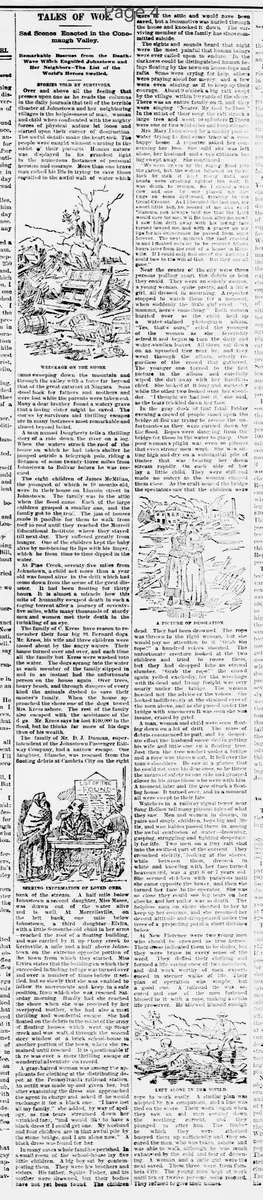
Over and above all the feeling that presses upon one as he reads the columns in the daily journals that tell of the terrible disaster at Johnstown and her neighboring villages is the helplessness of man, woman and child when confronted with the mighty forces of physical nature let loose and started upon their career of destruction. The awful details make the heart sick. The people were caught without warning in the midst of their pursuits. Human nature was displayed in its grandest light in the numerous instances of personal heroism and courage. More than one brave man risked his life in trying to save those engulfed in the awful wall of water which
WRECKAGE ON THE SHORE
came sweeping down the mountain and through the valley with a force far beyond that of the great cataract at Niagara. Sons stood back for fathers and mothers and were lost while the parents were taken out. Many a dear brother found a watery grave that a loving sister might be saved. The stories by survivors and thrilling escapes are in many instances most remarkable and almost beyond belief.
A man named Dougherty tells a thrilling story of a ride down the river on a log. When the waters struck the roof of the house on which he had taken shelter he jumped astride a telegraph pole, riding a distance of some twenty-three miles from Johnstown to Bolivar before he was rescued.
The eight children of James McMillan, the youngest of which is 10 months old, were in their house on Lincoln street in Johnstown. The family was in the attic when the flood came. Each of the large children grasped a smaller one, and the family got to the roof. The jam of houses made it possible for them to walk from roof to roof until they reached the Morrell Educational Institute where they stayed till next day. They suffered greatly from hunger. One of the children kept the baby alive by moistening its lips with his finger which he from time to time dipped in the water.
At Pine Creek, seventy-five miles from Johnstown, a child not more than a year old was found alive in the drift which had come down from the scene of the great disaster. It had been floating for thirty hours. It is almost a miracle how this mite of humanity escaped death in such a raging torrent after a journey of seventy-five miles, while many thousands of sturdy men and women met their death in the twinkling of an eye.
The family of C. Kress have reason to remember their four big St. Bernard dogs. Mr. Kress, his wife and three children were tossed about by the angry waters. Their house turned over and over, and each time all the family but Kress were washed into the water. The dogs sprang into the water as each member of the family slipped in and in an instant had the unfortunate person on the house again. Over trees, heavy brush, and through dangers of every kind the animals dashed to save their master's family. When the house approached the shore one of the dogs towed Mrs. Kress ashore. The rest of the family also escaped with the assistance of the dogs. Mr. Kress says he lost $100,000 in the flood, but he thinks far more of his dogs than of his wealth.
The family of Mr. D. J. Duncan, superintendent of the Johnstown Passenger Railway Company, had a narrow escape. One daughter, Blanche, was rescued from the floating debris at Cambria City on the right
SEEKING INFORMATION OF LOVED ONES
bank of the stream. A half mile below Johnstown a second daughter, Miss Masee, was drawn out of the water alive and is well. At Morrellsville, on the left bank, one mile below Johnstown, a third daughter—Elvira, with a little 6-months-old child in her arms—reached the roof of a floating building and was carried by it up Stony Creek to Kernville, a mile and a half above Johnstown, on the extreme opposite portion of the town from which they started. Miss Elvira states that the building on which they succeeded in finding refuge was turned over and over a number of times before it settled, but so slowly that she was enabled to follow its movements and keep in a safe position, from which she was rescued Saturday morning. Hardly had she reached the shore when she was received by her overjoyed mother, who had also a most thrilling and wonderful escape. She had floated on the debris in the midst of the army of floating houses which went up Stony Creek and was wafted through the second story window of a brick school-house in another portion of the town, where she remained until rescued. It is questionable if there was ever a more thrilling escape or wonderful adventure on record.
A gray-haired woman was among the applicants for clothing at the distributing depot at the Pennsylvania railroad station. An outfit was made up and given her, but after examining the dress she approached the agent in charge and asked if he would exchange it for a black one. "I have lost all my family," she added, by way of apology, as the tears streamed down her wrinkled face, "and would like to have a black dress if I could get one. My husband and four children are in that awful pile by the stone bridge, and I am alone now." A black dress was found for her.
In many cases whole families perished. In a small room of the school-house lay five little children. A big boy sat by contemplating them. They were his brothers and sisters. His father, Squire Fisher, and his mother were drowned, but their bodies have not yet been found. The children were in the attic and would have been saved, but a locomotive was hurled through the house and knocked it down. The surviving member of the family has since committed suicide.
The sights and sounds heard that night were the most painful that human beings were ever called upon to endure. In the darkness could be distinguished human beings floating by the town on house-tops and rafts. Some were crying for help, others were praying aloud for mercy, and a few were even singing as if to keep up their courage. About 9 o'clock a big raft swept by the village within 100 yards of the shore. There was an entire family on it, and they were singing "Nearer, My God, to Thee." In the midst of their song the raft struck a large tree and went to splinters. There were one or two wild cries and then silence.
Mrs. Mary Fenn stood by a muddy pool of water trying to find some trace of a once happy home. A reporter asked her concerning her loss. She said she was left alone, her husband and seven children being swept away. She continued: "We were driven by the raging flood into the garret, but the waters followed us there. Inch by inch it kept rising until our heads were crushing against the roof. It was death to remain. So I raised a window and one by one placed my darlings. Great Creator! As I liberated the last one, sweet little boy, he looked at me and said: Mamma, you always told me that the Lord would care for me; will He look after me now? I saw him drift away with his loving face turned toward me, and with a prayer on my lips for his deliverance he passed from sight forever. The next moment the roof crashed in and I floated outside to be rescued fifteen hours later from the roof of a house in Kernville. If I could only find one of my darlings I could bow to the will of God. But they are all gone."
Near the center of the city were three persons pulling apart the debris as best they could. They were an elderly woman, a young woman, quite pretty, and a little girl, all dressed in mourning. A reporter stopped to watch them for a moment when suddenly the little girl cried: "O mamma, here's something." Both women hurried over as the child held up a water-stained photograph album. "Yes, that's ours," cried the younger of the women as she feverishly seized it and began to turn the dirty and water-swollen leaves. All three sat down on an uprooted tree near by, and they went through the album, utterly regardless of the crowd that gathered. The younger one turned to the first picture in the album and carefully wiped the dirt away with her handkerchief. She looked at it long and earnestly while the other two looked over her shoulder. "I thought we had lost it," she said as the tears trickled down her face.
In the gray dusk of that fatal Friday evening a crowd of people stood upon the bridge at Bolivar trying to rescue the unfortunates as they were carried down by the flood. Ropes were dangling from the bridge for those in the water to grasp. One poor woman's plight was even so piteous that even strong men wept. She was sitting high and dry on a substantial pile of timber that was bearing her down stream rapidly. On each side of her lay a little child. They were still and made no outcry as the woman clasped them close. As the craft neared the bridge the spectators saw that the children
A PICTURE OF DESOLATION
were dead. They had been drowned. The rope was thrown to the rigid woman, but she would pay no attention to it. "Grab the rope!" a hundred voices shouted. The unfortunate creature looked at the two children and tried to rouse them, but they had dropped into an eternal slumber. "Grab the rope!" the crowd again yelled excitedly, for the wreckage with its dead and living freight was very nearly under the bridge. The woman heeded not the advice or the voices. She looked indifferently at the strained eyes of the men above, and as she passed under the bridge with unconcern it was seen she was insane, crazed by grief.
A man, woman and child were seen floating down on a lot of drift. The mass of debris commenced to part, and by desperate effort the husband succeeded in getting his wife and little one on a floating tree. Just then the tree washed under a bridge and a rope was thrown out. It fell over the man's shoulders. He saw at a glance that he could not save his dear ones, so he threw the means of safety to one side and grasped closer in his arms those who were with him. A moment later and the tree struck a floating house. It turned over, and in a moment all were swept to their fate.
Watchers in a railway signal tower near Sang Hollow tell many piteous tales of what they saw. Men and women in dozens, in pairs and singly, children, boys big and little, and wee babies passed there in among the awful confusion of water—drowning, gasping, struggling and fighting desperately for life. Two men on a tiny raft shot into the swiftest part of the current. They crouched stolidly, looking at the shores while between them, dressed in white and kneeling with her face turned heavenward, was a girl 6 or 7 years old. She seemed stricken with paralysis until she came opposite the tower, and then she turned her face to the operator. She was so close they could see big tears on her cheeks, and her pallor was as death. The helpless men on shore shouted to her to keep up her courage, and she resumed her devout attitude and disappeared under the trees of a projecting point a short distance below.
At New Florence were two young men who should be crowned as true heroes. Their dress indicated them to be dudes, but they were brave in every sense of the word. They doffed their clothing and formed a life-saving crew of two members and did work worthy of men experienced in sterner walks of life. Their plan of operation was simple, but a good one. A railroad tie was secured and one of the men fastened himself to it with a rope, making a crude life-preserver. He allowed himself enough
LEFT ALONE IN THE WORLD.
rope to work easily. A similar plan was adopted by his companion, and a line was tied on the shore. Their work began when they saw an old man coming down the seething current, and they plunged in after him. The timber to which they were attached buoyed them up sufficiently and they secured the man, who was taken ashore and was able to walk, although he was much exhausted by the cold and fear of drowning. A woman and a little girl were the next saved. These three were from Cambria City. The young men kept at work until ten or twelve persons were rescued. They refused to give their names.
What sub-type of article is it?
Disaster
What keywords are associated?
Johnstown Flood
Conemaugh Valley
Rescues
Survivors
Disaster
What entities or persons were involved?
Dougherty
James Mcmillan
C. Kress
D. J. Duncan
Mrs. Mary Fenn
Squire Fisher
Where did it happen?
Johnstown, Pa.
Domestic News Details
Primary Location
Johnstown, Pa.
Key Persons
Dougherty
James Mcmillan
C. Kress
D. J. Duncan
Mrs. Mary Fenn
Squire Fisher
Outcome
widespread death and destruction across johnstown and neighboring villages; numerous rescues and families lost