Thanks for visiting SNEWPapers!
Sign up free today to connect your AI tools to the Library of Congress' newspaper collection.
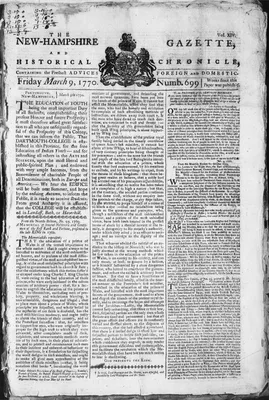
The New Hampshire Gazette And Historical Chronicle Letter to Editor March 9, 1770
Portsmouth, Rockingham, New Hampshire
What is this article about?
A reader denounces the imprisonment of five Quakers in Worcester jail for refusing to pay taxes supporting a town minister, calling it worse than the Stamp Act and contrary to liberty and common justice.
Quality green show the numbers
Measured from the scan
— how cleanly the OCR engine read the characters
- Mean ink quality
- 96.0% The length-weighted average confidence across the OCR lines — the mean of exactly the per-line scores whose tails the two figures below report. Typical is 99%.
- Illegible ink
- 0.0% Text sitting in OCR-detected lines that scored below 80% confidence — very shaky reads. Weighted by line length, so one long bad line counts for more than a short one.
- Uncertain ink
- 0.8% Text in lines that scored 80–90% — somewhat shaky reads.
- Matches source
- 93.95% How closely the served text matches the raw OCR of the same boxes, letter by letter, after collapsing spacing and case. This measures agreement, not correctness: the OCR is often wrong and the extractor corrects it, so 100% does not mean perfect, and a low figure usually means poor scan text was rewritten rather than that text was lost (length vs source shows loss).
- Length vs source
- 100.0% Below 100% means text was dropped from the OCR; above means text was added to make it read.
Assembled by the extraction model
— whether the stitched-together text holds up; catches layout and segmentation errors, which the scores above cannot see
- Transcription confidence
- 93.0% (typical 96%) How cleanly the extractor could assemble what it was given. Low here with clean ink scores points at layout analysis — the characters were read correctly but grouped or ordered wrongly.
- Comprehension
- 95.0% Whether the piece reads coherently start to finish. Can stay high while transcription confidence drops, when only part of the component is affected.
Clipping
Full Text
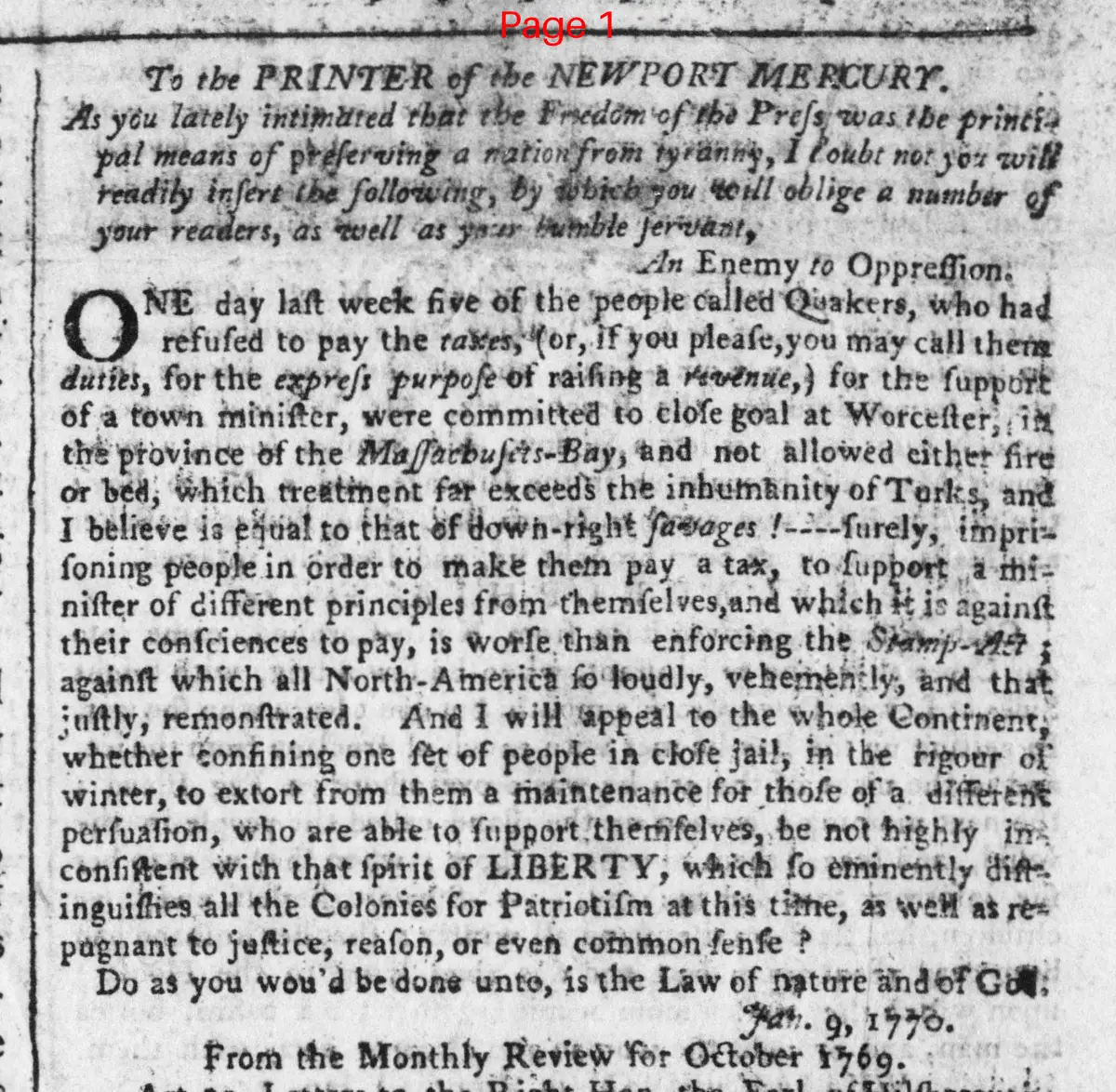
To the PRINTER of the NEWPORT MERCURY
As you lately intimated that the Freedom of the Press was the principal means of preserving a nation from tyranny, I doubt not you will readily insert the following, by which you will oblige a number of your readers, as well as your humble servant,
An Enemy to Oppression.
ONE day last week five of the people called Quakers, who had refused to pay the taxes, (or, if you please, you may call them duties, for the express purpose of raising a revenue,) for the support of a town minister, were committed to close gaol at Worcester, in the province of the Massachusetts-Bay; and not allowed either fire or bed; which treatment far exceeds the inhumanity of Turks, and I believe is equal to that of downright savages!----surely, imprisoning people in order to make them pay a tax, to support a minister of different principles from themselves, and which it is against their consciences to pay, is worse than enforcing the Stamp-Act, against which all North-America so loudly, vehemently, and that justly, remonstrated. And I will appeal to the whole Continent, whether confining one set of people in close jail, in the rigour of winter, to extort from them a maintenance for those of a different persuasion, who are able to support themselves, be not highly inconsistent with that spirit of LIBERTY; which so eminently distinguishes all the Colonies for Patriotism at this time, as well as repugnant to justice, reason, or even common sense ?
Do as you would be done unto, is the Law of nature and of God.
Feb. 9, 1770.
What sub-type of article is it?
Persuasive
Ethical Moral
What themes does it touch?
Religion
Constitutional Rights
Social Issues
What keywords are associated?
Quaker Imprisonment
Religious Liberty
Taxation
Worcester Gaol
Newport Mercury Letter
What entities or persons were involved?
The Printer Of The Newport Mercury
An Enemy To Oppression
Letter to Editor Details
Author
An Enemy To Oppression
Recipient
The Printer Of The Newport Mercury
Main Argument
Argues that imprisoning Quakers who refuse on conscience to pay a tax for a minister of a different persuasion is worse than the Stamp Act and inconsistent with the spirit of liberty.
Notable Details
- five Quakers committed to close gaol at Worcester
- no fire or bed allowed
- quotes 'Do as you would be done unto'
- compares treatment to Turks and savages