Thank you for visiting SNEWPapers!
Sign up free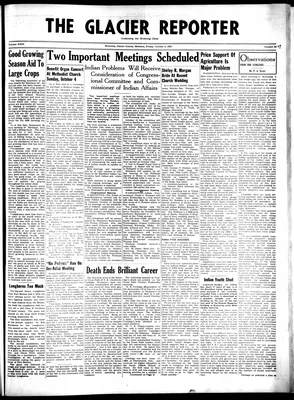
The Glacier Reporter Editorial October 2, 1953
Browning, Glacier, Montana
What is this article about?
Columnist T.A. Busey examines the government's plan to end Indian ward status on the Blackfeet reservation, presenting a full-blood Indian's proposal to settle mixed-blood claims and provide lifetime allowances for full-bloods.
Quality green show the numbers
Measured from the scan
— how cleanly the OCR engine read the characters
- Mean ink quality
- 99.0% The length-weighted average confidence across the OCR lines — the mean of exactly the per-line scores whose tails the two figures below report. Typical is 99%.
- Illegible ink
- 0.0% Text sitting in OCR-detected lines that scored below 80% confidence — very shaky reads. Weighted by line length, so one long bad line counts for more than a short one.
- Uncertain ink
- 0.0% Text in lines that scored 80–90% — somewhat shaky reads.
- Matches source
- 98.48% How closely the served text matches the raw OCR of the same boxes, letter by letter, after collapsing spacing and case. This measures agreement, not correctness: the OCR is often wrong and the extractor corrects it, so 100% does not mean perfect, and a low figure usually means poor scan text was rewritten rather than that text was lost (length vs source shows loss). Across pages, this is the worst fragment.
- Length vs source
- 98.17% Below 100% means text was dropped from the OCR; above means text was added to make it read.
Assembled by the extraction model
— whether the stitched-together text holds up; catches layout and segmentation errors, which the scores above cannot see
- Transcription confidence
- 95.0% (typical 96%) How cleanly the extractor could assemble what it was given. Low here with clean ink scores points at layout analysis — the characters were read correctly but grouped or ordered wrongly.
- Comprehension
- 90.0% Whether the piece reads coherently start to finish. Can stay high while transcription confidence drops, when only part of the component is affected.
Clippings

1 of 2
Full Text
Observations
FROM THE SIDELINES......
By T. A. Busey
Since locating in Browning a few weeks ago, the writer of this column has found that there are three major problems, or issues, which are uppermost in the mind of most people who are looking toward the future development of this immediate area—the government's announced policy of terminating the ward status of the Indian population; the possibilities of oil and gas development on a large scale along the mountain front, and the further development of the tourist traffic business during the summer months.
The first issue, and the one that is demanding immediate attention, appears to be the first mentioned—the government's intention of terminating the ward status of the Indians. There are about six thousand people living on the Blackfeet reservation who have some kind of rights recognized by the government. Among that number, not more than 1,000 it is conservatively estimated, are full blood Indians, and the remainder are of mixed Indian and white blood of varying proportions.
It has long been the desire of the government, and most of the Indian population, to give to the people of the Indian race the same equality of opportunity, and with that the responsibility that accompanies that privilege, to the Indian people that is enjoyed by their white neighbors. But just how to bring this desired result about has been a moot question, and it was not until the present administration took over the government the first of this year that any concrete plan looking toward the fulfillment of this worthy objective was undertaken.
Naturally there are many differing opinions and suggestions being put forth as to the best method of procedure, although most everyone is agreed that the step taken so far is in the right direction.
The Indians have been granted full citizenship, and for some time have had the same voting privilege as their white neighbors. But at the same time they have been hedged in with certain restrictions that have not been in keeping with the theory that the Indian people are the full equal as citizens with their white neighbors.
The government spends huge sums of the taxpayers' money ostensibly for the benefit of the Indians on the several reservations, mostly in the western states. The Indian population, as a whole, has shown some increase in recent years, but at the same time the economic and cultural status of the individual Indian ward has not kept pace with the achievements of the white population. Educational facilities provided by the government have been the most effective means of helping the Indians, it is pretty generally agreed, but even with this advancement in education, the average Indian has not shown the progress that might have been expected of him. Too many economic restrictions have made his path forward difficult.
Indians themselves, have not made the same determined effort to improve their condition that some of the other races have made—the negroes, for example. The so-called colored man, ever since his liberation from slavery. has put up a gallant fight for his individual rights, and they have made steady and rapid progress. The Indian people, it has been pointed out, have depended too much on the help of the government, and have not developed the same degree of aggressiveness and initiative that has helped the members of the negro race. This the Indians will have to do if they are to make a success of their much desired liberation and elevation to a full status of American citizenship, and its attendant opportunities.
In discussing the new governmental policy with representatives of the Indian people, government officials and representatives in the national Congress, some general conclusions have been reached as to the immensity of the problem faced by both the government and the Indian people. About as many suggested plans have been put forward as the number of people interviewed.
Perhaps as practical a plan as
OBSERVATIONS
(Continued from Page 1)
Any suggestion was advocated by a well known, well respected, educated full blood Indian who was born on the Blackfeet reservation and lived here all his life, who called at our office. When asked his opinion about the matter of terminating the ward status of his people, he said emphatically that he was against it—especially insofar as any plan yet suggested is concerned. He pointed out that of the six thousand people on this reservation who are classified as holding Indian status, there are only about one thousand full bloods. Of these 1,000 full bloods, he said, many of them cannot read or write, or even speak English. These people, he said, would in a large majority of cases, be helpless without some kind of government support. He then suggested his own plan, which stated simply, boils down to something like this: Liquidate all the property rights and governmental assistance, with the possible exception of educational facilities, for all those of mixed blood now having or claiming rights because of their Indian status. If they have rights to land, issue them fee patents as rapidly as possible, and then they could do as they please with it—sell it, work it themselves, lease it without restrictions, or make any other use of the property as they see fit. Start in, he suggested, with the quarter and less breeds, and settle their claims first. Then proceed in similar manner until all except the full bloods are settled with. As to the full bloods, who he stated would never be able to care for themselves, give them a direct, liberal allowance every month as long as they live, and give this without any red-tape hindrances that he claimed handicaps the present system of assistance. Let the full bloods retain their property rights, which would provide some additional income, and which could be distributed to their legal heirs at their death. This plan, argued our full blood friend, would probably be far too simple and inexpensive for the government to consider, but it contained what he thought would be the most practical and economical method of solving the whole problem.
This latter suggestion is presented for what it is worth, and only to illustrate what some of the Indian people themselves are thinking.
As this is a subject of vital importance, both to the Indians and whites, locally and to the government agencies as well, this newspaper will welcome any suggestions, and will provide space for publication for anyone who cares to offer constructive arguments, either for or against the suggested government program.
What sub-type of article is it?
Indian Affairs
What keywords are associated?
Blackfeet Reservation
Indian Ward Status
Termination Policy
Full Blood Indians
Mixed Blood
What entities or persons were involved?
T.A. Busey
Blackfeet Indians
Government Officials
Congress
Editorial Details
Primary Topic
Termination Of Indian Ward Status On The Blackfeet Reservation
Stance / Tone
Balanced, Informative, Open To Public Discussion
Key Figures
T.A. Busey
Blackfeet Indians
Government Officials
Congress
Key Arguments
- Termination of ward status is a complex and urgent issue
- Mixed-blood and full-blood Indians have different needs
- A suggested plan: liquidate mixed-blood claims and give full-bloods monthly allowances
- Indians need to develop more initiative, as other groups have
- The newspaper welcomes constructive arguments on the program