Thanks for visiting SNEWPapers!
Sign up free today to connect your AI tools to the Library of Congress' newspaper collection.
The Virginia Gazette Letter to Editor March 25, 1773
Williamsburg, Virginia
What is this article about?
Printer A. Purdie writes to Mr. Rind, defending his delay in publishing the Christian Layman's letters, denying any broken promise, and seeking reconciliation while affirming his dedication to his trade and the public good.
Quality green show the numbers
Measured from the scan
— how cleanly the OCR engine read the characters
- Mean ink quality
- 99.0% The length-weighted average confidence across the OCR lines — the mean of exactly the per-line scores whose tails the two figures below report. Typical is 99%.
- Illegible ink
- 0.0% Text sitting in OCR-detected lines that scored below 80% confidence — very shaky reads. Weighted by line length, so one long bad line counts for more than a short one.
- Uncertain ink
- 0.25% Text in lines that scored 80–90% — somewhat shaky reads.
- Matches source
- 96.47% How closely the served text matches the raw OCR of the same boxes, letter by letter, after collapsing spacing and case. This measures agreement, not correctness: the OCR is often wrong and the extractor corrects it, so 100% does not mean perfect, and a low figure usually means poor scan text was rewritten rather than that text was lost (length vs source shows loss). Across pages, this is the worst fragment.
- Length vs source
- 99.08% Below 100% means text was dropped from the OCR; above means text was added to make it read.
Assembled by the extraction model
— whether the stitched-together text holds up; catches layout and segmentation errors, which the scores above cannot see
- Transcription confidence
- 94.0% (typical 96%) How cleanly the extractor could assemble what it was given. Low here with clean ink scores points at layout analysis — the characters were read correctly but grouped or ordered wrongly.
- Comprehension
- 95.0% Whether the piece reads coherently start to finish. Can stay high while transcription confidence drops, when only part of the component is affected.
Clippings
1 of 2
Full Text
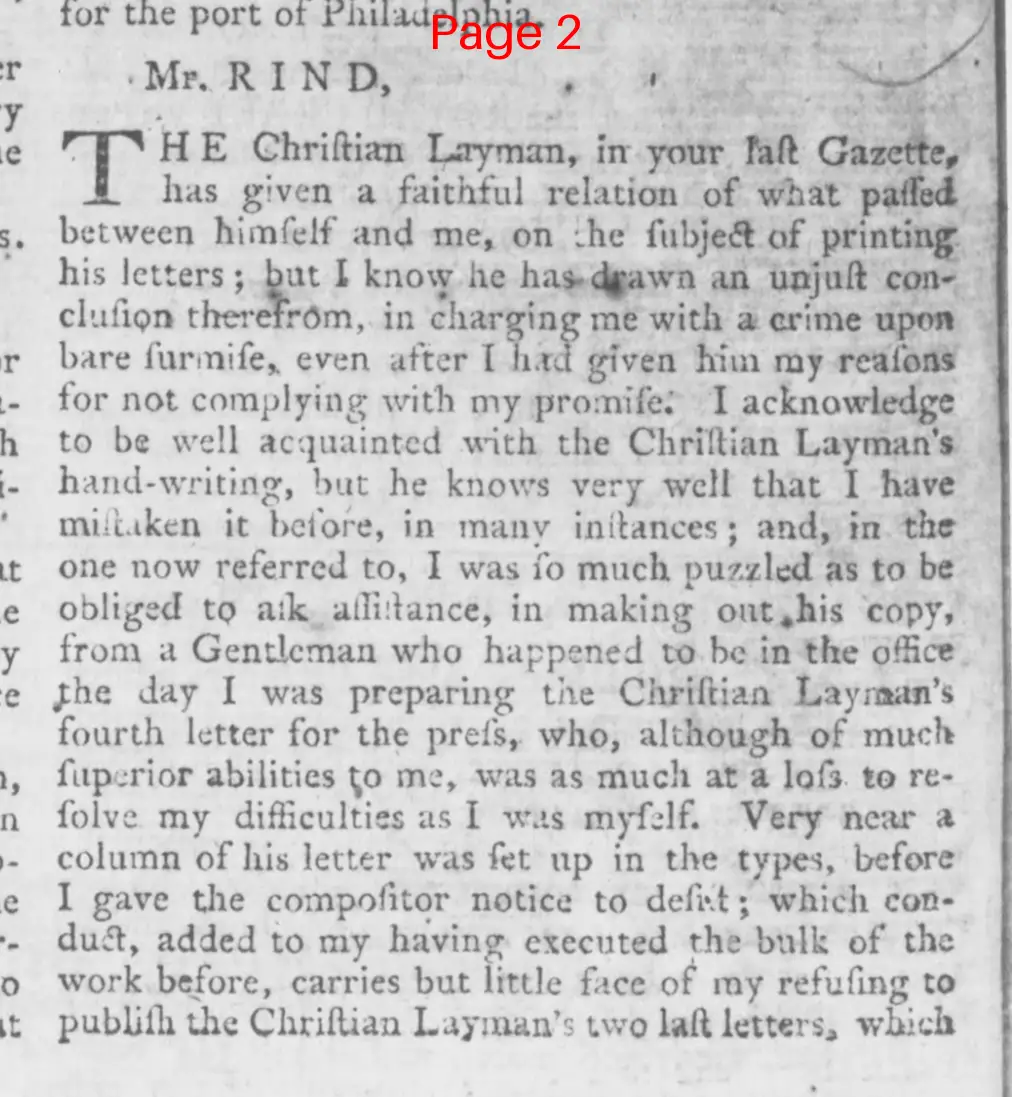
Mr. Rind has given a faithful relation of what passed between himself and me, on the subject of printing his letters; but I know he has drawn an unjust conclusion therefrom, in charging me with a crime upon bare surmise, even after I had given him my reasons for not complying with my promise: I acknowledge to be well acquainted with the Christian Layman's handwriting, but he knows very well that I have mistaken it before, in many instances; and, in the one now referred to, I was so much puzzled as to be obliged to ask assistance, in making out his copy, from a Gentleman who happened to be in the office the day I was preparing the Christian Layman's fourth letter for the press, who, although of much superior abilities to me, was as much at a loss to resolve my difficulties as I was myself. Very near a column of his letter was set up in the types, before I gave the compositor notice to desist; which conduct, added to my having executed the bulk of the work before, carries but little face of my refusing to publish the Christian Layman's two last letters, which
had been comprehended at first in one, but for the printer's convenience divided into two numbers, as the public has seen them in your Gazette.
I did not get his letter till November 12th, when I acknowledged the receipt of it in our Gazette of that date; intimating, that from the number of advertisements then in the paper (which I knew was likely to continue till the end of the merchants meeting in January) that, its publication might be deferred some considerable time,—I believe I said till the long cold winter nights, which would be a very proper season for religious and philosophical enquiries. My views were innocent in that remark, and I did not think to give the Christian Layman offence thereby.
The Christian Layman, soon after this, sent for his letter, and (as I said before) to make it more convenient to the printer, divided it into two numbers, supposing the letter, as it stood before, rather too long for one newspaper. The two letters I got soon after, and I was determined to print them as soon as I conveniently could; an opportunity, no great while after, presented itself, the northern post arriving without a mail, and there being no advices from Europe. The steps I then took towards their publication I have already related.
Conscious of the pains I have taken, and having set forth to the Christian Layman the true reasons for his letters not appearing, when I, by his own desire, returned them to him, I cannot say but I was a good deal chagrined at seeing, in the Christian Layman's card to his Orthodox opponent, that he had taxed me with violating a promise which I knew I had never broken; that he had received unmerited treatment from me, and for that reason had withdrawn his favours. Had the Christian Layman not been so hasty in his resentment, could he, for once, have condescended to reprove me as a friend (which I thought I had some pretensions to, considering his former regard, and the readiness, he will acknowledge, I have ever shown to oblige him) I should not have been drawn into the rash and unwise step of sending the card that gave him so much disgust, and which has exposed me to the galling attacks of so formidable an enemy, one so much my superior in every instance.
Had it occurred to the Christian Layman, however, that in attempting to wound me so deeply in the public esteem, he might, at the same time, be giving a deadly stab to the welfare of a numerous young family (who, he will readily join with me, merit some compassion, and demand all my care) his anger must have relented, and his tender and humane heart, I am sure, would have shuddered at the thoughts of so great cruelty. He would have considered, that Humanum est errare; an adage applicable to all ranks of people, from the mighty down to those in humbler stations. I will not yet, therefore, despair of a reconciliation, revenge being no part of my character, and I flatter myself does not compose any part of the Christian Layman's; nay that on some future occasion he will put it in my power to oblige him, and not entirely throw off his old and once regarded printer.
Since I have had the conduct of a newspaper, I have ever exerted my poor abilities, in its compilation, for the public entertainment; and although I cannot pretend to so great a knowledge in my business as many others, yet I am very happy in thinking I have served great part of my readers to their liking, which many of them have been kind enough to signify. That will still encourage me to go on in my endeavours for their amusement; and I do not despair, as long as I am blessed with health, and America enjoys the liberty of the press, but I shall find a comfortable livelihood, for myself and family, in a country where I have hitherto received so much encouragement and civility, and which is entitled to my utmost regard and gratitude.
As to literary merit, I cannot recollect that I ever pretended, especially to the Christian Layman, my having any pretensions to that distinguishing qualification. What I have the happiness to be possessed of, however, I believe quite sufficient for a man of my business. I would rather that I had more solid judgment than ask for any greater share of learning.
No matters of a private nature, nor sickness itself, have ever prevented me from attending to my business, and I hope never will. My customers and correspondents I always treated, to the best of my judgment, with gratitude and civility; they know best whether I have erred in any of those particulars. Should it be otherwise than I could wish, in a single instance, I will humbly ask pardon, and promise to reform my conduct.
It never was my intention that Mr. Dixon should be involved in any disputes of mine, as a printer. The printing business has been wholly directed by me since our entering into partnership, and he has never once attempted to invade that province of mine. When I make a false step, therefore, the weight will fall on my own shoulders. Mr. Dixon is a very worthy man; he needs no panegyrist. He acts with civility and good breeding upon every occasion, and has always been complaisant to me. Mr. Dixon will do me the justice to say that I have never been wanting in civility to him, or to any person who has ever favoured us with his custom, in any branch of our business. I
am now to acknowledge my gratitude to the Christian Layman for having been graciously pleased, as matters stand between us, to allow that I have any merit; and that is, being a good mechanical printer. I do not suspect him of flattery upon this occasion; let that be as it will, I shall strive, as long as I live, to gain more and more knowledge of my business; a duty I owe to my numerous benefactors. A humble artist may be a useful member of society. With my readers, I am vain enough to imagine that I shall be considered in that light.
I wish the Christian Layman a long life, many happy days, and that he may never know what it is to have an enemy. I am, brother Rind; your friend, and obedient humble servant, A. PURDIE.
What sub-type of article is it?
Persuasive
Reflective
Informative
What themes does it touch?
Press Freedom
Morality
What keywords are associated?
Christian Layman Letters
Printing Dispute
Newspaper Printer
A. Purdie
Letter To Editor
Reconciliation
What entities or persons were involved?
Mr. Rind
A. Purdie
Letter to Editor Details
Author
A. Purdie
Recipient
Mr. Rind
Main Argument
Purdie defends his delay in printing the Christian Layman's letters, denies breaking a promise, explains the circumstances, and seeks reconciliation while affirming his service to the public and the liberty of the press.
Notable Details
- reference to the Christian Layman's handwriting
- letter divided into two numbers for the printer's convenience
- quote: Humanum est errare
- acknowledges partner Mr. Dixon
- mentions liberty of the press