Thanks for visiting SNEWPapers!
Sign up free today to connect your AI tools to the Library of Congress' newspaper collection.
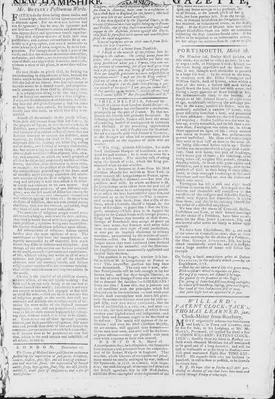
Fowle's New Hampshire Gazette And General Advertiser Editorial March 18, 1785
Portsmouth, Rockingham, New Hampshire
What is this article about?
A correspondent argues that Spain, emboldened by Britain's weak precedent under Walpole, has committed outrages violating treaty rights in the Mississippi, and America must demand satisfaction or lose respect as an independent nation.
Quality yellow Our extraction tools indicate this piece is a little shaky on the transcription; compare it to the source before quoting. show the numbers
Measured from the scan
— how cleanly the OCR engine read the characters
- Mean ink quality
- 99.0% The length-weighted average confidence across the OCR lines — the mean of exactly the per-line scores whose tails the two figures below report. Typical is 99%.
- Illegible ink
- 0.0% Text sitting in OCR-detected lines that scored below 80% confidence — very shaky reads. Weighted by line length, so one long bad line counts for more than a short one.
- Uncertain ink
- 0.0% Text in lines that scored 80–90% — somewhat shaky reads.
- Matches source
- 93.65% How closely the served text matches the raw OCR of the same boxes, letter by letter, after collapsing spacing and case. This measures agreement, not correctness: the OCR is often wrong and the extractor corrects it, so 100% does not mean perfect, and a low figure usually means poor scan text was rewritten rather than that text was lost (length vs source shows loss).
- Length vs source
- 102.27% Below 100% means text was dropped from the OCR; above means text was added to make it read.
Assembled by the extraction model
— whether the stitched-together text holds up; catches layout and segmentation errors, which the scores above cannot see
- Transcription confidence
- 80.0% (typical 96%) How cleanly the extractor could assemble what it was given. Low here with clean ink scores points at layout analysis — the characters were read correctly but grouped or ordered wrongly.
- Comprehension
- 95.0% Whether the piece reads coherently start to finish. Can stay high while transcription confidence drops, when only part of the component is affected.
Clipping
Full Text
NEW-YORK, March 18.
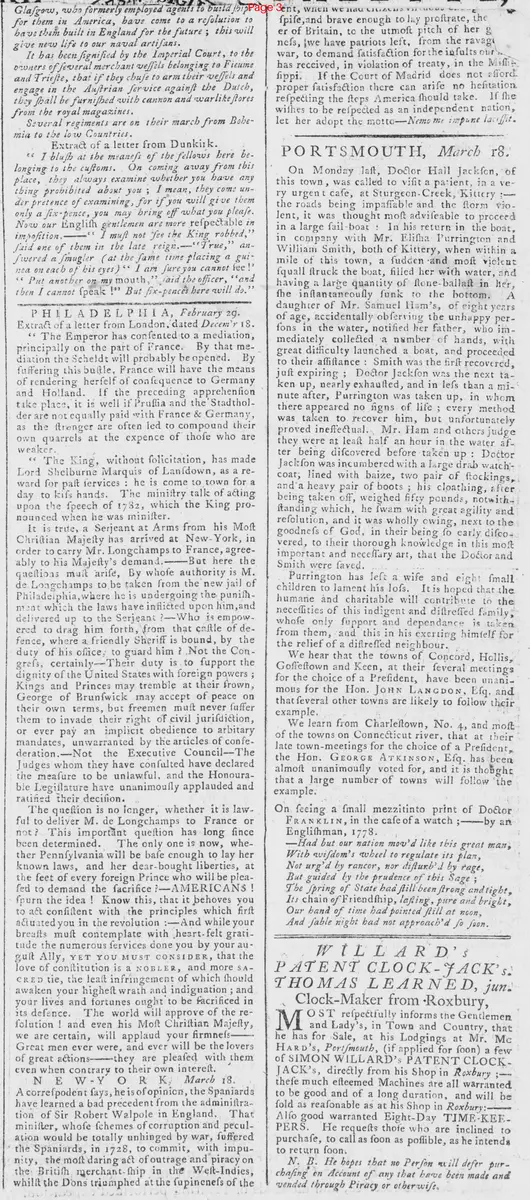
A correspondent says, he is of opinion, the Spaniards have learned a bad precedent from the administration of Sir Robert Walpole in England. That minister, whose schemes of corruption and peculation would be totally unhinged by war, suffered the Spaniards, in 1728, to commit, with impunity, the most daring act of outrage and piracy on the British merchant-ship in the West-Indies, whilst the Dons triumphed at the supineness of the spite, and brave enough to lay prostrate, the power of Britain, to the utmost pitch of her greatness, we have patriots left, from the ravages of war, to demand satisfaction for the insults our country has received, in violation of treaty, in the Mississippi. If the Court of Madrid does not afford proper satisfaction there can arise no hesitation respecting the steps America should take. If she wishes to be respected as an independent nation, let her adopt the motto—Nemo me impune lacessit.
A correspondent says, he is of opinion, the Spaniards have learned a bad precedent from the administration of Sir Robert Walpole in England. That minister, whose schemes of corruption and peculation would be totally unhinged by war, suffered the Spaniards, in 1728, to commit, with impunity, the most daring act of outrage and piracy on the British merchant-ship in the West-Indies, whilst the Dons triumphed at the supineness of the spite, and brave enough to lay prostrate, the power of Britain, to the utmost pitch of her greatness, we have patriots left, from the ravages of war, to demand satisfaction for the insults our country has received, in violation of treaty, in the Mississippi. If the Court of Madrid does not afford proper satisfaction there can arise no hesitation respecting the steps America should take. If she wishes to be respected as an independent nation, let her adopt the motto—Nemo me impune lacessit.
What sub-type of article is it?
Foreign Affairs
War Or Peace
What keywords are associated?
Spanish Outrages
Mississippi Treaty Violation
Walpole Precedent
American Honor
What entities or persons were involved?
Spain / Court Of Madrid
Sir Robert Walpole
Britain
American States
Editorial Details
Primary Topic
Spanish Treaty Violations And Outrages In The Mississippi; Demand For Satisfaction
Stance / Tone
Patriotic, Firm, Warning Of The Need For Decisive Action
Key Figures
Spain / Court Of Madrid
Sir Robert Walpole
Britain
American States
Key Arguments
- Spain learned a bad precedent from Walpole's appeasement
- Spanish outrages in the Mississippi violate treaty
- America must demand proper satisfaction
- an independent nation should adopt 'Nemo me impune lacessit'