Thanks for visiting SNEWPapers!
Sign up free today to connect your AI tools to the Library of Congress' newspaper collection.
Fowle's New Hampshire Gazette And General Advertiser Editorial April 29, 1785
Portsmouth, Rockingham, New Hampshire
What is this article about?
A correspondent urges Congress to sell western lands acquired from the Indians to pay the national debt of about $42 million, and to rely on imposts on foreign goods rather than taxing domestic industry and manufactures.
Quality green show the numbers
Measured from the scan
— how cleanly the OCR engine read the characters
- Mean ink quality
- 97.0% The length-weighted average confidence across the OCR lines — the mean of exactly the per-line scores whose tails the two figures below report. Typical is 99%.
- Illegible ink
- 0.0% Text sitting in OCR-detected lines that scored below 80% confidence — very shaky reads. Weighted by line length, so one long bad line counts for more than a short one.
- Uncertain ink
- 0.0% Text in lines that scored 80–90% — somewhat shaky reads.
- Matches source
- 94.75% How closely the served text matches the raw OCR of the same boxes, letter by letter, after collapsing spacing and case. This measures agreement, not correctness: the OCR is often wrong and the extractor corrects it, so 100% does not mean perfect, and a low figure usually means poor scan text was rewritten rather than that text was lost (length vs source shows loss).
- Length vs source
- 99.03% Below 100% means text was dropped from the OCR; above means text was added to make it read.
Assembled by the extraction model
— whether the stitched-together text holds up; catches layout and segmentation errors, which the scores above cannot see
- Transcription confidence
- 94.0% (typical 96%) How cleanly the extractor could assemble what it was given. Low here with clean ink scores points at layout analysis — the characters were read correctly but grouped or ordered wrongly.
- Comprehension
- 95.0% Whether the piece reads coherently start to finish. Can stay high while transcription confidence drops, when only part of the component is affected.
Clipping
Full Text
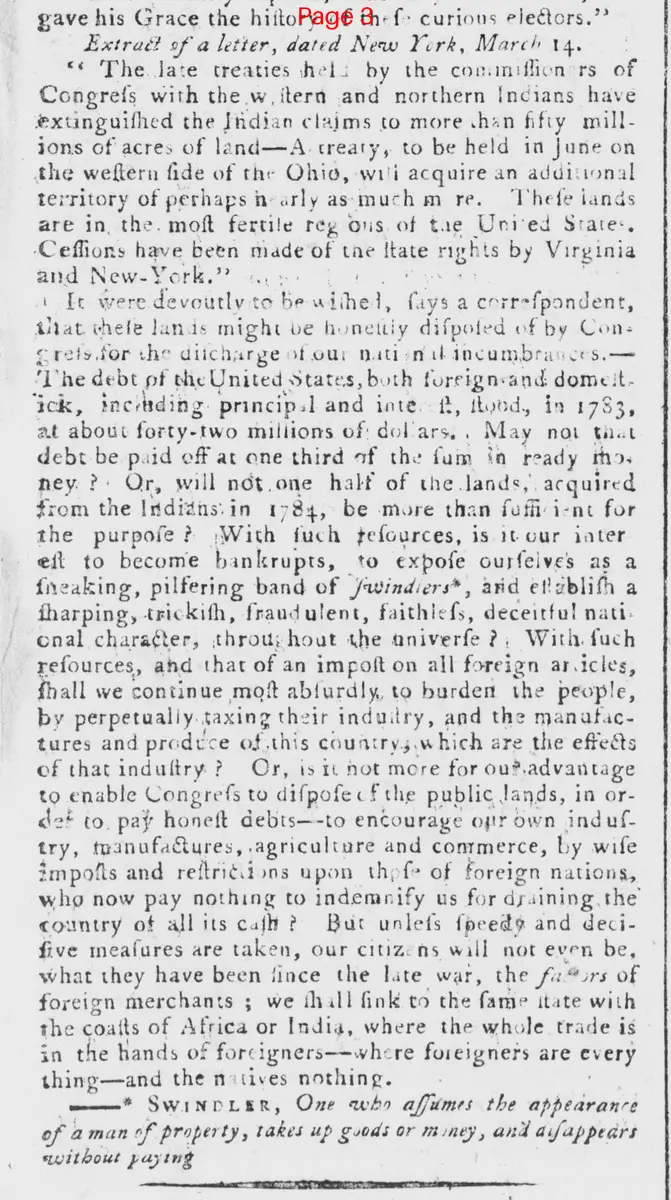
Extract of a letter, dated New York, March 14.
"The late treaties held by the commissioners of Congress with the western and northern Indians have extinguished the Indian claims to more than fifty millions of acres of land. A treaty, to be held in June on the western side of the Ohio, will acquire an additional territory of perhaps nearly as much more. These lands are in the most fertile regions of the United States. Cessions have been made of the State rights by Virginia and New-York."
It were devoutly to be wished, says a correspondent, that these lands might be honestly disposed of by Congress for the discharge of our national incumbrances. The debt of the United States, both foreign and domestic, including principal and interest, stood, in 1783, at about forty-two millions of dollars. May not that debt be paid off at one third of the sum in ready money? Or, will not one half of the lands, acquired from the Indians in 1784, be more than sufficient for the purpose? With such resources, is it our interest to become bankrupts, to expose ourselves as a sneaking, pilfering band of swindlers, and establish a sharping, trickish, fraudulent, faithless, deceitful national character, throughout the universe? With such resources, and that of an impost on all foreign articles, shall we continue most absurdly, to burden the people, by perpetually taxing their industry, and the manufactures and produce of this country, which are the effects of that industry? Or, is it not more for our advantage to enable Congress to dispose of the public lands, in order to pay honest debts--to encourage our own industry, manufactures, agriculture and commerce, by wise imposts and restrictions upon those of foreign nations, who now pay nothing to indemnify us for draining the country of all its cash? But unless speed and decisive measures are taken, our citizens will not even be, what they have been since the late war, the factors of foreign merchants; we shall sink to the same state with the coasts of Africa or India, where the whole trade is in the hands of foreigners--where foreigners are every thing--and the natives nothing.
* Swindler, One who assumes the appearance of a man of property, takes up goods or money, and disappears without paying
What sub-type of article is it?
Economic Policy
Taxation
Indian Affairs
What keywords are associated?
Public Land Sales
National Debt Payment
Impost On Foreign Goods
Indian Land Cessions
Western Lands
What entities or persons were involved?
Congress
Indian Tribes
Virginia
New York
Editorial Details
Primary Topic
Using Public Land Sales And Foreign Imposts To Discharge The National Debt
Stance / Tone
Strongly Supportive Of Land Sales And Protective Imposts; Critical Of Taxing Domestic Industry
Key Figures
Congress
Indian Tribes
Virginia
New York
Key Arguments
- Indian treaties extinguished claims to over fifty million acres
- a June treaty west of the Ohio may add nearly as much
- the 1783 national debt stood at about $42 million
- land sales could discharge the debt at a fraction of its value
- an impost on foreign articles is preferable to taxing domestic industry
- otherwise Americans may become mere factors for foreigners