Thank you for visiting SNEWPapers!
Sign up free
The New Hampshire Gazette And Historical Chronicle Letter to Editor October 14, 1763
Portsmouth, Rockingham, New Hampshire
What is this article about?
A reader writes to the printer urging that congregations stand while singing psalms and hymns, arguing that sitting or lounging during divine music is an irreverent act of praise.
Quality green show the numbers
Measured from the scan
— how cleanly the OCR engine read the characters
- Mean ink quality
- 98.0% The length-weighted average confidence across the OCR lines — the mean of exactly the per-line scores whose tails the two figures below report. Typical is 99%.
- Illegible ink
- 0.0% Text sitting in OCR-detected lines that scored below 80% confidence — very shaky reads. Weighted by line length, so one long bad line counts for more than a short one.
- Uncertain ink
- 0.0% Text in lines that scored 80–90% — somewhat shaky reads.
- Matches source
- 96.93% How closely the served text matches the raw OCR of the same boxes, letter by letter, after collapsing spacing and case. This measures agreement, not correctness: the OCR is often wrong and the extractor corrects it, so 100% does not mean perfect, and a low figure usually means poor scan text was rewritten rather than that text was lost (length vs source shows loss).
- Length vs source
- 99.54% Below 100% means text was dropped from the OCR; above means text was added to make it read.
Assembled by the extraction model
— whether the stitched-together text holds up; catches layout and segmentation errors, which the scores above cannot see
- Transcription confidence
- 92.0% (typical 96%) How cleanly the extractor could assemble what it was given. Low here with clean ink scores points at layout analysis — the characters were read correctly but grouped or ordered wrongly.
- Comprehension
- 90.0% Whether the piece reads coherently start to finish. Can stay high while transcription confidence drops, when only part of the component is affected.
Clipping
Full Text
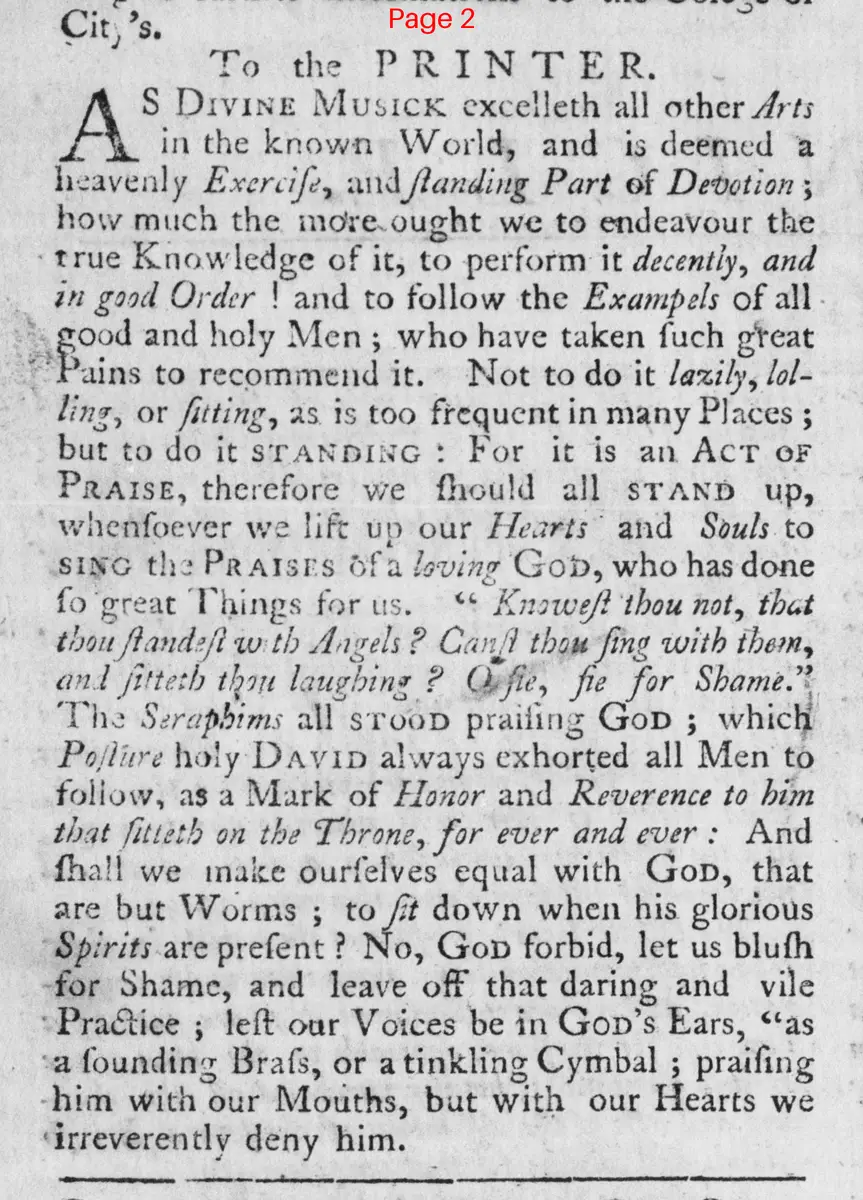
To the PRINTER.
The Divine Musick excelleth all other Arts in the known World, and is deemed a heavenly Exercise, and standing Part of Devotion; how much the more ought we to endeavour the true Knowledge of it, to perform it decently, and in good Order! and to follow the Examples of all good and holy Men; who have taken such great Pains to recommend it. Not to do it lazily, lolling, or sitting, as is too frequent in many Places; but to do it standing: For it is an Act of Praise, therefore we should all stand up, whensoever we lift up our Hearts and Souls to sing the Praises of a loving God, who has done so great Things for us. "Knowest thou not, that thou standest with Angels? Canst thou sing with them, and sittest thou laughing? O fie, fie for Shame." The Seraphims all stood praising God; which Posture holy David always exhorted all Men to follow, as a Mark of Honor and Reverence to him that sitteth on the Throne, for ever and ever: And shall we make ourselves equal with God, that are but Worms; to sit down when his glorious Spirits are present? No, God forbid, let us blush for Shame, and leave off that daring and vile Practice; lest our Voices be in God's Ears, as a sounding Brass, or a tinkling Cymbal; praising him with our Mouths, but with our Hearts we irreverently deny him.
What sub-type of article is it?
Persuasive
Religious
Ethical Moral
What themes does it touch?
Religion
Morality
What keywords are associated?
Divine Music
Standing In Worship
Reverence
Psalm Singing
What entities or persons were involved?
The Printer
Letter to Editor Details
Recipient
The Printer
Main Argument
Christians should stand while singing praises to God as a mark of reverence; sitting or lounging during worship is a daring and vile practice.
Notable Details
- quotes that worshippers stand with angels
- references Seraphims standing in praise
- calls sitting singers 'sounding brass or tinkling cymbal'