Thanks for visiting SNEWPapers!
Sign up free today to connect your AI tools to the Library of Congress' newspaper collection.
Alexandria Gazette & Daily Advertiser Recipe October 27, 1817
What is this article about?
Scalded cream butter: milk set twelve hours, scalded half an hour over a smokeless wood fire without boiling, cooled, and the thick cream skimmed next day and made into butter.
Quality green show the numbers
- Mean ink quality
- 99.0% The length-weighted average confidence across the OCR lines — the mean of exactly the per-line scores whose tails the two figures below report. Typical is 99%.
- Illegible ink
- 0.0% Text sitting in OCR-detected lines that scored below 80% confidence — very shaky reads. Weighted by line length, so one long bad line counts for more than a short one.
- Uncertain ink
- 0.0% Text in lines that scored 80–90% — somewhat shaky reads.
- Matches source
- 99.22% How closely the served text matches the raw OCR of the same boxes, letter by letter, after collapsing spacing and case. This measures agreement, not correctness: the OCR is often wrong and the extractor corrects it, so 100% does not mean perfect, and a low figure usually means poor scan text was rewritten rather than that text was lost (length vs source shows loss).
- Length vs source
- 99.88% Below 100% means text was dropped from the OCR; above means text was added to make it read.
- Transcription confidence
- 96.0% (typical 96%) How cleanly the extractor could assemble what it was given. Low here with clean ink scores points at layout analysis — the characters were read correctly but grouped or ordered wrongly.
- Comprehension
- 95.0% Whether the piece reads coherently start to finish. Can stay high while transcription confidence drops, when only part of the component is affected.
Clipping
Full Text
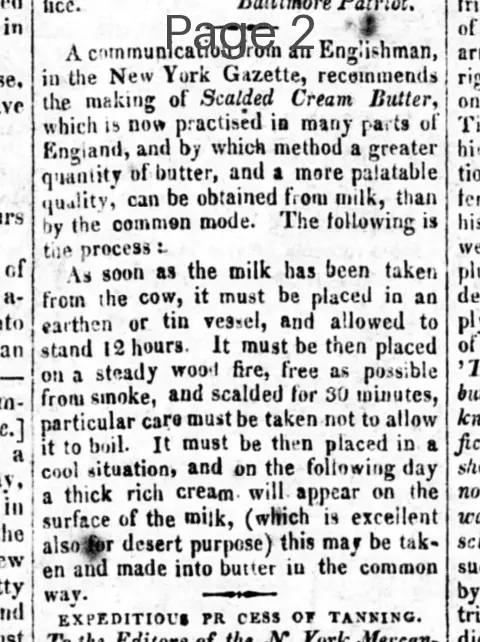
As soon as the milk has been taken from the cow, it must be placed in an earthen or tin vessel, and allowed to stand 12 hours. It must be then placed on a steady wood fire, free as possible from smoke, and scalded for 30 minutes, particular care must be taken not to allow it to boil. It must be then placed in a cool situation, and on the following day a thick rich cream will appear on the surface of the milk, (which is excellent also for dessert purpose) this may be taken and made into butter in the common way.
What sub-type of article is it?
What keywords are associated?
Recipe Details
Dish
Scalded Cream Butter
Cuisine / Origin
English Method
Ingredients
Equipment
Cooking Time
Stand 12 Hours; Scald 30 Minutes
Attributed Source
New York Gazette
Method
As soon as the milk is taken from the cow, put it in an earthen or tin vessel and let it stand twelve hours. Set it over a steady wood fire as free from smoke as possible and scald it for thirty minutes without letting it boil; then cool it, and the next day a thick rich cream rises which is skimmed off and made into butter in the usual way.