Thanks for visiting SNEWPapers!
Sign up free today to connect your AI tools to the Library of Congress' newspaper collection.
Weekly Independent Weather Report April 23, 1909
Elko, Elko, Nevada
What is this article about?
Foster's long-range weather bulletin, April 23, 1909, forecasts disturbances, warm and cool waves across North America, an unusually cool and dry May bad for crops, severe storms, and a notable cold spell around May 13-20 (blackberry winter), with advice on grain prices and farmer organization.
Quality green show the numbers
Measured from the scan
— how cleanly the OCR engine read the characters
- Mean ink quality
- 98.0% The length-weighted average confidence across the OCR lines — the mean of exactly the per-line scores whose tails the two figures below report. Typical is 99%.
- Illegible ink
- 0.0% Text sitting in OCR-detected lines that scored below 80% confidence — very shaky reads. Weighted by line length, so one long bad line counts for more than a short one.
- Uncertain ink
- 0.0% Text in lines that scored 80–90% — somewhat shaky reads.
- Matches source
- 96.68% How closely the served text matches the raw OCR of the same boxes, letter by letter, after collapsing spacing and case. This measures agreement, not correctness: the OCR is often wrong and the extractor corrects it, so 100% does not mean perfect, and a low figure usually means poor scan text was rewritten rather than that text was lost (length vs source shows loss).
- Length vs source
- 95.26% Below 100% means text was dropped from the OCR; above means text was added to make it read.
Assembled by the extraction model
— whether the stitched-together text holds up; catches layout and segmentation errors, which the scores above cannot see
- Transcription confidence
- 97.0% (typical 96%) How cleanly the extractor could assemble what it was given. Low here with clean ink scores points at layout analysis — the characters were read correctly but grouped or ordered wrongly.
- Comprehension
- 90.0% Whether the piece reads coherently start to finish. Can stay high while transcription confidence drops, when only part of the component is affected.
Clipping
Full Text
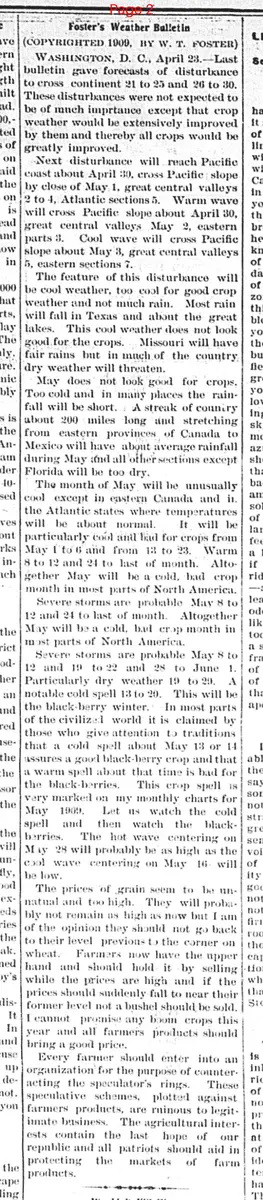
Foster's Weather Bulletin
(COPYRIGHTED 1909, BY W. T. FOSTER)
WASHINGTON, D. C., April 23.—Last bulletin gave forecasts of disturbance to cross continent 21 to 25 and 26 to 30. These disturbances were not expected to be of much importance except that crop weather would be extensively improved by them and thereby all crops would be greatly improved.
Next disturbance will reach Pacific coast about April 30, cross Pacific slope by close of May 1, great central valleys 2 to 4, Atlantic sections 5. Warm wave will cross Pacific slope about April 30, great central valleys May 2, eastern parts 3. Cool wave will cross Pacific slope about May 3, great central valleys 5, eastern sections 7.
The feature of this disturbance will be cool weather, too cool for good crop weather and not much rain. Most rain will fall in Texas and about the great lakes. This cool weather does not look good for the crops. Missouri will have fair rains but in much of the country dry weather will threaten.
May does not look good for crops. Too cold and in many places the rainfall will be short. A streak of country about 200 miles long and stretching from eastern provinces of Canada to Mexico will have about average rainfall during May and all other sections except Florida will be too dry.
The month of May will be unusually cool except in eastern Canada and in the Atlantic states where temperatures will be about normal. It will be particularly cool and bad for crops from May 1 to 6 and from 13 to 23. Warm 8 to 12 and 24 to last of month. Altogether May will be a cold, bad crop month in most parts of North America.
Severe storms are probable May 8 to 12 and 19 to 22 and 28 to June 1. Particularly dry weather 19 to 29. A notable cold spell 13 to 20. This will be the black-berry winter. In most parts of the civilized world it is claimed by those who give attention to traditions that a cold spell about May 13 or 14 assures a good black-berry crop and that a warm spell about that time is bad for the black-berries. This crop spell is very marked on my monthly charts for May 1909. Let us watch the cold spell and then watch the black-berries. The hot wave centering on May 28 will probably be as high as the cool wave centering on May 16 will be low.
The prices of grain seem to be unnatural and too high. They will probably not remain as high as now but I am of the opinion they should not go back to their level previous to the corner on wheat. Farmers now have the upper hand and should hold it by selling while the prices are high and if the prices should suddenly fall to near their former level not a bushel should be sold. I cannot promise any boom crops this year and all farmers products should bring a good price.
Every farmer should enter into an organization for the purpose of counteracting the speculator's rings. These speculative schemes, plotted against farmers products, are ruinous to legitimate business. The agricultural interests contain the last hope of our republic and all patriots should aid in protecting the markets of farm products.
What sub-type of article is it?
Forecast
Drought
Extreme Cold
What keywords are associated?
May 1909 Forecast
Crop Weather
Blackberry Winter
Cool Wave
Dry Weather
Where did it happen?
North America
Weather Report Details
Location
North America
Event Date
April 23
May 1909
Description
- Next disturbance will reach Pacific coast about April 30, cross Pacific slope by close of May 1, great central valleys 2 to 4, Atlantic sections 5.
- Warm wave will cross Pacific slope about April 30, great central valleys May 2, eastern parts 3.
- Cool wave will cross Pacific slope about May 3, great central valleys 5, eastern sections 7.
- The feature of this disturbance will be cool weather, too cool for good crop weather and not much rain.
- Most rain will fall in Texas and about the great lakes.
- May will be unusually cool except in eastern Canada and in the Atlantic states where temperatures will be about normal.
- Severe storms are probable May 8 to 12 and 19 to 22 and 28 to June 1.
- Particularly dry weather 19 to 29.
- A notable cold spell 13 to 20. This will be the black-berry winter.
Impact / Damage
- crop weather would be extensively improved by earlier disturbances
- cool weather does not look good for the crops
- may does not look good for crops; rainfall will be short in many places
- a streak of country about 200 miles long from eastern provinces of canada to mexico will have about average rainfall; all other sections except florida will be too dry.
Observations
- Grain prices seem unnatural and too high; farmers should sell while prices are high
- Every farmer should enter into an organization to counteract speculator's rings.