Thank you for visiting SNEWPapers!
Sign up free
The New Hampshire Gazette Foreign News January 21, 1763
Portsmouth, Rockingham, New Hampshire
What is this article about?
Correspondence between Col. Amherst and Count d'Haussonville over the surrender of Fort St. John's in September 1762: Amherst demands immediate possession or the garrison will be put to the sword; d'Haussonville negotiates, finally consenting to surrender the fort in good condition if his troops' terms are granted.
Quality yellow The extractor was unsure its transcription reads as real language, even though the scan measures clean. show the numbers
Measured from the scan
— how cleanly the OCR engine read the characters
- Mean ink quality
- 97.0% The length-weighted average confidence across the OCR lines — the mean of exactly the per-line scores whose tails the two figures below report. Typical is 99%.
- Illegible ink
- 0.2% Text sitting in OCR-detected lines that scored below 80% confidence — very shaky reads. Weighted by line length, so one long bad line counts for more than a short one.
- Uncertain ink
- 1.0% Text in lines that scored 80–90% — somewhat shaky reads.
- Matches source
- 94.86% How closely the served text matches the raw OCR of the same boxes, letter by letter, after collapsing spacing and case. This measures agreement, not correctness: the OCR is often wrong and the extractor corrects it, so 100% does not mean perfect, and a low figure usually means poor scan text was rewritten rather than that text was lost (length vs source shows loss).
- Length vs source
- 100.37% Below 100% means text was dropped from the OCR; above means text was added to make it read.
Assembled by the extraction model
— whether the stitched-together text holds up; catches layout and segmentation errors, which the scores above cannot see
- Transcription confidence
- 90.0% (typical 96%) How cleanly the extractor could assemble what it was given. Low here with clean ink scores points at layout analysis — the characters were read correctly but grouped or ordered wrongly.
- Comprehension
- 90.0% Whether the piece reads coherently start to finish. Can stay high while transcription confidence drops, when only part of the component is affected.
Clipping
Full Text
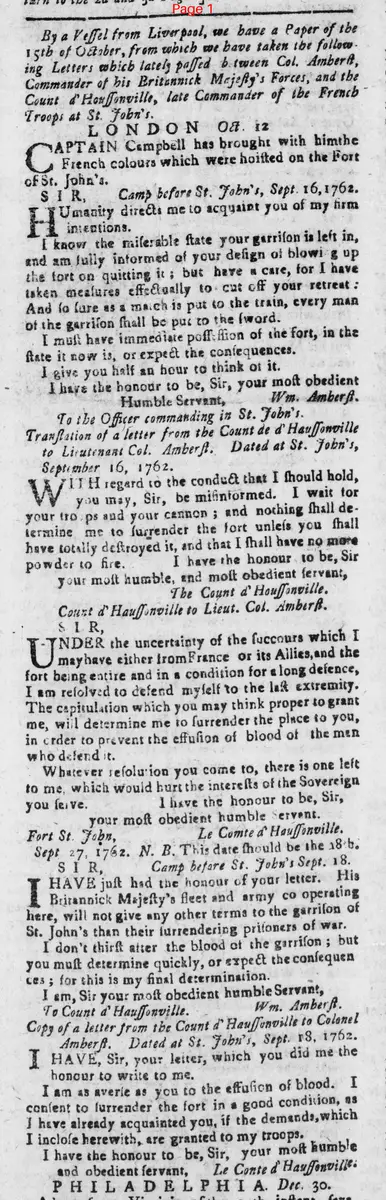
By a Vessel from Liverpool, we have a Paper of the 19th of October, from which we have taken the following Letters which lately passed between Col. Amherst, Commander of his Britannick Majesty's Forces, and the Count d'Haussonville, late Commander of the French Troops at St. John's.
LONDON, Oct. 12.
A T N C of St. John's.
SIR,
Camp before St. John's, Sept. 16, 1762.
Humanity directs me to acquaint you of my firm intentions. I know the miserable state your garrison is left in, and am fully informed of your design of blowing up the fort on quitting it; but have a care, for I have taken measures effectually to cut off your retreat: And as sure as a match is put to the train, every man of the garrison shall be put to the sword. I must have immediate possession of the fort, in the state it now is, or expect the consequences. I give you half an hour to think of it.
I have the honour to be, Sir, your most obedient Humble Servant,
Wm. Amherst.
To the Officer commanding in St. John's.
Translation of a letter from the Count de d'Haussonville to Lieutenant Col. Amherst. Dated at St. John's, September 16, 1762.
your troops and your cannon; and nothing shall determine me to surrender the fort unless you shall have totally destroyed it, and that I shall have no more powder to fire. I have the honour to be, Sir, your most humble, and most obedient servant,
The Count d'Haussonville.
Count d'Haussonville to Lieut. Col. Amherst.
SIR,
Under the uncertainty of the succours which I may have either from France or its Allies, and the fort being entire and in a condition for a long defence, I am resolved to defend myself to the last extremity. The capitulation which you may think proper to grant me, will determine me to surrender the place to you, in order to prevent the effusion of blood of the men who defend it. Whatever resolution you come to, there is one left to me, which would hurt the interests of the Sovereign you serve. I have the honour to be, Sir, your most obedient humble Servant.
Fort St. John,
Le Comte d'Haussonville.
Sept. 27, 1762. N.B. This date should be the 18th.
SIR,
Camp before St. John's, Sept. 18.
Britannick Majesty's fleet and army co-operating here, will not give any other terms to the garrison of St. John's than their surrendering prisoners of war. I don't thirst after the blood of the garrison; but you must determine quickly, or expect the consequences; for this is my final determination.
I am, Sir, your most obedient humble Servant,
To Count d'Haussonville.
Wm. Amherst.
Copy of a letter from the Count d'Haussonville to Colonel Amherst. Dated at St. John's, Sept. 18, 1762.
I HAVE, Sir, your letter, which you did me the honour to write to me. I am as averse as you to the effusion of blood. I consent to surrender the fort in a good condition, as I have already acquainted you, if the demands, which I enclose herewith, are granted to my troops.
I have the honour to be, Sir, your most humble and obedient servant,
Le Comte d'Haussonville.
What sub-type of article is it?
Military Campaign
What keywords are associated?
St John's Siege
Amherst D'haussonville Letters
French Surrender
Seven Years War
What entities or persons were involved?
Wm. Amherst (Col. Amherst)
Count D'haussonville
Where did it happen?
St. John's
Foreign News Details
Primary Location
St. John's
Event Date
Sept. 16–18, 1762
Key Persons
Wm. Amherst (Col. Amherst)
Count D'haussonville
Outcome
fort st. john's surrendered; garrison to become prisoners of war; d'haussonville agreed to surrender the fort in good condition if his troops' demands were granted.