Thanks for visiting SNEWPapers!
Sign up free today to connect your AI tools to the Library of Congress' newspaper collection.
Fowle's New Hampshire Gazette And General Advertiser Editorial December 30, 1785
Portsmouth, Rockingham, New Hampshire
What is this article about?
Portsmouth editorial urging full compliance with the peace treaty and the return of non-hostile loyalists; laments the departure of 'Public Spirit' amid ingratitude and self-interest, and insists America will be great, rich, and respected only through virtue, honesty, and public faith.
Quality green show the numbers
Measured from the scan
— how cleanly the OCR engine read the characters
- Mean ink quality
- 99.0% The length-weighted average confidence across the OCR lines — the mean of exactly the per-line scores whose tails the two figures below report. Typical is 99%.
- Illegible ink
- 0.0% Text sitting in OCR-detected lines that scored below 80% confidence — very shaky reads. Weighted by line length, so one long bad line counts for more than a short one.
- Uncertain ink
- 0.0% Text in lines that scored 80–90% — somewhat shaky reads.
- Matches source
- 96.64% How closely the served text matches the raw OCR of the same boxes, letter by letter, after collapsing spacing and case. This measures agreement, not correctness: the OCR is often wrong and the extractor corrects it, so 100% does not mean perfect, and a low figure usually means poor scan text was rewritten rather than that text was lost (length vs source shows loss).
- Length vs source
- 98.74% Below 100% means text was dropped from the OCR; above means text was added to make it read.
Assembled by the extraction model
— whether the stitched-together text holds up; catches layout and segmentation errors, which the scores above cannot see
- Transcription confidence
- 95.0% (typical 96%) How cleanly the extractor could assemble what it was given. Low here with clean ink scores points at layout analysis — the characters were read correctly but grouped or ordered wrongly.
- Comprehension
- 95.0% Whether the piece reads coherently start to finish. Can stay high while transcription confidence drops, when only part of the component is affected.
Clipping
Full Text
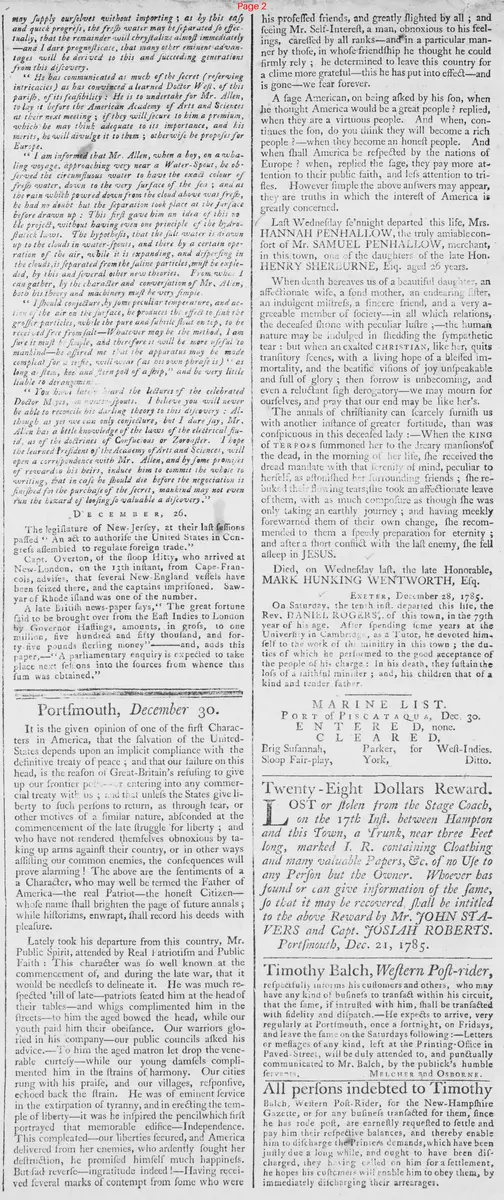
Portsmouth, December 30.
It is the given opinion of one of the first Characters in America, that the salvation of the United-States depends upon an implicit compliance with the definitive treaty of peace; and that our failure on this head, is the reason of Great-Britain's refusing to give up our frontier posts—or entering into any commercial treaty with us; and that unless the States give liberty to such persons to return, as through fear, or other motives of a similar nature, absconded at the commencement of the late struggle for liberty; and who have not rendered themselves obnoxious by taking up arms against their country, or in other ways assisting our common enemies, the consequences will prove alarming! The above are the sentiments of a Character, who may well be termed the Father of America—the real Patriot—the honest Citizen—whose name shall brighten the page of future annals; while historians, enwrapt, shall record his deeds with pleasure.
Lately took his departure from this country, Mr. Public Spirit, attended by Real Patriotism and Public Faith: This character was so well known at the commencement of, and during the late war, that it would be needless to delineate it. He was much respected 'till of late—patriots seated him at the head of their tables—and whigs complimented him in the streets—to him the aged bowed the head, while our youth paid him their obeisance. Our warriors gloried in his company—our public councils asked his advice.—To him the aged matron let drop the venerable courtesy—while our young damsels complimented him in the strains of harmony. Our cities rung with his praise, and our villages, responsive, echoed back the strain. He was of eminent service in the extirpation of tyranny, and in erecting the temple of liberty—it was he inspired the pencil which first portrayed that memorable edifice—Independence. This compleated—our liberties secured, and America delivered from her enemies, who ardently fought her destruction, he promised himself much happiness. But sad reverse—ingratitude indeed!—Having received several marks of contempt from some who were his professed friends, and greatly slighted by all; and seeing Mr. Self-Interest, a man, obnoxious to his feelings, caressed by all ranks—and in a particular manner by those, in whose friendship he thought he could firmly rely; he determined to leave this country for a clime more grateful—this he has put into effect——and is gone—we fear forever.
A sage American, on being asked by his son, when he thought America would be a great people? replied, when they are a virtuous people. And when, continues the son, do you think they will become a rich people?—when they become an honest people. And when shall America be respected by the nations of Europe? when, replied the sage, they pay more attention to their public faith, and less attention to trifles. However simple the above answers may appear, they are truths in which the interest of America is greatly concerned.
What sub-type of article is it?
Foreign Affairs
Moral Or Religious
What keywords are associated?
Treaty Compliance
Public Faith
Public Virtue
Ingratitude
Self Interest
Frontier Posts
Return Of Loyalists
American Independence
What entities or persons were involved?
The Father Of America (Likely George Washington)
Great Britain
The United States
Mr. Public Spirit
Real Patriotism
Public Faith
Mr. Self Interest
Editorial Details
Primary Topic
Compliance With The Peace Treaty And The Cultivation Of Public Virtue And Faith.
Stance / Tone
Patriotic Admonition; Critical Of Ingratitude And Self Interest, Urging Virtue And Public Faith.
Key Figures
The Father Of America (Likely George Washington)
Great Britain
The United States
Mr. Public Spirit
Real Patriotism
Public Faith
Mr. Self Interest
Key Arguments
- The salvation of the United States depends on implicit compliance with the definitive treaty of peace.
- Failure to comply is why Great Britain refuses to give up frontier posts or enter a commercial treaty.
- States should permit the return of those who absconded during the war but did not take up arms or assist the enemy.
- America's ingratitude has driven away Public Spirit, while Self-Interest is caressed.
- America will become great when virtuous, rich when honest, and respected when it attends to public faith over trifles.