Thanks for visiting SNEWPapers!
Sign up free today to connect your AI tools to the Library of Congress' newspaper collection.
The Massachusetts Spy, Or, Thomas's Boston Journal Commercial March 25, 1773
Boston, Suffolk, Massachusetts
What is this article about?
Letter from London reports that duties on tea are hurting Britain: the East India Company is out of cash and credit, its stock has fallen from 280 to 160, and losing the American tea market has thrown trade to foreigners.
Quality green show the numbers
Measured from the scan
— how cleanly the OCR engine read the characters
- Mean ink quality
- 99.0% The length-weighted average confidence across the OCR lines — the mean of exactly the per-line scores whose tails the two figures below report. Typical is 99%.
- Illegible ink
- 0.0% Text sitting in OCR-detected lines that scored below 80% confidence — very shaky reads. Weighted by line length, so one long bad line counts for more than a short one.
- Uncertain ink
- 0.0% Text in lines that scored 80–90% — somewhat shaky reads.
- Matches source
- 96.55% How closely the served text matches the raw OCR of the same boxes, letter by letter, after collapsing spacing and case. This measures agreement, not correctness: the OCR is often wrong and the extractor corrects it, so 100% does not mean perfect, and a low figure usually means poor scan text was rewritten rather than that text was lost (length vs source shows loss).
- Length vs source
- 98.89% Below 100% means text was dropped from the OCR; above means text was added to make it read.
Assembled by the extraction model
— whether the stitched-together text holds up; catches layout and segmentation errors, which the scores above cannot see
- Transcription confidence
- 94.0% (typical 96%) How cleanly the extractor could assemble what it was given. Low here with clean ink scores points at layout analysis — the characters were read correctly but grouped or ordered wrongly.
- Comprehension
- 95.0% Whether the piece reads coherently start to finish. Can stay high while transcription confidence drops, when only part of the component is affected.
Clipping
Full Text
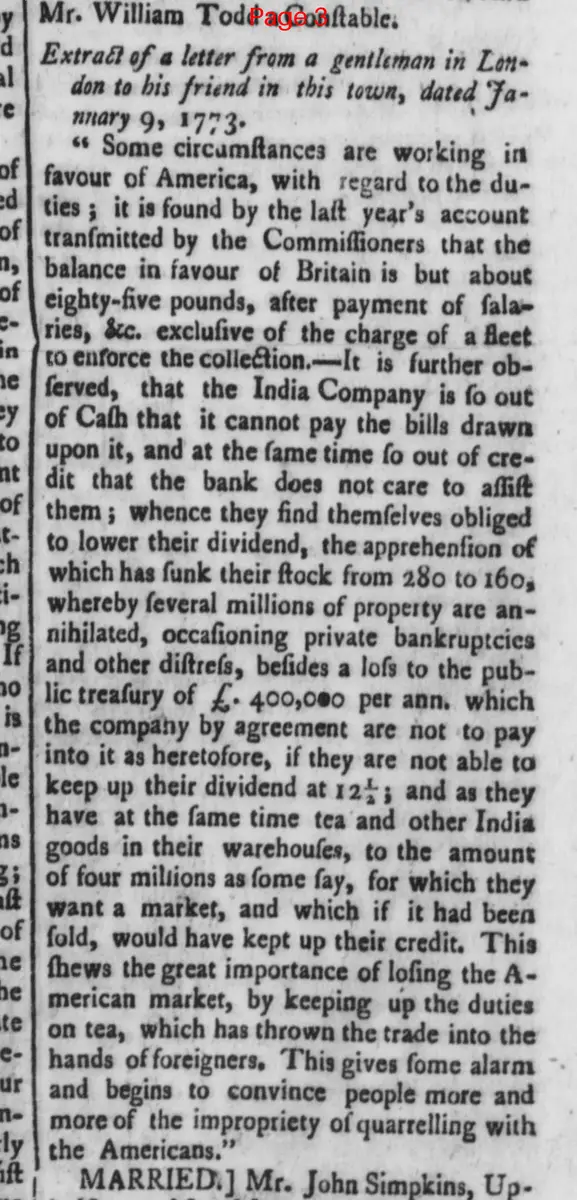
Extract of a letter from a gentleman in London to his friend in this town, dated January 9, 1773.
"Some circumstances are working in favour of America, with regard to the duties; it is found by the last year's account transmitted by the Commissioners that the balance in favour of Britain is but about eighty-five pounds, after payment of salaries, &c. exclusive of the charge of a fleet to enforce the collection. It is further observed, that the India Company is so out of Cash that it cannot pay the bills drawn upon it, and at the same time so out of credit that the bank does not care to assist them; whence they find themselves obliged to lower their dividend, the apprehension of which has sunk their stock from 280 to 160, whereby several millions of property are annihilated, occasioning private bankruptcies and other distress, besides a loss to the public treasury of £. 400,000 per ann. which the company by agreement are not to pay into it as heretofore, if they are not able to keep up their dividend at 12½; and as they have at the same time tea and other India goods in their warehouses, to the amount of four millions as some say, for which they want a market, and which if it had been sold, would have kept up their credit. This shews the great importance of losing the American market, by keeping up the duties on tea, which has thrown the trade into the hands of foreigners. This gives some alarm and begins to convince people more and more of the impropriety of quarrelling with the Americans.
What sub-type of article is it?
Banking
Import Export
Trade Or Economy
What keywords are associated?
East India Company
Tea Duties
London Commercial Letter
American Trade
Stock Decline
What entities or persons were involved?
East India Company
Bank Of England
Commissioners Of Trade
Where did it happen?
London
Commercial Details
Location
London
Event Date
January 9, 1773
Commodities
Tea
Key Figures
East India Company
Bank Of England
Commissioners Of Trade
Notable Details
- balance in favour of Britain only about £85 after salaries
- East India Company unable to pay bills or obtain bank credit
- company stock fell from 280 to 160, annihilating millions in property
- loss to the public treasury of £400,000 per annum
- tea and other India goods worth about £4,000,000 awaiting a market
- American market lost to foreigners by keeping up the duties on tea